

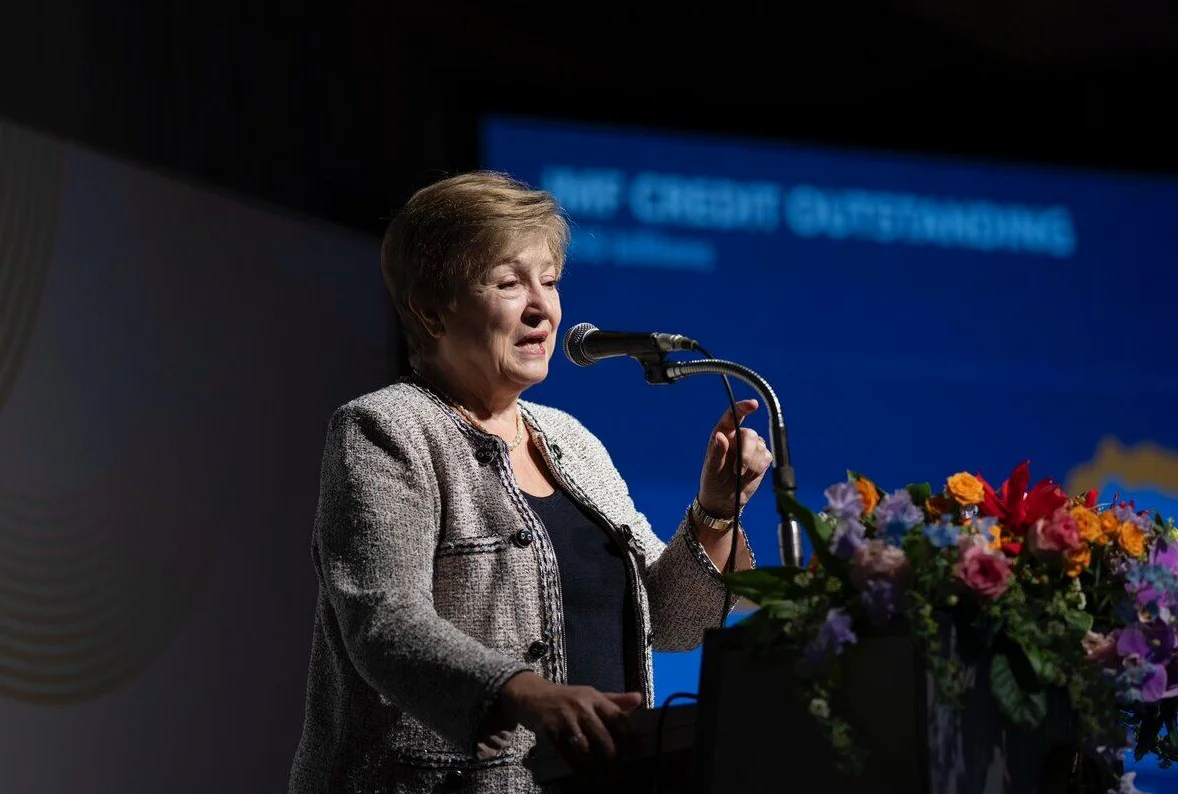
The International Monetary Fund (IMF) Managing Director Kristalina Georgieva has issued a stark warning that a sustained rise in oil prices caused by ongoing tensions in the Middle East could drive global inflation higher, even as global economic growth remains resilient.
Oil Prices Surge Amid Geopolitical Uncertainty
Georgieva made her comments during a symposium hosted by Japan’s Ministry of Finance, where she emphasized the potential economic consequences of prolonged conflict in the region. “As a rule of thumb, we see every 10 percent increase in oil prices—if persistent through most of this year—resulting in a 40 basis point increase in global headline inflation and a 0.1-0.2 percent fall in global output,” she said.
According to data from the energy market, Brent crude for May delivery climbed more than 21 percent on Monday, reaching $112 per barrel. Since the Middle East conflict began on February 28, crude oil prices have surged by over 50 percent. This dramatic increase has raised concerns about its impact on inflation and economic growth worldwide.
Georgieva acknowledged that world growth has held up relatively well, with the IMF projecting global economic growth to be 3.3 percent in 2026 and 3.2 percent in 2027. However, she warned that the current situation remains highly fluid and adds to an already uncertain global economic environment.
Energy Security Becomes Top Priority
Georgieva pointed out that shipping traffic through the Strait of Hormuz has plummeted by 90 percent, significantly affecting global energy supply chains. “For much of Asia and the world, energy security has shot up the list of concerns,” she stated.
She highlighted that nearly a fifth of global oil supply and liquefied natural gas (LNG) trade typically transits through the Strait of Hormuz. This includes almost half of Asia’s oil imports and about one-quarter of its LNG imports. For Japan, the figures are even more pronounced, with nearly 60 percent of oil imports and 11 percent of LNG imports passing through the strait.
Georgieva added that world oil prices have risen nearly 50 percent since December, while Asia and Europe are grappling with steep increases in gas prices. “If the new conflict proves prolonged, it has clear and obvious potential to affect global market sentiment, growth, and inflation, placing new demands on policymakers,” she said.
Policymakers Urged to Prepare for the Unthinkable
Addressing policymakers, Georgieva advised them to “think of the unthinkable and prepare for it.” She urged nations to focus on what they can control and offered three key pieces of advice: “One, invest in strong institutions and policy frameworks to underpin strong economies and private sector-led growth. Two, use policy space when needed and be sure to replenish it. Three—above all—be agile.”
Last week, the IMF announced that it is closely monitoring developments in the Middle East. “So far, we have observed disruptions to trade and economic activity, surges in energy prices, and volatility in financial markets,” the IMF stated. “The situation remains highly fluid and adds to an already uncertain global economic environment. It is too early to assess the economic impact on the region and the global economy. That impact will depend on the extent and duration of the conflict.”
Georgieva’s remarks come amid growing concerns over the economic fallout from the ongoing Middle East conflict. With oil prices at their highest levels since the early 2020s, the potential for further inflationary pressures is a key concern for global policymakers. The IMF is expected to provide a more detailed assessment of the situation in its upcoming World Economic Outlook report, scheduled for release later this year.



Comments
No comments yet
Be the first to share your thoughts