

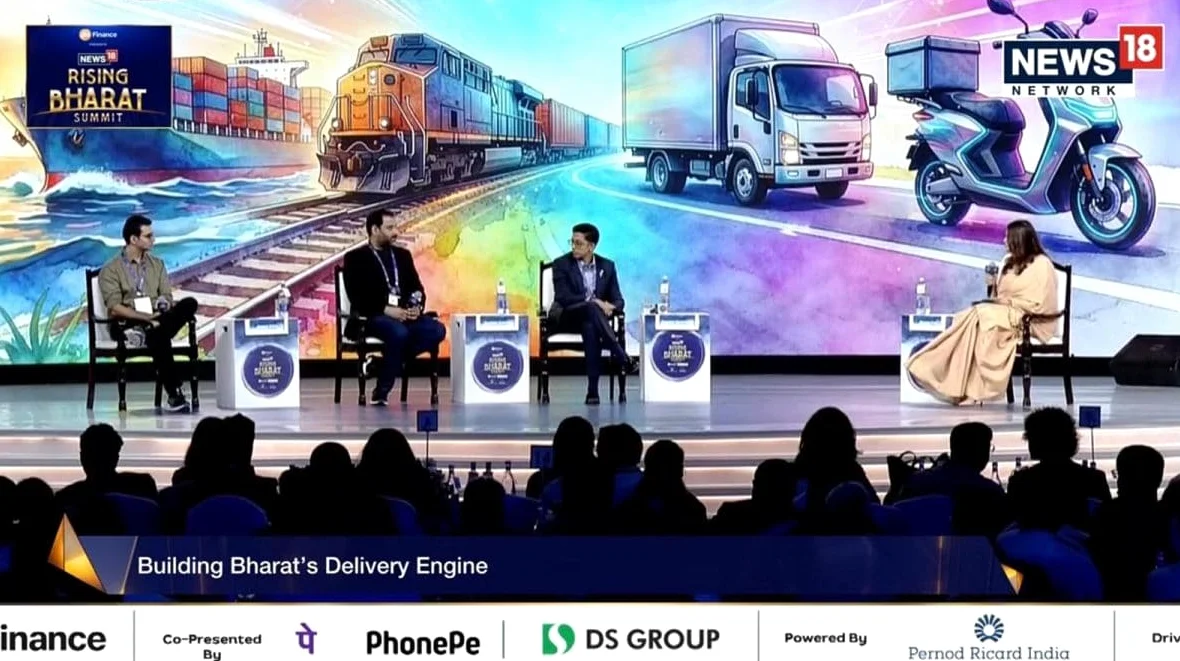
Indian brands are capitalizing on a surge in domestic manufacturing and e-commerce growth, targeting new consumer segments in tier-2 and tier-3 cities, according to industry leaders at the News18 Rising Bharat Summit. The summit highlighted how evolving production capabilities and digital-first strategies are changing trade and distribution models, with a focus on domestic production, flexible supply chains, and expanding consumer aspirations.
Domestic Manufacturing Gains Momentum
Abhishek Chakraborty, CEO of DTDC Express, emphasized the volatility of the global trade environment over the past few years, forcing both manufacturers and logistics players to adapt. ‘Two or three years ago, there was a lot of uncertainty for both logistics and manufacturers,’ he said. ‘The past one year has seen some of the biggest shake-ups in the global world of trade, whether it’s because of tariffs or other shocks.’
Chakraborty noted that Indian brands and sellers have used the disruption as an opportunity to strengthen domestic production. ‘One story that stood out is that Indian brands, Indian sellers, Indian manufacturers, have taken as a big cue to take it upon themselves and honestly start focusing on actual domestic production and manufacturing,’ he said.
He added that the shift is no longer limited to multinational companies producing in India. ‘Now, not only the big brands or MNCs that used to come and produce, we got Indian homegrown D2C brands, omnichannel brands, brands using completely different distribution models that are now coming in and using the supply chain and logistics capabilities that we have built.’
Low-Cost Brand Creation Fuels Entrepreneurship
Gautam Kapoor, co-founder and CEO of PEP Brands (mCaffeine and Hyphen), said India’s entrepreneurial culture is increasingly finding expression through e-commerce. ‘India is a land of entrepreneurs. A large part of young Bharat is becoming entrepreneurs than looking for a job,’ he said.
Kapoor explained that e-commerce has lowered entry barriers for new brands by enabling smaller investments and flexible manufacturing options. ‘I think e-commerce is one of those places where people find a lot of connect and are able to create brands and products by investing less amount of money,’ he said.
He noted that India’s manufacturing ecosystem now allows brands to experiment and start small. ‘What has the Indian manufacturing ecosystem done is that it gives the capability to any brand to go back and go to a manufacturer, create a fashion brand or personal care brand, create a healthcare brand if they have a good idea, and then get able to get small batches of manufacturing and branding, everything, so, you can really really start now.’
Kapoor added that this has fueled a flurry of new brands coming up with interesting products and branding. ‘That’s fuelling a flurry of new brands coming up with interesting products and branding,’ he said.
Tier-2 and Tier-3 India Emerging as Growth Engine
Angad Kikla, CEO and founder of Citymall, said while much attention has been on 10-minute deliveries and urban D2C brands, the largest untapped opportunity lies in smaller towns and lower middle-income households. ‘In this entire euphoria about 10-minute deliveries, fashion, D2C brands, etc., the largest market in India is low-middle-income people living in tier-2, tier-3, and tier-4 towns,’ he said.
Kikla noted that grocery, which accounts for roughly 40% of household spending, remains under-penetrated in organized e-commerce models. ‘Also, the largest category, which is grocery comprising around 40% spending of a household, has been completely ignored. Maybe because the infrastructure required to deliver a grocery order at the doorstep profitably has not been made. We (Citymall) have been trying to do that.’
He also pointed to changing consumption patterns driven by digital content exposure. ‘In the low-middle-class consumer group, there is a lot of aspiration driven by the content proliferation. For example, on our platform, we see a lot of new categories like Korean Noodles, which is one of the largest growing categories being sold on our platform more than normal noodles.’
‘So, a lot of aspiration is being driven by content. Our job is to make these aspirations affordable for these consumers,’ he added.





Comments
No comments yet
Be the first to share your thoughts