

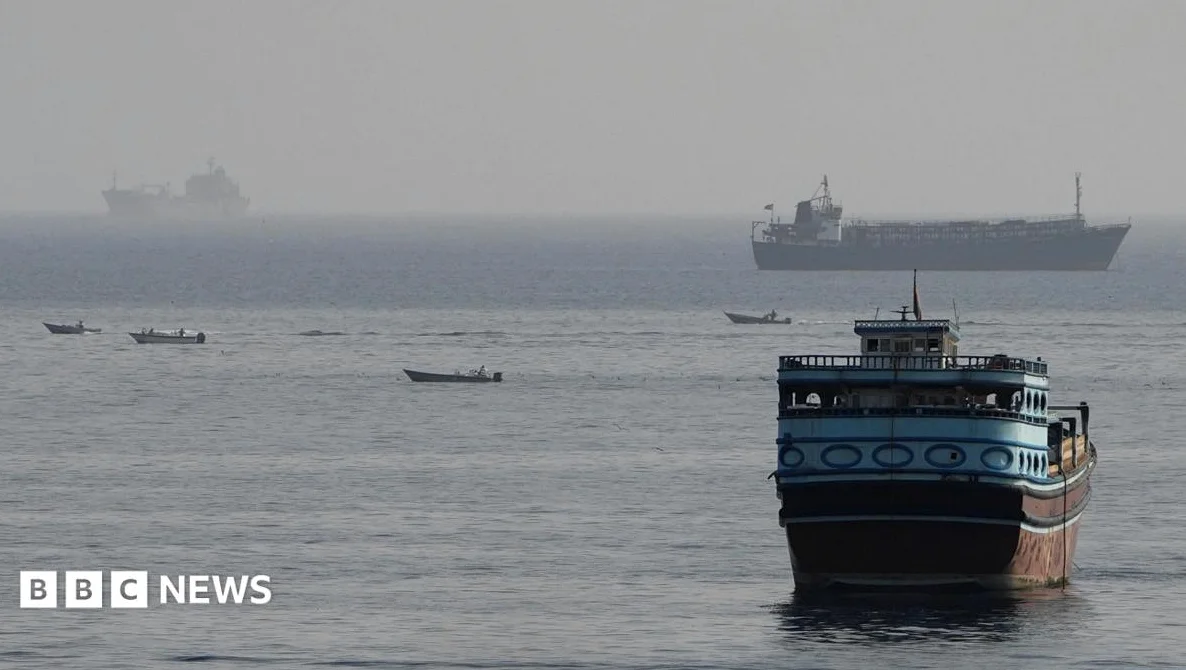
A ship was hit by an ‘unknown projectile’ in the Strait of Hormuz off the coast of Oman, the British maritime security agency (UKMTO) reported, as the incident occurred about 37 kilometers northeast of the Omani town of Al Khasab. No immediate information on casualties or damage was released.
Iran’s Legal and Strategic Moves
The Strait of Hormuz is an international strait that connects the Persian Gulf to the Gulf of Oman — it is a key route for global oil and gas shipments. Iran and Oman share territorial waters in the strait, making navigation complex. Iran has not imposed a formal blockade, but its actions create legal and military risks for commercial shipping, according to a report by Junge Wissenschaft im Öffentlichen Recht.
Iran’s control over the strait has been a point of contention since the start of the war in February, though Tehran requires ships to follow a designated route along its coast, claiming it is the only safe passage. This unilateral measure has led to the detention and attack of over 40 neutral merchant vessels, according to a report by 위키리크스한국.
International Law in a Gray Zone
International law treats the Strait of Hormuz as an international strait, meaning it is open to all ships of commerce, However, the overlapping territorial waters of Iran and Oman create legal ambiguities. States disagree on the rules governing such straits, leading to a fragmented legal framework where law does not prevent conflict but redefines it.
Iran’s actions, while not constituting a formal blockade, expose ships to military and legal risks. This situation is further complicated by the fact that the U.S. and Iran have accused each other of violating a 60-day interim peace deal, reported by 위키리크스한국. The dispute is a major reason for the recent escalation in tensions between the U.S. and Iran.
Economic and Market Implications
The reopening of the Strait of Hormuz could affect global oil prices and currency markets, but Oil prices fell to $75.50, a three-week low, as the Euro held above 1.1500 on the possibility of a deal. Al Arabiya, citing a high-ranking source, reported that an announcement on the strait’s reopening is expected soon, If successful, the move could reduce inflation risks and potentially delay interest-rate hikes by the Federal Reserve and the European Central Bank in September.
Iran and Oman are currently negotiating provisional shipping corridors, while Until a new agreement is reached, Iran insists that only its designated route is safe. The U.S. Secretary of State Marco Rubio stated that progress has been made in discussions with Iran and Oman, but no final agreement has been reached.
Before the war, the Strait of Hormuz was completely open for international shipping; Now, the dispute over how passage is regulated has become a focal point in the broader conflict involving the U.S., Iran, and regional actors. The situation remains fluid, with traders and analysts closely watching developments that could affect global trade and energy markets.






Comments
No comments yet
Be the first to share your thoughts