

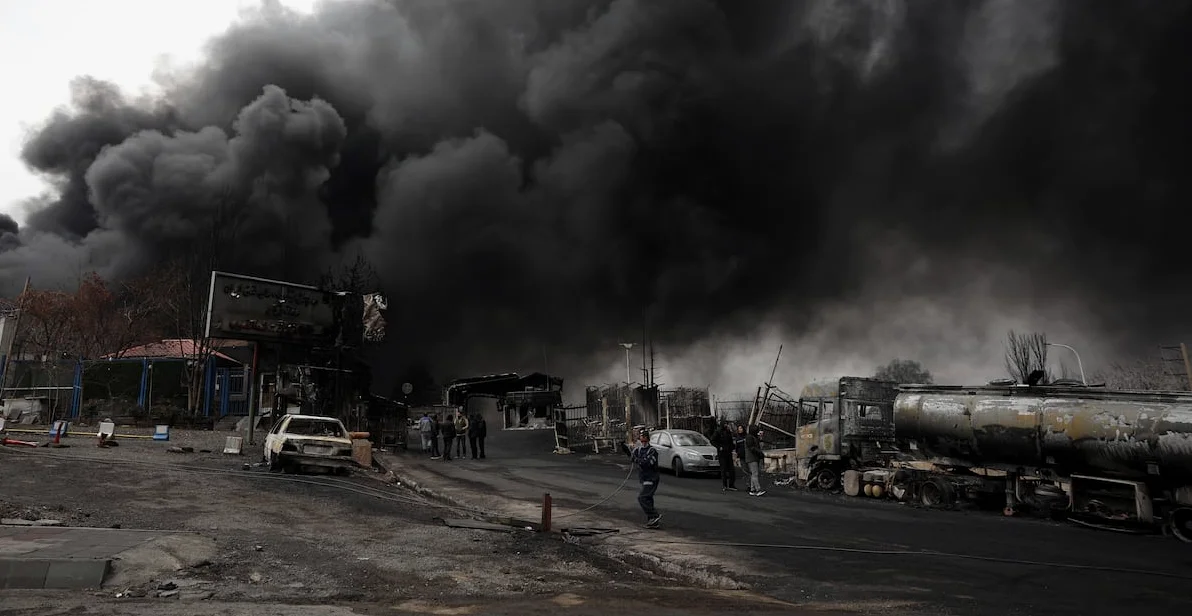
The conflict that began on March 28 with U.S. and Israeli airstrikes on Iran has escalated into a full-scale war targeting the Middle East’s vital oil and water infrastructure. With the Strait of Hormuz effectively blockaded, the global economy is reeling, and the survival of Middle Eastern nations hangs in the balance.
Infrastructure Under Fire
Iran, facing existential threats from Israeli and U.S. military operations, has adopted a strategy of ‘active and unprecedented deterrence.’ Since last week, it has launched indiscriminate attacks on the economic infrastructure of pro-U.S. allies in the Gulf region.
Iran’s sweeping attacks halted Qatar’s liquefied natural gas (LNG) facility operations on March 7 and 8. Kuwait International Airport’s fuel tanks and the UAE’s oil terminal were struck by drone attacks. Saudi Arabia’s refineries also faced drone assaults, with the core economic infrastructure of oil-producing nations under relentless bombardment.
The Israeli military bombed civilian industrial energy facilities near Tehran, including oil storage and refining sites, over the weekend. This marked the first time Israel directly targeted Iran’s civilian energy infrastructure, blanketing parts of Tehran with black smoke and toxic gas, causing a ‘black oil rain.’
U.S. Disapproval and Escalation
Reports suggest U.S. disapproval of Israel’s airstrikes on Iranian refineries. Axios cited an Israeli official on March 9, stating a U.S. official sent a message reading ‘WTF’ (a slang expression meaning ‘What the hell are you doing?’) after Israel’s large-scale attack on Iranian refineries.
Iran has retaliated by targeting the Gulf states’ critical ‘water’ infrastructure, a lifeline for survival. Iranian Foreign Minister Abbas Araghchi condemned on March 7, ‘The U.S. bombed Iran’s desalination facilities, cutting off water supply to 30 villages,’ and accused the U.S. of setting a ‘dangerous precedent.’
A day later, Iran struck Bahrain’s desalination facilities, a Gulf island nation hosting U.S. military bases. This attack instilled new fear in Saudi Arabia and Kuwait that Iranian drones and missiles could destroy their water sources.
Desalination: A Critical Vulnerability
Desalination facilities, which convert seawater into potable water, are vital to Gulf oil-producing nations. The Gulf Cooperation Council (GCC) countries account for nearly 40% of global desalination capacity. Nations like Kuwait (90%), Oman (86%), and Saudi Arabia (70%), which are heavily dependent on desalination, face national disasters if these facilities are crippled.
The Wall Street Journal (WSJ) noted, ‘Iran has struck a critical vulnerability,’ adding, ‘Desalination facilities are a greater Achilles’ heel than energy infrastructure for Gulf monarchies.’ Iran’s strategy of targeting regional allies’ infrastructure aims to destabilize the entire geopolitical landscape.
As the crisis spirals toward catastrophe, targeting oil and water — essential for national survival — no breakthrough is in sight. Israeli Prime Minister Benjamin Netanyahu is waging a rapid war to overthrow the Iranian regime, even attacking civilian facilities. U.S. President Donald Trump, despite global concerns over soaring oil prices, called it ‘a small price to pay to destroy Iran’s nuclear threat’ and endorsed Israel’s escalation.
On March 8, Trump told Israeli media, ‘The timing of ending the war with Iran will be decided jointly with Netanyahu,’ bolstering Israel’s hardline stance. The same day, Iranian President Masoud Pezeshkian warned in a video message, ‘We have no choice but to respond when attacked,’ and added, ‘The more pressure they exert, the stronger our response will be.’
Concerns grow that if Iran’s attacks on Gulf nations’ essential infrastructure, including desalination plants, continue, these countries may intervene, triggering an unprecedented pan-Middle East war. Saudi Arabia’s Ministry of Foreign Affairs issued a stern statement on March 9, condemning Iran: ‘Iran’s hostile acts toward neighboring states are intolerable under any circumstances. We will take all necessary measures to protect our people, territory, and sovereignty.’
It added, ‘If Iran continues to escalate tensions, it will face the heaviest consequences.’ This marks the strongest condemnation from Saudi Arabia since the war began, signaling potential military retaliation if Iran’s aggression persists.






Comments
No comments yet
Be the first to share your thoughts