

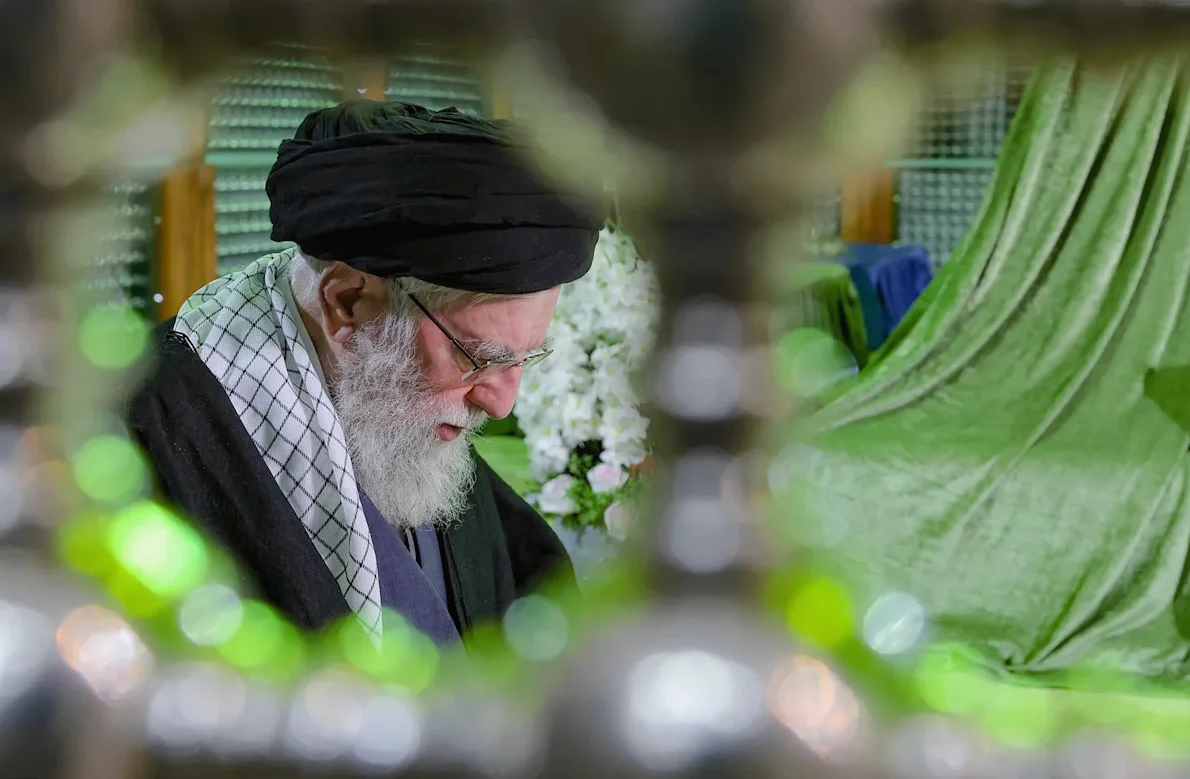
Iran’s Supreme Leader Ayatollah Ali Khamenei, who has held power since 1989, was targeted in recent attacks that struck areas linked to his residence and offices in Tehran, intensifying regional tensions. The attacks, attributed to the United States and Israel, have raised concerns over the stability of Iran’s leadership and the potential for further escalation in the Middle East.
Locations of the Attacks
Iranian media reported that the attacks occurred nationwide, with several areas in the capital, Tehran, being targeted. According to the semiofficial Tasnim news agency, seven missiles hit an area near the presidential palace, located in Shemiran to the north of Tehran, as well as near Khamenei’s compound. The Associated Press also reported that attacks struck near Khamenei’s offices in the capital.
Where is Khamenei?
The current whereabouts of Khamenei remain unclear. Reuters cited a source as saying that Khamenei was not in Tehran and had been transferred to a secure location. This suggests that the leadership may have taken precautionary measures to protect its most prominent figure from potential threats.
Who is Khamenei?
Khamenei, an 86-year-old Islamic scholar, has been Iran’s Supreme Leader since 1989, succeeding the late Ayatollah Ruhollah Khomeini, the founder of the Islamic Republic. Khomeini returned from exile in 1979 to lead the revolution that overthrew the shah, Mohammed Reza Pahlavi, a US ally. Khamenei holds ultimate authority over all branches of government, the military, and the judiciary, while also serving as the country’s spiritual leader.
During his rule, Khamenei has faced an adversarial relationship with the West, including intense sanctions and several rounds of protests over economic and rights issues. He has repeatedly labeled the United States as Iran’s “number one enemy” and has placed Israel in second place. His power is largely supported by the loyalty of two key security institutions: the Islamic Major Guard Corps (IRGC) and the Basij paramilitary forces, which have hundreds of thousands of volunteers.
Khamenei’s Stance on Nuclear Weapons
Khamenei has long maintained that Iran will never build a nuclear weapon and that its nuclear program is for civilian purposes only. Neither US intelligence nor the UN nuclear watchdog has found evidence that Iran is pursuing an atomic weapon, a narrative that Israel and some in the Trump administration have pushed despite the lack of proof.
Threats from the US and Israel
Officials from both the United States and Israel have previously issued threats against Khamenei. In June, Israel’s Defence Minister Israel Katz stated that Khamenei “cannot continue to exist.” He described the Iranian leader as a dictator with the “horrible goal of destroying Israel.”
In the same month, Israeli Prime Minister Benjamin Netanyahu suggested that Israel had not ruled out the possibility of assassinating Khamenei, an act he said would “end” the long-running conflict between the US and Iran.
On the US side, former President Donald Trump has made remarks that appeared to threaten Khamenei. In an interview with ABC earlier this month, Trump said the Iranian leader should be “very worried” as the US amassed military assets in the region. In separate remarks, he stated that regime change in Iran would be “the best thing that could happen” and that “there are people” who could assume leadership, without elaborating.
During his attacks on Iran last year, Trump claimed that Khamenei would be an “easy target” if the US decided to go after him. He said, “We know exactly where the so-called ‘Supreme Leader’ is hiding. He is an easy target, but is safe there – We are not going to take him out (kill!), at least not for now.”
Goals of the Latest Attacks
In remarks following the attacks, Trump vowed to “annihilate” Iran’s navy and missile sites and urged Iranians to overthrow their government. “When we are finished, take over your government. It will be yours to take,” he said. “This will be probably your only chance for generations.”
Al Jazeera’s Ali Hashem, who has covered Iran extensively, said it is clear that the US-Israeli attacks are “mainly aimed at decapitating [the political elite].” He added that it is too early to determine whether these attacks will be successful or not.
The attacks come amid ongoing tensions between Iran and its regional adversaries. The targeting of Khamenei’s locations raises questions about the stability of Iran’s leadership and the potential for further conflict in the region.
What’s Next?
Analysts are closely watching the situation to see if Iran will retaliate or if the attacks will lead to a broader conflict. The upcoming decisions by both the US and Iran will be critical in determining the trajectory of the situation. The international community is also monitoring the developments, as any escalation could have significant global implications.




Comments
No comments yet
Be the first to share your thoughts