

 BBC
BBC 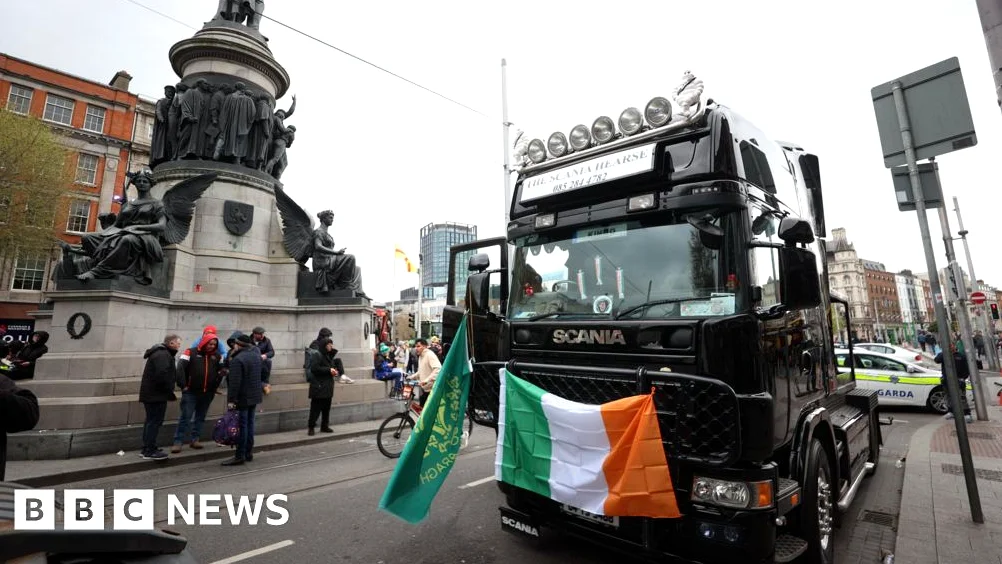
The Irish government has confirmed that a fuel support package is being finalised after a day of what they described as ‘constructive engagement’ with representatives of the haulage and farming sectors, according to the BBC.
Blockades Disrupt Travel Across Ireland
Travel across parts of the Republic of Ireland was affected for the fourth day in a row as slow-moving convoys made up of vehicles, including tractors, blocked roads in protest against high fuel prices caused by the US-Israeli war against Iran.
Irish ministers had said earlier on Friday that no further package of support measures would be announced until fuel protesters ended their blockades around the country.
Meetings between Irish ministers and those involved are expected to continue over the weekend, as the government seeks to resolve the ongoing crisis.
Finance Minister Pledges Support Package
Tánaiste (Irish deputy prime minister) and Finance Minister Simon Harris said that there will be a ‘substantial and significant’ package of support for ‘key sectors of the economy’, according to the BBC.
Speaking to Irish broadcaster RTÉ, Harris said the talks were ‘going well’, adding that further ‘intensive engagement’ into the weekend was likely.
However, he added: ‘The blockade has to end.’
Earlier, Taoiseach (Irish prime minister) Micheál Martin said that the blockades mean the country is ‘on the precipice of turning oil away from the country’ amidst a global oil supply crisis.
There were long queues on the M1, heading towards the border with Northern Ireland, due to protesters closing the motorway at Dundalk on Friday, with vehicles blocking both lanes at the Carlingford turnoff, RTÉ reported.
Emergency Services Under Pressure
The National Emergency Coordination Group (NECG), which brings together government departments and state agencies to coordinate emergency response, said fuel supplies for emergency response vehicles, including the ambulance service and fire service, are under ‘increasing pressure’, according to the BBC.
In a statement, they said: ‘These vehicles rely on retail fuel forecourts for their fuel supply through the use of fuel cards.’
Following a meeting on Friday, the Irish ministers for health issued a joint statement saying that ‘the serious risks to patient safety caused by the blockade of fuel supplies are completely unacceptable.’
It went on to call on the protesters to ‘reflect on their actions and cease the restriction of access to critical fuel infrastructure immediately.’
Kildare farmer John Dallon said the protests could continue for ‘maybe for another week, maybe two weeks. If it takes a month, we are prepared to sit here.’
He said it had been his understanding that he had been invited to the meeting on Friday but was refused entry.
He said he is hopeful that government proposals to deal with high fuel costs would resolve the crisis.
Sinn Féin leader Mary Lou McDonald said: ‘What on earth are Fianna Fáil and Fine Gael doing locking the protesters out of the talks.’
In a post on social media, she said the two coalition parties are ‘making an absolute shambles of things,’ adding that they were ‘escalating’ the crisis.
The supply, which she said would typically last the Raceside Service Station four to five working days, had run out within seven hours.
A second supply was delivered to the County Tipperary station on Friday, but a €30 (£26) cap was implemented for customers.
Another supply is due to arrive on Monday, but Burke said there’s no guarantee she will receive the delivery.
‘I’m 100% going to run out of fuel before Monday.’
Burke said she’s making no money on the fuel and instead the business is just ‘providing a service.’
‘I’m dreading Saturday evening, Sunday morning when I’m going to run out of fuel,’ she said, adding that staff will be affected.
The Chief Executive of Home and Community Care Ireland said many of their staff who rely on cars to travel between home care appointments are struggling to access fuel supplies.
Joseph Musgrave said he is being ‘flooded’ with reports from staff ‘particularly around the mid-west, but also up as far as Donegal, Cork, Kerry, Waterford, Tipperary.’
‘On any given day nationally, our carers will call around 15 to 25 ambulances because they’ve gone to attend their client and their client needs help.’
‘If they can’t get to their client, then those ambulances can’t be called. And we all know what that means.’
Micheál Martin told RTÉ that the blockade ‘is damaging Ireland’s economy and society’, and that ‘self-appointed’ groups do not have a right to ‘close down the country.’
He added that the Irish army ‘is on standby’ to make sure the ‘law is upheld.’
Gardaí (Irish police) said they secured access to the National Critical Infrastructure site at Whitegate, where there was no disorder.
On Friday afternoon, RTÉ reported that five fuel trucks passed through the blockade but said protesters have said no further tankers are permitted.
The Irish Minister for Justice, Jim O’Callaghan, said there would be ‘legal consequences’ for some protests.
‘It might not arise today or tomorrow but people have licences to drive vehicles, those licences will be affected.’
The Irish Health Service Executive called for all approaches to medical facilities to be kept clear for people to access treatment and the President of the Irish Medical Organisation, the trade union body, Prof Matthew Sadlier said that potential missed appointments due to the blockades were having a ‘hugely detrimental’ effect on patient welfare.
What have protesters said?
Katie Cooney travelled to the Dublin protests from County Cavan and said the price of diesel is ‘unreal’ and if there are no farms there is ‘no future.’
‘Farms were impacted two weeks ago,’ she said. ‘It was €550, now it’s up to €800 for fertiliser. Farms and contractors need support.’
‘I’m a student. My commute to college is going to cost 80-100 euro a week.’
Mark Hegarty helped organise a large protest in Bridgend, County Donegal on Thursday evening, where he said ‘hundreds and hundreds of lorries, tractors, vans and cars’ blocked the road.
Hegarty told BBC Radio Foyle’s North West Today programme he felt compelled to take part in the demonstration after the government ‘threatened to bring the army in on’ protesters in the Irish capital.
The slow-moving convoy was on the road for more than four hours, but Hegarty said that instead of holding the protest during rush hour, it started at 19:00 local time to minimise disruption.
Which roads and transport are affected?
Parts of the the M50 north and southbound are closed.
Transport Infrastructure Ireland has said road closures are ‘currently impacting Counties Clare, Limerick, Tipperary, Laois, Offaly, Kildare, Galway, Cork, and Dublin.’
Dublin Airport passengers are being advised to allow extra time for their journeys a day after people were seen walking with their luggage along a motorway.
Delivery service DPD Ireland said it will temporarily suspend services in the Republic of Ireland on Saturday.
Why are the protests taking place?
The conflict in the Middle East has caused rapid price rises for both petrol and diesel.
Diesel in the Republic of Ireland has risen from about €1.70 (£1.48) a litre to €2.17 (£1.89) on many forecourts in recent weeks and petrol is now up to 25 cents more per litre at many pumps.






Comments
No comments yet
Be the first to share your thoughts