

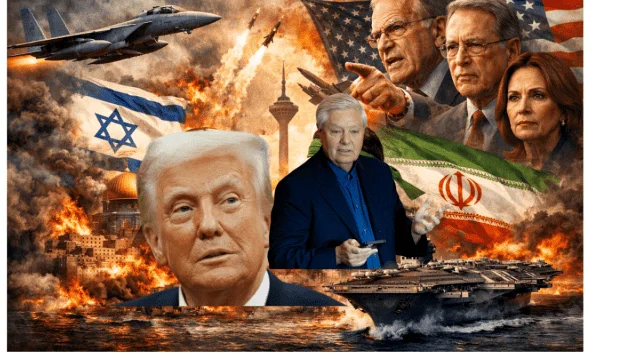
Israeli and American hardliners are reportedly pushing the U.S. toward a potential war with Iran, despite warnings of catastrophic consequences, as the Iranian economy grapples with a 42% inflation rate and widespread unrest. This development, according to global affairs analyst Patrick Henningsen, who recently returned from Iran, highlights growing tensions that could lead to a regional conflict with far-reaching implications.
Economic Strain Fuels Protests in Iran
The economic conditions in Iran have deteriorated sharply, with food prices rising by 72% and medical costs increasing by 50% in December 2025. The Iranian rial has also seen significant depreciation, exacerbated by poor fiscal policies and the impact of international sanctions. These factors have contributed to mass protests, with reports of thousands of deaths, although the exact number remains disputed.
According to the U.N. Special Rapporteur on Iran, Mai Sato, approximately 5,000 people were killed in the demonstrations, while the Human Rights Activists News Agency reported 7,015 deaths. Iran state media, however, claimed 3,117 deaths, including over 100 officers. Some analysts have described the situation as a “spiral of disinformation,” with claims inflated by supporters of the former Shah’s son, Reza Pahlavi.
Escalating Rhetoric and Justifications for War
Israeli and U.S. officials have cited Iran’s ballistic missile program as a reason for potential military action, claiming it poses an existential threat. Former U.S. President Donald Trump has reiterated his stance that Iran should not be allowed to develop nuclear weapons, despite Iran’s denial and U.S. intelligence assessments that suggest otherwise.
Former CIA director Mike Pompeo, in a statement to the Jerusalem Post, alleged that Israeli intelligence agency Mossad was actively supporting anti-regime protesters in Iran, saying, “Every Mossad agent walks beside them. Mossad encouraged the anti-regime protestors: ‘Go out together into the streets. The time has come.'”
Sen. Lindsey Graham, a prominent U.S. conservative, has argued that the best solution to Iran’s problems is “regime change” and that the U.S. must “meet the moment” as Iran is “at its weakest point since 1979.” Graham acknowledged the risks of an Iranian response but claimed the potential consequences of inaction are far greater.
Israel’s Role and U.S. Concerns
Israeli Prime Minister Benjamin Netanyahu has long advocated for military action against Iran and is reportedly urging U.S. leaders to consider an attack to achieve regime change in Tehran. A writer for Israel’s Haaretz News has warned that the U.S. is “approaching the precipice without articulating a vision as to what will follow” and is “plunging toward a large-scale war against the Islamic Republic of Iran.”
Iran, meanwhile, is receiving support from China, which relies on daily shipments of 1.5 million barrels of Iranian oil. Henningsen noted that Iran possesses advanced missile technology, including hypersonic systems, improved targeting capabilities, and Chinese-assisted navigation technology, which could complicate any potential military strike.
Despite these defensive capabilities, Henningsen emphasized that “the Neocons and Israeli operatives in U.S. media and politics seem determined to take America to war,” even as the potential consequences are “likely to be devastating, not only to Iran but also to Israel itself.”
Former U.S. Ambassador to Saudi Arabia, Chas Freeman, has criticized Israel’s leadership, stating, “to be hated means that one does hateful things” and that Israel’s leaders are “behaving badly.” He argued that Netanyahu’s vision of peace is “pacification of Arab nations” and that his policies show a “complete lack of understanding of one’s enemies.”
Freeman also described Israel as an “apartheid state” and criticized its role in enabling “dictatorial decisions that are not the ‘will of the people.'” He added that Israel’s leaders “believe in their own propaganda, but they are not hated because they are Jews but because of their behavior in the destruction of Gaza as well as their targeted assassinations.”
As tensions continue to rise, the international community is closely watching the situation, with many analysts warning that any military action could lead to a wider regional conflict with unpredictable consequences. The U.S. is expected to make key decisions in the coming weeks, as pressure mounts from both Israeli and American hardliners.






Comments
No comments yet
Be the first to share your thoughts