

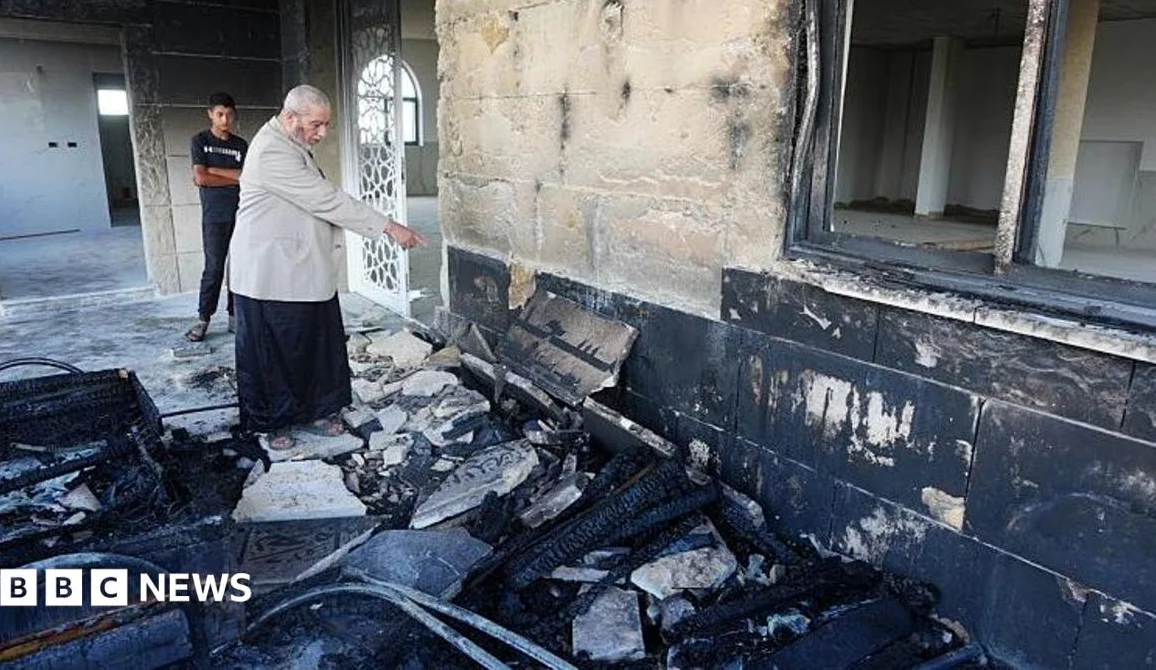
Israeli settlers have set fire to mosques, cars, and farmland in the West Bank, according to reports from the BBC and the United Nations Office for the Coordination of Humanitarian Affairs (OCHAOPT). The attacks have led to displacement and increased humanitarian needs across the region. Villagers described violent confrontations with masked settlers, while the Israeli military stated it was working to prevent ‘incidents of nationalist crime.’
Violent Confrontations and Property Damage
Hanan, a resident of a West Bank village, described seeing crowds of settlers running toward her home. She said she fled with four children, fearing her house would be burned. ‘They came from everywhere,’ she said. ‘We tried to escape but they followed us and threw stones.’
Kaied Ahmad Turabi, visiting from Miami, was filmed fighting with settlers on a neighbor’s porch. He had sustained injuries requiring 12 stitches and was still recovering when he spoke to the BBC. ‘I worked all my life with Jewish people, but these people… they all had covered faces, all of them had a lot of stuff – sticks, and things in their pockets. They came ready,’ he said.
Hours after the attack, dozens of young men gathered to defend the village. Israeli soldiers were deployed to separate the groups as settlers retreated. Meanwhile, Palestinians were dispersed using tear gas. Some residents tried to bury the canisters or kick them away while chanting ‘Palestine, Palestine.’
Humanitarian Crisis and Displacement
According to the OCHAOPT, the Occupied Palestinian Territory remains heavily fragmented, with movement restrictions and ongoing violence deepening humanitarian needs. Recent attacks have forced new waves of displacement before previous ones had ended, according to the May 25, 2026 Humanitarian Situation Report.
Across the West Bank, including East Jerusalem, escalating settler violence and Israeli military operations are increasing protection risks and disrupting access to essential services. Hundreds of Palestinians in Area C of eastern Jerusalem are at risk of forced displacement. The Israeli Finance Minister recently ordered the rapid implementation of demolition orders against Khan al Ahmar, a Bedouin community.
Bedouin community leaders reported high levels of fear and uncertainty. Khan al Ahmar is among 18 communities,comprising about 4,000 people,affected by the E1 settlement plan between East Jerusalem and Ma’ale Adumim.
Security and Movement Restrictions
OCHAOPT noted that humanitarian partners face significant challenges in delivering staff and supplies to affected areas. Movement restrictions, military operations, and demolitions continue to disrupt access to services. The situation in the West Bank is complicated by the fragmentation of the territory, with people unable to move freely between the Gaza Strip and the West Bank.
Residents and humanitarian workers alike described conditions as both difficult and unsafe. The repeated violence and displacement are straining resources and support systems. The Israeli military has stated it is working to prevent ‘incidents of nationalist crime,’ but residents remain at risk from settler attacks.






Comments
No comments yet
Be the first to share your thoughts