

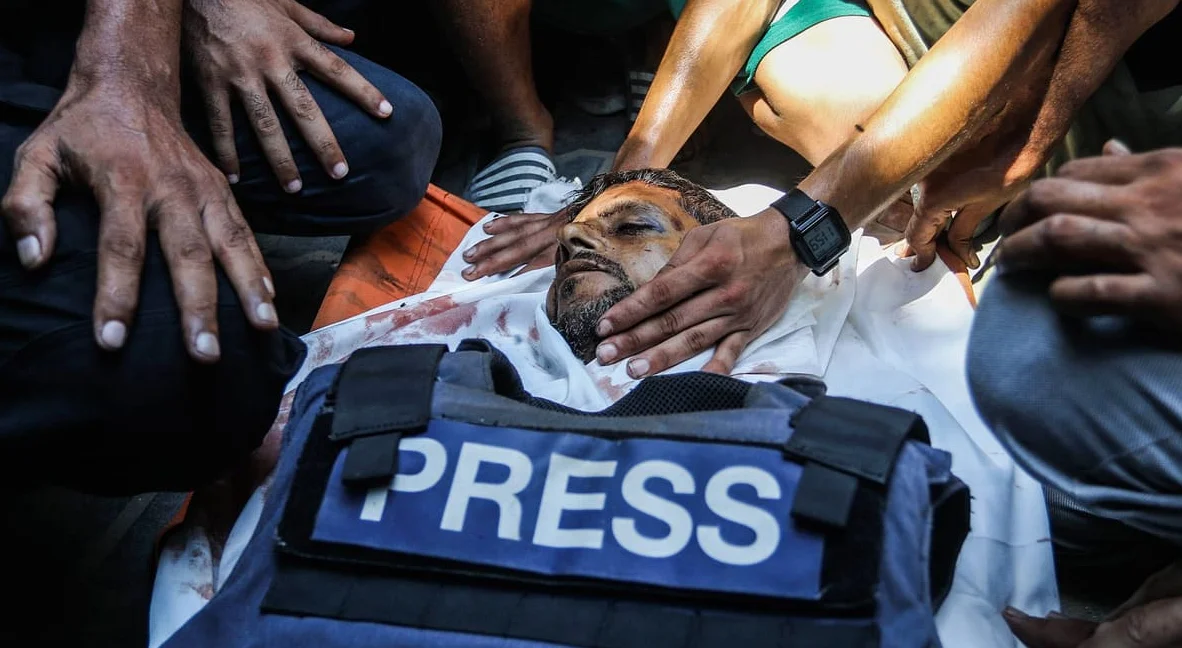
Amal Khalil, a journalist for Lebanon’s Al Akhbar newspaper, was killed in an Israeli strike in the southern Lebanese town of Tayri, according to Lebanon’s National News Agency (NNA). She is the fourth media worker killed by Israeli strikes in Lebanon since March. The other journalist killed was identified as Zeinab Faraj, a freelance photojournalist. Al Akhbar is a left-leaning, pro-Hezbollah newspaper.
Journalists killed in multiple locations
Separately, in the Gaza Strip, an Israeli air strike hit a tent for journalists outside the Shifa Hospital in Gaza City. The attack killed Al Jazeera reporter Anas al-Scharif, 28, and three other members of his team—Mohammed Kreikeh, Ibrahim Saher, and Mohammed Nufal. Additionally, two freelance journalists were killed in the same strike. The Israeli military claimed al-Scharif had been a leader of a Hamas terror cell responsible for rocket attacks on Israeli civilians, according to intelligence reports. Al Jazeera stated Israel provided no verified evidence to support this claim.
On the same day, the Israeli military also struck the Nasser Hospital in the southern Gaza Strip, killing five journalists, including 33-year-old Mariam Dagga, a freelancer for the Associated Press and The Independent. She had worked extensively at the hospital, documenting the plight of children suffering from malnutrition. The hospital is now the only functioning medical facility in southern Gaza. Israel stated it had aimed to strike a Hamas surveillance camera located on the hospital grounds.
On 10 September, Israeli strikes on Sanaa and the northern Yemeni province of al-Jawf killed at least 13 journalists, according to the Yemeni Journalists Syndicate (YJS). The attack hit the offices of the 26 September Newspaper, an official media outlet of the Houthis. Among the dead were Abdulaziz Al-Sheikh, Abbas Al-Dailami, and others. The Israeli Defense Forces confirmed they targeted military facilities belonging to the Houthi movement, including a public relations department and fuel storage. The Houthi health ministry reported 35 deaths and 131 injuries.
Lebanese government condemns attacks as war crimes
Lebanese Prime Minister Nawaf Salam accused Israel of committing war crimes after the Tayri strike. He stated that targeting journalists and obstructing rescue efforts “constitute described war crimes.” Salam emphasized that the attacks were “no longer isolated incidents,” but rather “an established method.” Lebanon’s Health Ministry said Israel “pursued” Khalil by “targeting” the house where she took shelter.
According to NNA, Israeli forces also blocked emergency workers from reaching the Tayri site. Red Cross workers took Faraj to a hospital under “hostile gunfire.” Several others were killed in the Tayri strike. The Israeli military acknowledged that two journalists were injured in the strike but denied targeting journalists, stating it “acts to mitigate harm to them while maintaining the safety and security of its troops.” It said details surrounding the incident were under review.
International condemnation and calls for investigation
International media watchdogs and unions have condemned the strikes. Sara Qudah, Regional Director of the Committee to Protect Journalists (CPJ), stated, “Journalists are civilians and must never be attacked.” She accused Israel of repeatedly labeling Gaza-based journalists as terrorists without credible evidence.
The International Federation of Journalists (IFJ) called the Yemen strike “an appalling massacre,” with General Secretary Anthony Bellanger stating, “Targeting journalists is a grave violation of international law.” The IFJ urged an “immediate, swift, and truly independent investigation” into the incident.
In Lebanon, TV Azteca reported that Khalil and Faraj were documenting the situation at the Lebanon-Israel border when they were struck. Local media said repeated Israeli strikes on the area and on rescue teams delayed efforts to save them.






Comments
No comments yet
Be the first to share your thoughts