

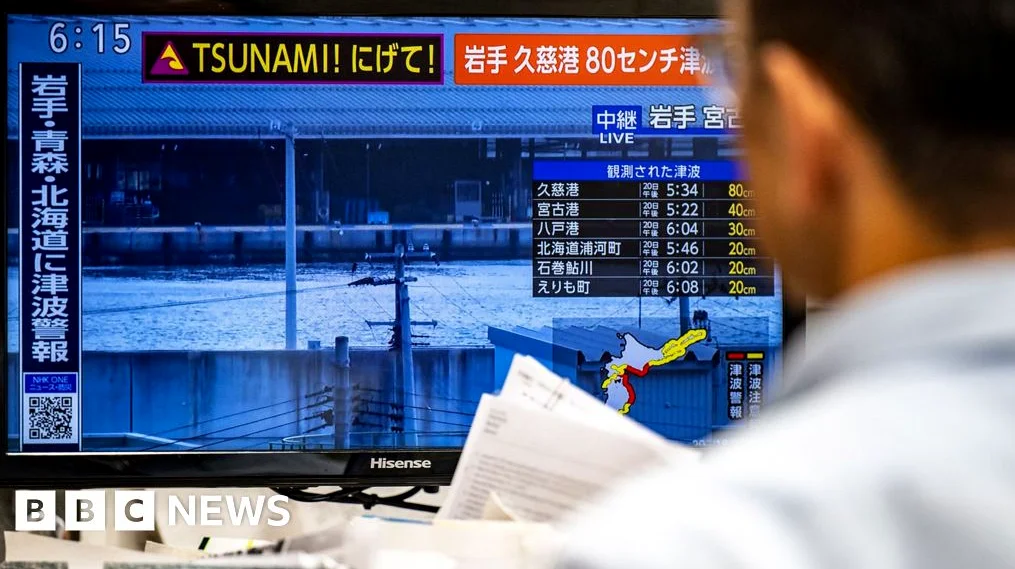
Japan has been placed on high alert following a 7.7 magnitude earthquake that struck off the country’s northern coast, triggering a tsunami warning and prompting widespread evacuations. The quake occurred near the Chishima and Japan trenches, with authorities noting a 1% chance of a mega-quake in the coming days, up from the usual 0.1% risk, according to the AP.
Evacuations and Emergency Measures
Across five prefectures along Japan’s coastline, more than 156,000 people were evacuated as part of emergency measures, according to The Independent — Local authorities used loudspeakers to warn residents of the potential tsunami and urged them to move to higher ground. Office workers in some areas were allowed to leave early, as reported by Chaw Su Thwe, a Myanmar national living in Hokkaido, who shared her experience with the BBC.
Broadcasters such as NHK showed footage of ships leaving Hachinohe port in anticipation of tsunami waves — the emergency alert app NERV advised people to stay away from the coast and avoid large bodies of water until the warnings were lifted. The incident has stirred memories of the 2011 Tohoku earthquake and tsunami, which killed 18,000 people and caused a meltdown at the Fukushima nuclear plant, according to The Independent.
Impact on Infrastructure and Nuclear Facilities
The earthquake caused disruptions to infrastructure, including the suspension of bullet train services and the loss of power in 100 homes, according to the BBC; Japan’s Cabinet Secretary Minoru Kihara reported no immediate damage or injuries. Meanwhile, Japan’s nuclear authority confirmed that no abnormalities were detected at the Fukushima plant, which experienced a meltdown in 2011, according to ScienceAlert.
However, the quake did cause temporary disruptions to cooling systems at reactors in Fukushima and Onagawa, Miyagi, and the country’s nuclear watchdog stated that these systems were quickly restored. TV footage showed structural damage in the northeast, including the collapse of a stone wall at Aoba Castle in Sendai city.
Geological Context and Historical Precedent
Japan’s location on the Pacific Ring of Fire makes it one of the world’s most earthquake-prone countries, experiencing about 1,500 earthquakes annually, and Around 20% of global earthquakes measuring 6.0 magnitude or higher occur in Japan, according to The Independent. The 2011 Tohoku earthquake. A 9.0-magnitude disaster, remains a stark reminder of the region’s vulnerability to such events.
Prime Minister Sanae Takaichi urged residents to prepare for potential aftershocks and to confirm their evacuation routes and shelters, but Officials emphasized that the increased risk advisory was not a prediction but a call for heightened preparedness, as reported by the AP.
Despite the heightened risk, the tsunami warning was later downgraded and eventually lifted shortly before midnight local time; the International Atomic Energy Agency confirmed no abnormalities at Japan’s nuclear facilities, providing some reassurance to the public.
The incident has reignited discussions about Japan’s readiness for natural disasters, with experts and officials emphasizing the importance of continuous vigilance and preparedness in a country prone to frequent seismic activity.






Comments
No comments yet
Be the first to share your thoughts