

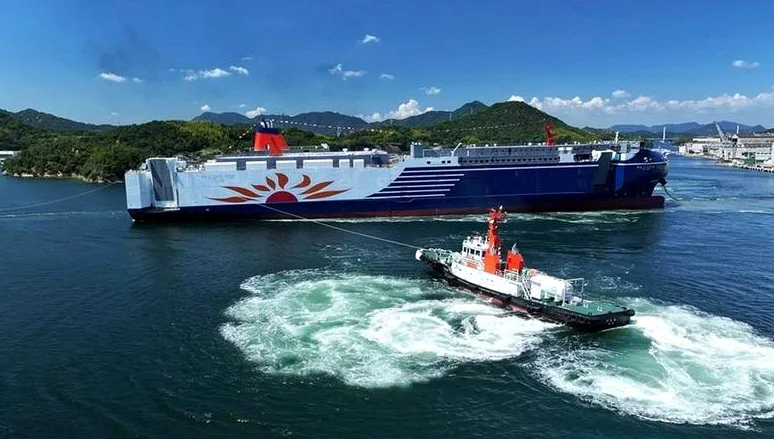
Japan’s coastal ferry network got a major upgrade with the arrival of the Keyaki, a 199-meter ro-pax ferry that entered service last November between Otaru on Hokkaido and Maizuru in Kyoto Prefecture. Built by Mitsubishi Shipbuilding at its Enoura plant in Shimonoseki, the 14,157-gt vessel carries 150 trucks and 30 cars, or an equivalent mix, plus 286 passengers in upgraded berths. Officials at Shin Nihonkai Ferry Co., which jointly ordered the ship with the Japan Railway Construction, Transport & Technology Agency, hailed it as a benchmark for efficiency on the Sea of Japan route.
The Keyaki replaces ships from 2004, like the 224-meter Akashia and Hamanasu, which boasted 31-knot speeds and hybrid propulsion but carried higher operating costs. Powered by four 14-cylinder Wärtsilä 31-series engines totaling 34,160 kW, Keyaki tops out at 28 knots. Its hull features a Katana Bow, buttock-flow stern with ducktail, anti-roll tank and fin stabilizers. Those tweaks cut propulsion resistance and boost stability in rough seas, according to Mitsubishi Shipbuilding. Maintenance costs should fall too, compared to the complex setups on the outgoing pair.
A sister ship, Hamanasu, arrives in mid-2026 to complete the duo. Shin Nihonkai has now taken delivery of nine ferries from Mitsubishi, highlighting deep ties between Japan’s shipowners and builders. Naikai Zosen’s Setoda yard near Innoshima has also ramped up output, delivering three notable vessels in 2025 alone.
MOL Sunflower’s Sunflower Pirka joined the fleet in June on the Tomakomai-Oarai route, linking Hokkaido to the Tokyo area. This 199-meter dual-fuel ro-pax runs on an MAN 12S50ME-C8.5-GI two-stroke engine built by licensee Mitsui E&S. Rated at 21,240 kW, it pushes the ship to 24 knots while slashing SOx emissions to near zero and cutting CO2 by 35% versus its predecessor. A simplified hull with fo’c’sle windshield, rounded bow and spray tearing plates fights wave resistance. The ship hauls 155 trucks—vital for fresh produce southbound and goods northbound—alongside 157 berths mainly for drivers and travelers.
Sunflower Kamuy, the lead sister, started service in January 2025. MOL Sunflower operators note LNG fueling drives the emissions gains. Two-stroke engines like these are gaining ground in Japan’s ferry sector, once dominated by medium-speed types such as Pielstick and newer Wärtsilä models.
Naikai Zosen also handed over Blue Grace in 2025 to Tsugaru Kaikyo Ferry for the seven-hour Muroran-Aomori crossing between Hokkaido and Honshu. This 144-meter ship packs an MAN 6S50ME-C engine of 8,300 kW. It loads 64 12-meter trucks, 30 cars and 422 passengers. Blue Grace’s debut freed up the 2020-built Blue Luminous for Japan’s Ministry of Defense logistics, aiding rapid troop and gear deployment in crises.
Shin Nihonkai shifted its current Hamanasu to sealift duties after Keyaki arrived. Reports suggest the defense ro-ro fleet could grow from two to eight ships amid rising regional tensions. Japan’s ferry renewal push blends freight demands, passenger comfort and environmental goals. New vessels offer plush interiors, a far cry from utilitarian predecessors, as leisure travel rises. Government policy nudges cargo from clogged highways to sea, exacerbated by truck driver shortages. Japanese yards like Mitsubishi and Naikai Zosen keep dominating builds, proving resilience through design tweaks and productivity gains.
These projects sustain Japan’s edge in long-haul ro-pax, connecting Hokkaido, Honshu and beyond while cutting carbon footprints—MOL claims 35% for Sunflower Pirka alone.






Comments
No comments yet
Be the first to share your thoughts