

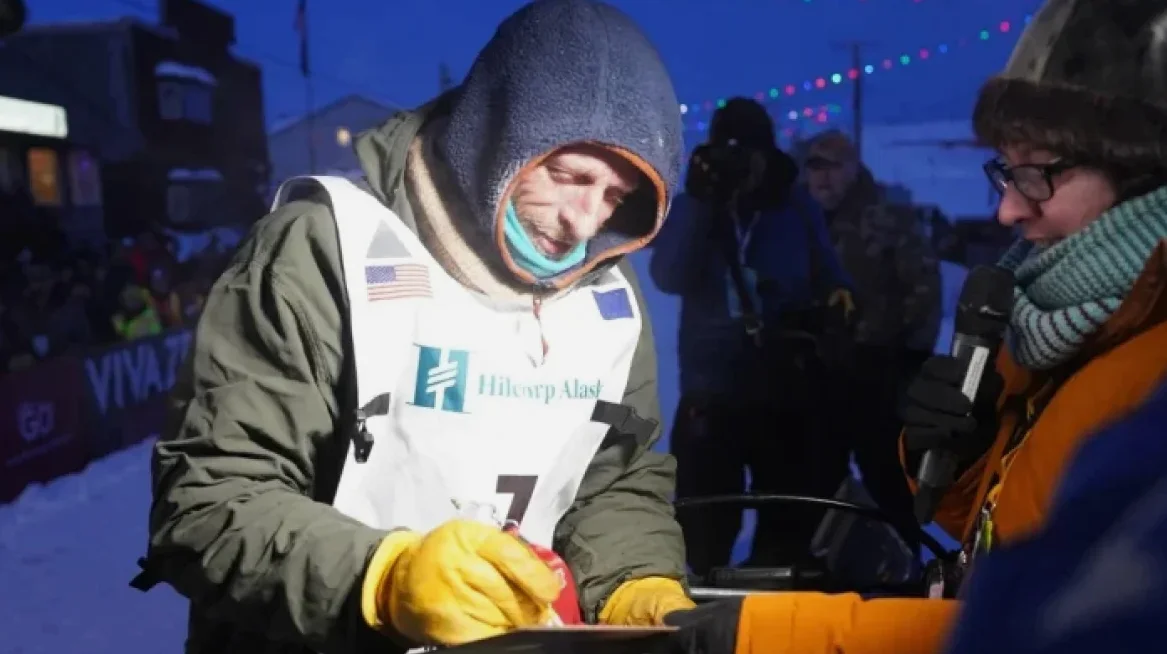
Jessie Holmes, 44, crossed the finish line in Nome, Alaska, on Tuesday night, sealing a rare second consecutive victory in the 1,000-mile Iditarod Trail Sled Dog Race. The defending champion arrived at the Burled Arch in Nome around 9:30 p.m. ET as fans cheered along Front Street, and police vehicles escorted his 12-dog team through the cold Alaskan night. Holmes, who is also a former cast member of National Geographic’s “Life Below Zero,” has now won the race twice in a row, joining an exclusive group of repeat champions in the race’s 54-year history.
Finish-Line Moment in Nome: A Second Straight Title
The celebration in Nome was marked by biting cold, with temperatures dipping below freezing as fans waited for the champion’s arrival on St. Patrick’s Day. Holmes, visibly elated, pumped his arms and exchanged high-fives with his team as they ran down Front Street. Upon reaching the finish chute, he delivered a simple message: “Dogs first, man, dogs first. They deserve all the glory.” After a brief interview, he fed his dogs ribeye steaks, a gesture that underscored his deep connection with his team.
Officials presented Holmes with a check for $80,000, a significant increase from the $57,000 he received last year. He selected two lead dogs—Zeus, a black-and-white three-year-old, and Polar, an all-white nine-year-old—as the Golden Harness-winning most valuable dogs. White roses were placed around their necks in recognition of their performance.
Race Route, Pace, and the Approach That Powered the Run
The 2026 race began on March 8 in Willow, one day after a ceremonial start in Anchorage. The trail carried teams over two mountain ranges, along the frozen Yukon River, and across unpredictable Bering Sea ice before the final push to Nome. Holmes’ team, Team Can’t Stop, finished in 9 days, 7 hours, and 32 minutes after leading most of the way.
Earlier Tuesday, on the run to White Mountain—where mushers must take a mandatory eight-hour break before the final 77-mile push—Holmes gave his dogs extra snacks and rubbed frost off their snouts, showing attention to each animal on the team. He described his strategy as continuous reinvestment in dog care: “I invest back into the dogs constantly with rest and food, and it perpetuates power, which perpetuates speed. If you ain’t got power, you ain’t got speed, and you aren’t going to be able to race.”
Holmes’ win is a personal milestone shaped by the communities along the route. “It’s a blessing to be out here,” he said. “I was just so full of gratitude and gratefulness being welcomed into all these communities, and being out in all this beautiful country with the most amazing dog team I’ve ever seen.”
Reactions, Records, and the Money Behind This Year’s Purse
Holmes acknowledged the legacy of repeat champions in the race’s history. He mentioned Susan Butcher (1986-1987) and Lance Mackey (2007-2008), both of whom went on to claim four titles. “I mushed into Nome thinking about Butcher and Mackey, noting the legacy of repeat champions,” he said.
This year’s purse was significantly boosted by financial support from Norwegian billionaire Kjell Rokke, who participated in a newly created, noncompetitive amateur category. Rokke provided $100,000 in additional prize money and $170,000 to Alaska Native villages that serve as checkpoints. Another participant in the noncompetitive “expedition” class, Canadian entrepreneur Steve Curtis, pledged $50,000 for youth sports programs in villages, though he did not finish the race.
Despite the financial boost, the Iditarod has faced ongoing criticism from animal rights groups. People for the Ethical Treatment of Animals (PETA) has claimed that more than 150 dogs have died in the history of the race and urged Rokke to spend his money to help dogs rather than put them through “hazards and misery.” The Iditarod has never provided its own count of dogs who have died on the race.
On Tuesday, the race confirmed that one dog has died in this year’s event: a four-year-old female named Charly from musher Mille Porsild’s team. A necropsy will be conducted to determine the cause of death. This incident has reignited the debate over the safety and treatment of dogs in the race.
For now, Jessie Holmes leaves Nome as champion again, celebrated for a fast, controlled run and a visibly energetic team. However, the event’s safety questions remain active as officials move forward with a necropsy and the sport heads toward its next season.
What’s Next: Eyes Already on a Three-Peat Attempt
Holmes has now raced in the Iditarod nine times, with seven top 10 finishes and top-five placements in each of the last five races. Asked at the finish line whether he would pursue a third straight win with the race set to run its southern route in 2027, he answered: “That’s what we’re going to be shooting for. And we’re going to be shooting to break that southern route record, because that’s our favorite route. We can’t wait.”
Holmes’ eight-year stint on National Geographic’s “Life Below Zero” provided the means to acquire better dogs and equipment. It also enabled him to purchase raw land near Denali National Park and Preserve, where the carpenter has established a homestead in the wilderness, his closest neighbor some 30 miles away.
The Iditarod continues to face scrutiny, but for now, Jessie Holmes stands as a champion, having secured a rare repeat victory and setting his sights on an even greater challenge.






Comments
No comments yet
Be the first to share your thoughts