

 The Guardian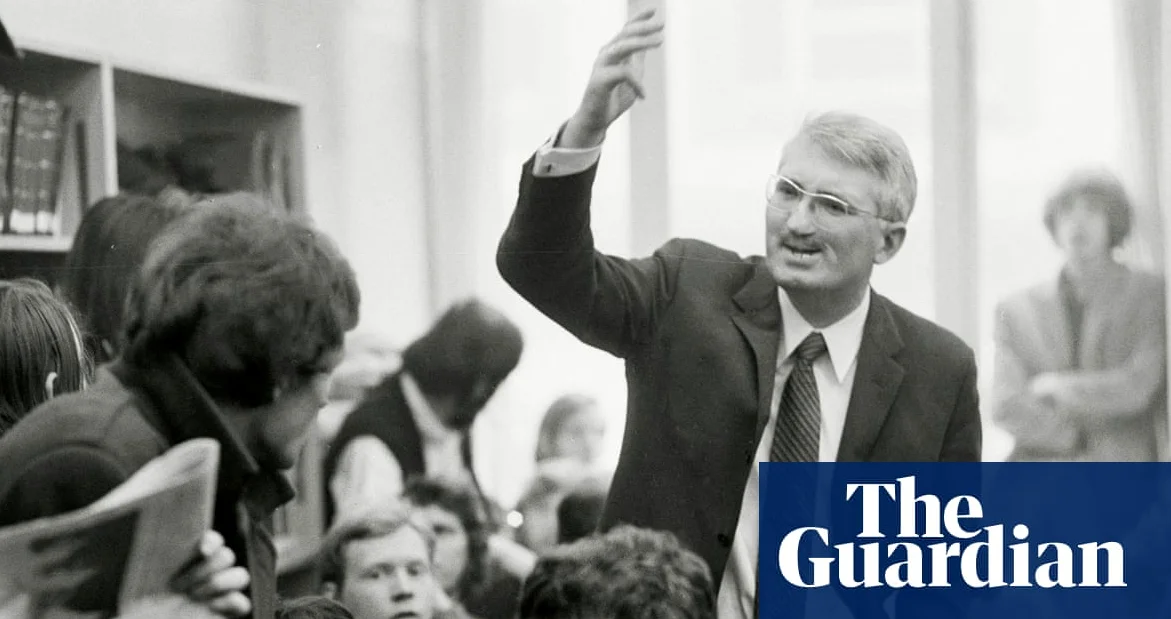
Jürgen Habermas, the German philosopher, social theorist, and defender of humane Enlightenment values, has died at the age of 96. His work, which sought to redefine German thought after the atrocities of the Nazi era, left a profound legacy in political theory, social criticism, and the development of modern democratic discourse.
Early Life and the Shock of Nazi Realities
Jürgen Habermas was born in Düsseldorf in 1929 and spent his early years in Gummersbach, near Cologne. As a teenager, he became a member of the Hitler Youth and was conscripted into the anti-aircraft defense units during the final months of World War II. At 15, he was too young to be sent to the front lines but too old to be exempt from service. This experience, while brief, marked the beginning of a complex relationship with the Nazi regime.
After the war, Habermas described his father, a director of the local seminary, as a ‘passive sympathiser’ with the Nazis. Habermas himself was initially influenced by this mindset. However, the Nuremberg trials and the harrowing documentaries of Nazi concentration camps shattered his earlier complacency. He later recalled, ‘All at once we saw that we had been living in a politically criminal system.’ This moment of realization, as he called it, ‘that first rupture, which still gapes,’ became a defining point in his intellectual journey.
Habermas was profoundly affected by the revelations of the Holocaust and the inhumanity of the Nazi regime. He later wrote that his fellow Germans had ‘collectively realised inhumanity,’ a sentiment that shaped his commitment to redefining German thought in the postwar era.
From Adorno to a New Direction in German Thought
Habermas was influenced by the work of his great leftist teachers, Theodor Adorno and Max Horkheimer, who had returned from American exile to reestablish the Institute of Social Research at the University of Frankfurt. Together, they were developing what became known as ‘critical theory,’ an interdisciplinary approach to understanding society and power.
In 1956, Habermas became Adorno’s assistant, a position that deepened his engagement with critical theory. However, he diverged from his teachers in a key way. While Adorno, who had survived Auschwitz, questioned whether those who escaped by accident could ‘go on living,’ Habermas sought to build a positive framework for human emancipation. He rejected Adorno’s ‘negative dialectics’ and instead pursued a systematic and methodical approach, inspired by the great German philosophers Kant, Hegel, and Marx.
Habermas believed that the Enlightenment, despite its failures, could still serve as a foundation for human progress. He argued that the horrors of the Holocaust could be averted by cultivating a new ‘categorical imperative’—a moral framework that would guide thought and action to prevent such atrocities from recurring.
Challenging Heidegger and the Limits of German Philosophy
Habermas’s intellectual development was not without conflict. In 1949, he spent four years studying the philosophy of Martin Heidegger, a former Nazi party member. In 1953, he challenged Heidegger to explain his controversial claim in Introduction to Metaphysics that National Socialism had an ‘inner truth and greatness.’
Heidegger never responded to Habermas’s challenge, a silence that Habermas interpreted as emblematic of the failure of German philosophy to confront its past. This failure, he argued, mirrored the reluctance of postwar Germany to fully reckon with its Nazi legacy. The conservative government of Konrad Adenauer, preoccupied with anti-communist rhetoric, avoided confronting the past, which further fueled Habermas’s critique of German intellectual and political life.
Habermas’s frustration with the intellectual climate of the time led him to leave Frankfurt in 1961 and complete his habilitation thesis at Marburg University under the Marxist jurist Wolfgang Abendroth. His work, The Structural Transformation of the Public Sphere, published in 1962, argued that the public sphere was essential for democratic discourse and rational consensus. He emphasized that citizens must be free to express their opinions and form public opinion in a space of unrestricted communication.
Habermas believed that the public sphere was not just a space for debate but a necessary condition for the exercise of reason and democratic participation. He argued that the Enlightenment, despite its flaws, had a ‘sound core’ that could guide post-Holocaust societies toward a more just future. This belief put him at odds with both student radicals and postmodernist thinkers like Jean-François Lyotard, who rejected the notion of universal values and progress.
In 1964, Adorno lured Habermas back to Frankfurt, where he took over Horkheimer’s position as professor of philosophy and sociology. However, his ideas were often dismissed as politically moderate by the radical student movements of the late 1960s. In 1967, he participated in a public debate in Hanover with student leaders Rudi Dutschke and Hans-Jürgen Krahl, where he supported their democratic goals but criticized their use of violence.
Habermas argued that ‘voluntarist ideology’—a term he applied to Dutschke’s approach—was akin to ‘left fascism.’ He emphasized the importance of reason and rational consensus in preventing the resurgence of authoritarianism. His work continued to evolve, culminating in The Philosophical Discourse of Modernity (1985), where he defended Enlightenment values against postmodern critics such as Michel Foucault and Jacques Derrida.
Habermas’s legacy extends far beyond academia. His ideas on the public sphere, democratic deliberation, and the role of reason in society continue to influence political theory, media studies, and public policy. His work remains a cornerstone of modern democratic thought, offering a vision of a society where rational dialogue can lead to collective flourishing and social justice.






Comments
No comments yet
Be the first to share your thoughts