

 The New York Times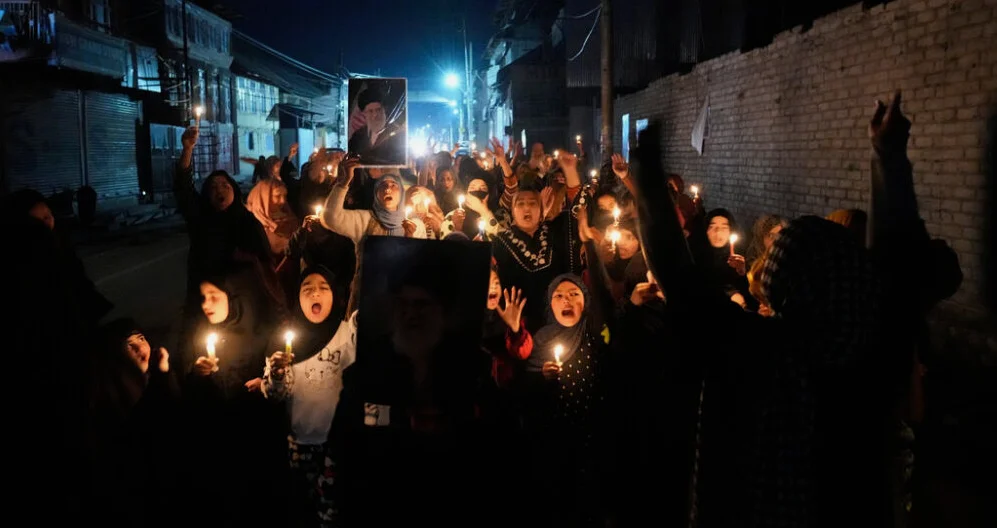
Ayatollah Ali Khamenei, the late supreme leader of Iran and a revered figure among Shiite Muslims worldwide, was mourned by millions across South Asia. His death, caused by U.S.-Israeli strikes on Saturday, sparked massive demonstrations in India and Pakistan, where Shiite communities have long looked to Iran for spiritual and political guidance.
Protests and Violence Across the Region
In Pakistan, where Shiites make up an estimated 15% of the population—around 35 million people—protests erupted across major cities. Thousands gathered in Karachi, Lahore, and Islamabad to express their grief and anger. In Karachi, clashes with security forces left 10 people dead, according to a police surgeon at the city’s main hospital. Demonstrators stormed the U.S. consulate, which was heavily guarded.
Authorities imposed temporary curfews in several areas to control the unrest. In India, where estimates suggest the Shiite population exceeds 40 million, similar demonstrations occurred. In Indian-administered Kashmir, a Muslim-majority region with deep cultural ties to Iran, schools were closed this week as officials sought to prevent further violence.
“When Iran is attacked, we feel our faith, our identity and our very existence are being targeted,” said Asghar Jaffer, a Shiite student activist who joined the demonstrations in Karachi. He described Khamenei as a symbol of resistance against U.S. and Israeli influence.
Symbol of Shiite Unity and Resistance
Khamenei, who passed away at the age of 86, was seen by many as the spiritual leader of all Shiites, not just Iran. Nawab Masood Abdullah, a Shiite community leader in Lucknow, India, compared his status to that of the Pope in Christianity. “His influence was not limited to Iran; he was the guiding light for Shiites around the world,” he said.
For over three decades, Khamenei led Iran as a resistance figure against Western powers. His legacy extended to countries like Pakistan and India, where Shiites often feel a deep spiritual connection to Iran despite the physical distance.
“Iran may be far away, but for many Shiites the bond is spiritual,” said Areeba Zahra, a college student in northern Kashmir. “When something happens there, people here feel it too.”
Experts noted that Khamenei’s death could further strain relations between Shiite and Sunni communities in Pakistan, where sectarian tensions have long been a source of instability. Shiite Muslims have been frequent targets of attacks by Sunni militant groups, and Iran was seen as a powerful ally in the face of such threats.
Political and Regional Implications
Pakistan has long balanced its relationships with Iran and Saudi Arabia, a close U.S. ally. The country has condemned both the attacks on Iran and Iran’s retaliatory strikes on Gulf countries. However, the mood at the protests in Pakistan was far from neutral.
“Khamenei’s assassination feels like an assault on the spiritual and political voice of the Shiite community worldwide,” said Azhar Naqvi, a banker who joined a protest in Islamabad. Demonstrators chanted a familiar anti-U.S. and anti-Israel slogan: “Death to America, death to Israel.”
Simon Wolfgang Fuchs, a professor of Islam in South Asia at the Hebrew University of Jerusalem, explained that for many Pakistanis, Iran represented a symbol of power, strength, and dignity. “Iran’s influence helped Shiite communities feel secure in a region where they have often been marginalized,” he said.
With Khamenei’s death, the power vacuum in Iran could lead to uncertainty in the region. Analysts are watching closely to see how the new leadership will respond to U.S. and Israeli actions, and whether tensions will escalate further. The situation is also expected to impact trade and diplomatic relations in the Middle East and South Asia.
As the mourning continues, the global community is left to assess the long-term implications of Khamenei’s death on Shiite communities, regional stability, and international relations.






Comments
No comments yet
Be the first to share your thoughts