

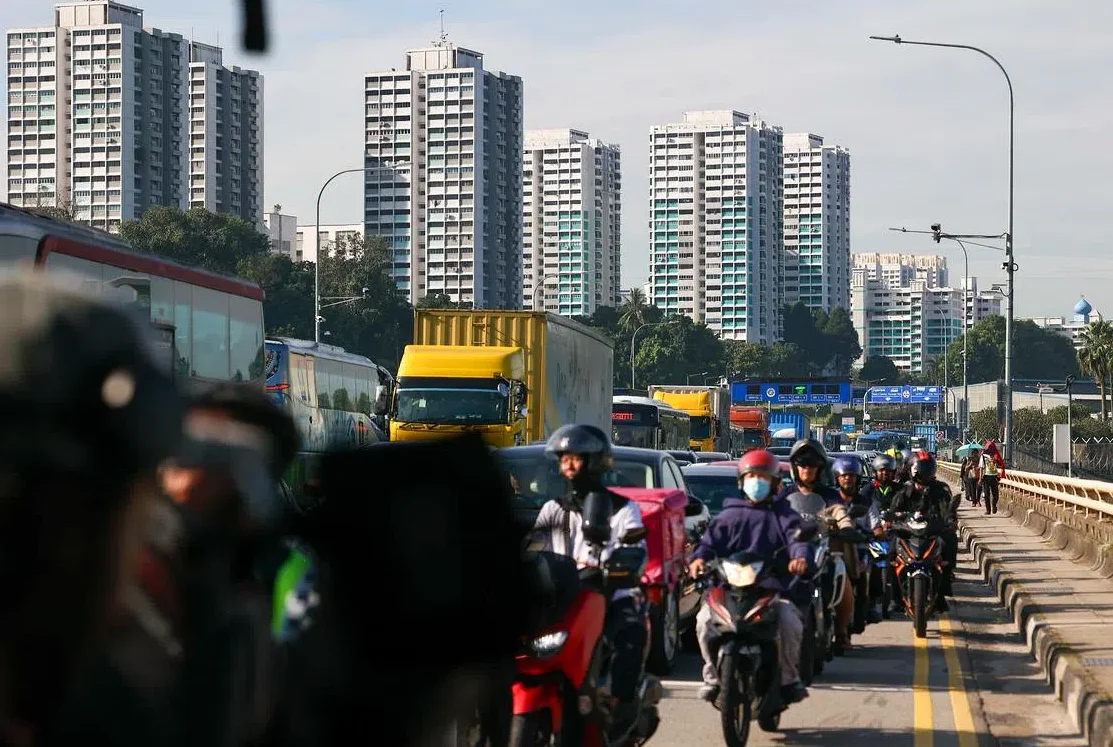
Johor Bahru, Malaysia — Every week, social worker Muhammad Fariezatul Ahmed rides his motorcycle across the Causeway into Singapore, not to work, but to assist Malaysians injured in road accidents on their daily commute. Many of these workers are fellow motorcyclists crossing the border daily for higher-paying jobs, often unaware of their insurance coverage or completely unprotected during their journey.
Insurance Gap for Cross-Border Workers
According to Ahmed, a 35-year-old based in Tebrau, the situation is concerning. He works with the Singapore Accident Help Centre (SAHC), a Johor Bahru-based NGO that assists injured workers with financial aid, legal support, and repatriation services. He said the lack of insurance coverage for daily commutes has led to tragic outcomes, with at least one person dying in an accident each month.
Malaysia is addressing this growing problem with a new insurance scheme aimed at covering the roughly 400,000 Malaysians who commute daily between Johor and Singapore, beyond their working hours. The Traveller Scheme, announced on Feb 5 by Human Resources Minister R. Ramanan, is expected to be implemented by the second quarter of 2026. Authorities are currently reviewing related laws to align with international labor standards.
The need for such a scheme is clear. Hundreds of thousands of Malaysians cross the land border daily, many on motorcycles, which are one of the most cost-effective and efficient ways to avoid traffic congestion. In 2024, about 77,000 foreign-registered vehicles entered Singapore daily, with 82 per cent of them being motorcycles. This high volume of traffic contributes to the risk of accidents during the daily commute.
Risks and Real-World Impact
SAHC recorded 48 deaths in 2024 from accidents involving Malaysian workers traveling to and from Singapore, and 54 in 2025. These figures highlight the severity of the issue. Workers like Mr Izzat Rozali, a 36-year-old who commutes from Gelang Patah to Tuas for work, already pay for personal accident and life insurance in Malaysia. However, he supports the new scheme, comparing it to SOCSO, the government-mandated social security organization that provides coverage for workplace injuries and accidents.
SOCSO, or Perkeso, was established in 1971 and mandates monthly contributions from both employers and employees to fund benefits like medical care and cash payments for temporary or permanent disability. The wage ceiling for contributions has recently been increased to expand coverage. Mr Nathan Krishna, a 40-year-old who commutes from Iskandar Puteri to an aircraft engineering firm in Changi, noted that many workers are unaware of the limits of their employer’s insurance coverage.
Motorcyclists have identified several high-risk zones along the daily commute, including the Causeway, Second Link, SLE, BKE, and AYE during peak periods. In Singapore, the Eastern Dispersal Link (EDL) and Pasir Gudang Highway are also known for frequent accidents. Mr Wilson Lee, who works for a port operator in Johor, highlighted that these roads are poorly maintained, heavily congested, and often populated by heavy vehicles, creating a dangerous environment for motorcyclists.
In Singapore, employers of work permit and S Pass holders are required to provide their workers with medical insurance coverage with an annual claim limit of at least $60,000. However, under Singapore’s Work Injury Compensation Act (WICA), workers are generally not covered for accidents that occur while commuting in their own vehicles, a friend’s car, or on public transport between home and their workplace. This is not considered to be “in the course of employment,” leaving many workers exposed.
Grey Area for Cross-Border Workers
Financial adviser Carlos Lee said this leaves many workers in a vulnerable position. “Generally, workers are not covered for their commute to and from work,” he said. “But some employers may want to better protect their workers by purchasing an extension on the existing plans for their employee that covers the journey to and from work.”
Ms Janey Wong, chief operating officer of SAHC, noted that this grey area is common among cross-border workers. “Many cases we hear of, they (Malaysians) get caught in an accident (in Singapore) and the immediate reaction is to want to go home… they are afraid that the hospital bills in Singapore will be more expensive,” she said.
One such case is Mr Loqman Hussen, a 26-year-old kitchen assistant in Tuas, who was injured on March 10 while riding from his home in Gelang Patah to work. He had cleared Malaysian immigration but had not yet entered Singapore when the accident occurred. He suffered a broken ankle and collarbone and was treated at Hospital Sultanah Aminah in Johor Bahru, which gave him two months of medical leave. However, his employer’s insurance did not cover the accident, and his medical leave from a Malaysian hospital was not recognized for paid leave.
“I don’t have personal accident insurance, and my company’s plan only covers treatment in Singapore,” he said. “I might have to look for another job,” he added, unsure if he still has a job to return to.
Industry observers say such cases highlight the fragmented nature of protection for cross-border workers. Malaysian Employers Federation president Syed Hussein Syed Husman noted that workers often rely too heavily on employer-provided benefits, which are limited in scope and geography. “As a result, incidents that occur outside the workplace, particularly during the commute between Malaysia and Singapore, may fall into a ‘grey’ area where coverage is unclear or insufficient,” he said.
A Malaysian-based scheme could help close that gap, especially if it mirrors elements of SOCSO, which provides protection against workplace injuries, disability, and death through mandatory contributions. Still, questions remain over how the Traveller Scheme will work in practice — including who will pay, how contributions will be structured, and what level of coverage it will provide.
Ms Wong said clarity will be crucial to ensure workers understand their protection. “Implementation is key,” she stressed. “Workers need to know exactly what they are covered for, especially during that daily work commute which carries the most risk.”
“What are the limits and extent of the coverage offered by the scheme?” is a question she hopes will be answered soon. With the new scheme on the horizon, many cross-border workers are hopeful that the bridging of the grey area will finally provide them with the security they need during their daily commute.






Comments
No comments yet
Be the first to share your thoughts