

 BBC
BBC 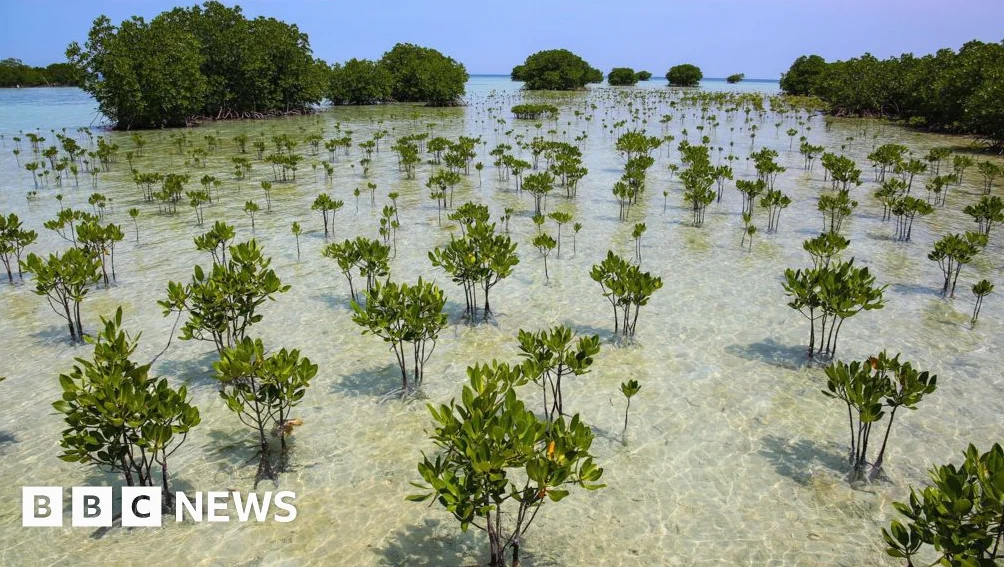
Mangrove forests, which shield millions from storms and store large amounts of greenhouse gases, are making an unexpected comeback, scientists have found.
Historic Decline and Recent Recovery
For decades, these swampy trees were rapidly declining as they were cleared for fish farms and housing, But since 2010, the world has been gaining more mangroves than it has been losing.
This shift is attributed to stronger legal protections and increased public awareness of their importance, spurred by events like the 2004 Indian Ocean tsunami.
Natural Regeneration and Legal Measures
Researchers highlight that these forests can regenerate naturally once deforestation stops. The new study reveals that from the 1980s to 2010, over 12,000 sq km of mangroves were cleared or destroyed across Asia, Africa, and the Americas.
However, the trend has reversed in recent years, the total net losses since the 1980s have now been reduced to around 849 sq km, Restoration efforts and the natural expansion of mangroves have contributed to this positive change.
Indonesia and Myanmar have seen forest levels stabilise and grow, respectively, In Indonesia, the aftermath of the 2004 tsunami helped shift public opinion, and the removal of trees for fish farming has slowed.
Dr. Zhen Zhang from Tulane University noted that after the tsunami, some islands were protected well, increasing public awareness about the importance of mangroves.
Technological Advances and Environmental Trade-offs
Technology is also playing a role in the recovery — the study used a more detailed satellite imaging system, revealing a greater number of new trees compared to previous studies.
Prof. Elizabeth Robinson from the Grantham Research Institute said the satellite imagery is highly sensitive to canopy changes and provides globally consistent observations that previous assessments may have missed.
Despite the positive news, there are trade-offs; In some countries, including Brazil, new mangrove growth is occurring alongside upstream environmental damage from mining and deforestation, which flushes nutrients into waterways.
Dr. Pete Bunting from Aberystwyth University said while more mangroves are appearing, it is only good news if upstream areas are not severely damaged.
West and Central Africa remain hotspots for destruction, with the Niger Delta being a notable example of mangrove pollution impact; Oil pollution is causing significant damage, and pipelines are visible in satellite images cutting through the forests.
Tropical cyclones also pose a serious threat, with some of the most dramatic single-year losses recorded in the study, from Australia to the Caribbean.
Despite these challenges, the study indicates a positive trend, and the proportion of closed canopy mangroves, the richest and most carbon-dense, has grown by nearly 20% since the 1980s.
Dr. Zhen Zhang said they are moving in the right direction, with a clear trend of decreased loss rates and healthier forests.






Comments
No comments yet
Be the first to share your thoughts