

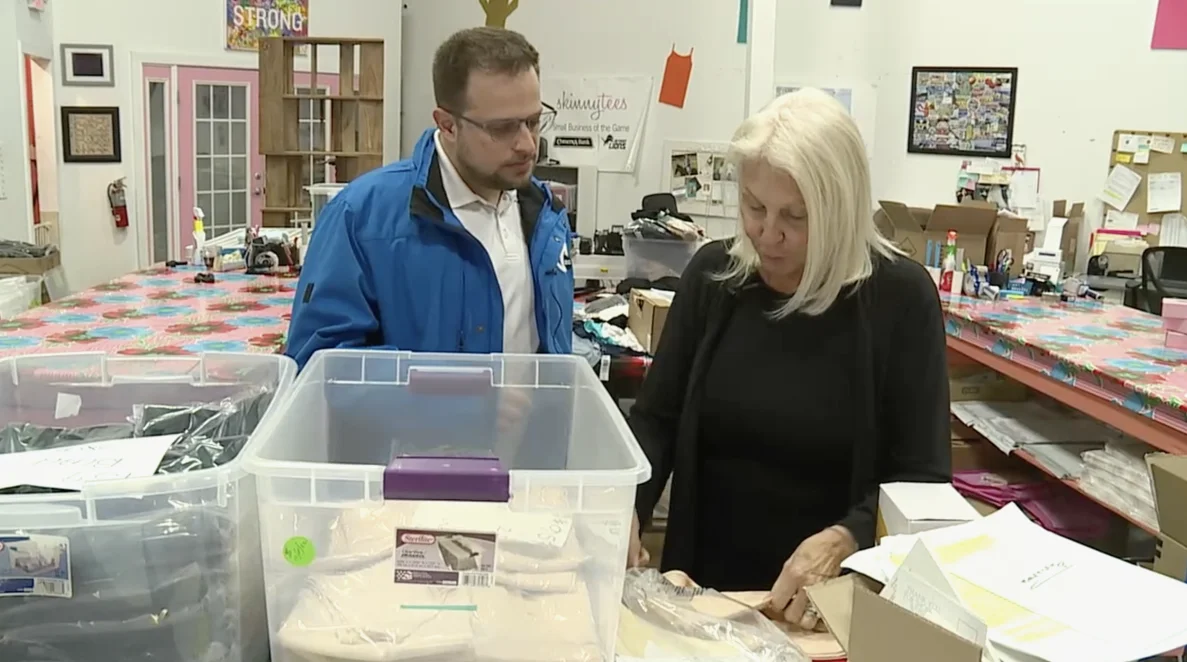
LINDA SCHLESINGER got the news from one of her employees at Skinnytees, her women’s apparel shop in Birmingham, Michigan. The worker called her over to watch breaking coverage of the Supreme Court’s 6-3 ruling that invalidated most of Trump’s tariffs. Relief lasted barely an hour.
“One of the girls said ‘come here. I have to show you something running across the news,'” Schlesinger recounted. Trump quickly responded by announcing the new 10% tariff on global imports, set to run for 150 days starting Monday.
Skinnytees sources 80% of its materials from China and 15% from Italy as it expands into men’s clothing. Contractors in both countries halted orders amid the chaos. “My contractors in Italy and China are so anti, of course, what’s going because it affects their orders,” Schlesinger said. “What they’re getting, a lot of people brought everything to a screeching halt.”
The back-and-forth has hammered her operations during Trump’s second term. She has avoided price hikes so far by adapting her business model. Still, the unpredictability weighs heavy. “Ten percent and then tomorrow, will he wake up and decide an additional 20%?” she asked. “I mean, there’s no checks and balances here.”
Dr. Joseph Eisenhauer, dean of the College of Business Administration at the University of Detroit Mercy, described the developments as major international news with huge financial stakes. The federal government has pulled in more than $100 billion—and possibly $200 billion—in tariff revenue, according to Eisenhauer. Much of that money may now need refunding to importers who paid it.
Constant policy swings breed economic volatility. “Whether there will be taxes, won’t be taxes, new tariffs, no tariffs, that volatility and uncertainty deters investment in the economy,” Eisenhauer said.
Michigan businesses like Skinnytees sit at the epicenter of these tariff battles. The state relies heavily on manufacturing and imports for industries from autos to apparel. Trump’s initial tariffs targeted steel, aluminum and a range of Chinese goods, hitting supply chains hard. The Supreme Court ruled Friday that most exceeded presidential authority under existing trade laws.
Trump’s rejoinder—a blanket 10% levy on all imports—aims to sidestep the court’s decision. White House officials said it falls within emergency powers granted by Congress. Critics, including business groups, argue it will spike costs for consumers and manufacturers alike.
Schlesinger plans to monitor the situation closely. She has stockpiled some materials and shifted suppliers where possible. But with 150 days ahead, she worries about long-term damage. “For an hour, we’ll believe it, and he’ll swing it, and he did,” she said of the rapid policy reversal.
Eisenhauer expects ripple effects across Detroit’s economy. Local firms already grapple with higher input costs from prior tariffs. Refunds could provide a cash infusion, but only if importers can handle the paperwork. “The financial implications are significant,” he added.
As Monday approaches, Michigan executives huddle with lawyers and accountants. Skinnytees employees field customer questions about potential delays. The tariff saga shows no sign of easing, leaving businesses to pivot on short notice.






Comments
No comments yet
Be the first to share your thoughts