

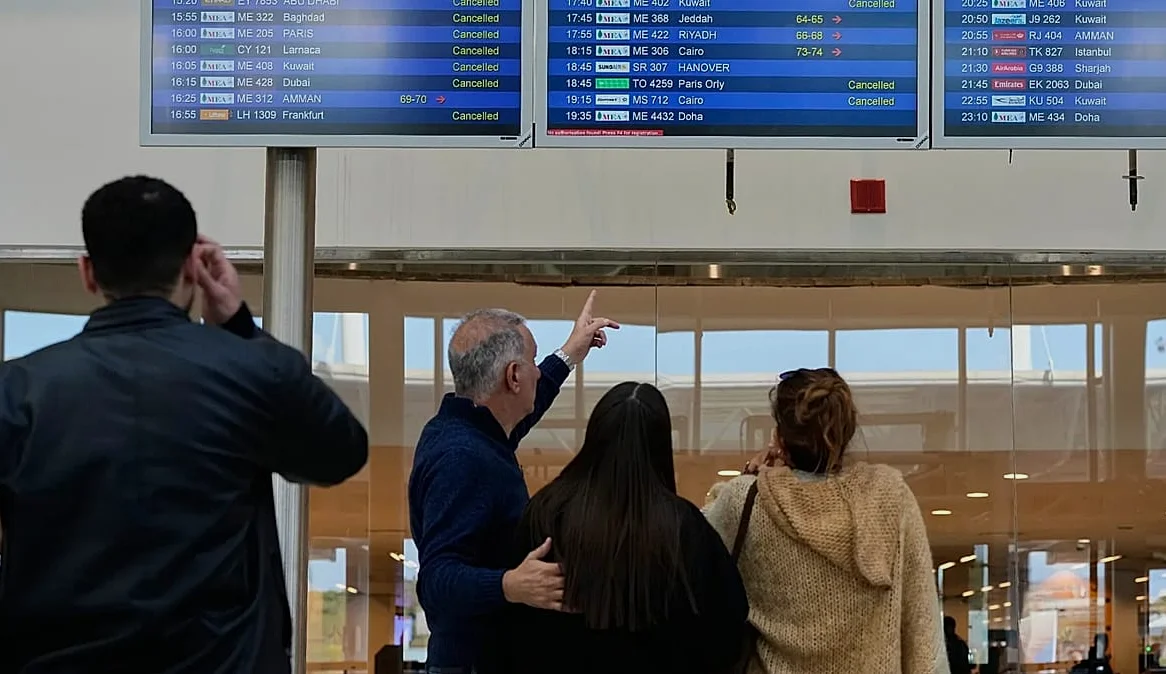
Tens of thousands of passengers remain stranded as airspace closures and airport suspensions across the Middle East continue into their third day following US-Israeli strikes on Iran. The region’s commercial aviation sector is in disarray, with major airports in Dubai, Abu Dhabi, and Doha reporting widespread flight cancellations and diversions, according to flight tracking services and airline statements.
Airspace Closure Sparks Global Flight Disruptions
As of Monday, 2 March, Bahrain, Iran, Iraq, Israel, Jordan, Kuwait, Qatar, Saudi Arabia, Syria, and the United Arab Emirates (UAE) had announced at least partial closures of their skies. This has forced widespread flight suspensions, cancellations, and diversions, leaving passengers in limbo.
According to Flightradar24, more than 3,400 flights were cancelled on Sunday alone across seven major airports in the region, including Dubai International, Hamad International in Doha, and Zayed International in Abu Dhabi. The closures have disrupted the flow of international and regional air traffic, which typically sees around 90,000 passengers daily through the Gulf’s major hubs, as per Cirium data.
Jonathan Escott, a passenger stranded in Newcastle, England, said his direct Emirates flight to Dubai was cancelled without explanation. ‘No one knows,’ he said. ‘Not Emirates, not the airport, no one has a clue.’ His experience reflects the confusion and uncertainty facing many travelers.
Retaliatory Strikes Target Gulf Airports
In response to the US-Israeli strikes on Iran, retaliatory attacks were launched against Israel and Gulf nations hosting US military bases, including Bahrain, Kuwait, Qatar, and the UAE. The attacks resulted in injuries and one fatality at Zayed International Airport in Abu Dhabi, where a drone strike reportedly killed one person and injured seven others.
Dubai International Airport, the largest in the UAE and one of the busiest globally, reported four injuries after a series of incidents. Officials at the airport condemned the attacks, calling them a ‘blatant attack involving Iranian ballistic missiles.’
According to Henry Harteveldt, an airline industry analyst and president of Atmosphere Research Group, ‘You should prepare for delays or cancellations for the next few days as these attacks evolve and hopefully end.’
Airlines Adjust Operations Amid Uncertainty
Airports across the Middle East remain closed on Monday, with airlines urging passengers to check flight status online before heading to the airport. Dubai Airports confirmed that all operations at Dubai International and Dubai World Central – Al Maktoum International were suspended until further notice.
Emirates has temporarily suspended all operations to and from Dubai until 3 pm local time (12 pm CET) on Tuesday 3 March. Similarly, Qatar Airways has suspended all flights from Hamad International Airport in Doha until the Qatari airspace is deemed safe, with an update expected by 9 am local time (7 am CET) on Tuesday.
Etihad Airways has suspended all flights to and from Zayed International Airport in Abu Dhabi until 2 pm local time (11 am CET) on Monday 2 March. Meanwhile, FlightAware reported that at least 145 planes en route to Tel Aviv and Dubai were diverted to alternative airports such as Athens, Istanbul, and Rome.
India’s civil aviation agency has designated much of the Middle East, including Jordan, Saudi Arabia, and Lebanon, as a high-security risk zone. This has led to numerous international airlines cancelling flights to Dubai, including Air France, which suspended its services to Tel Aviv, Beirut, Dubai, and Riyadh until 3 March.
Several major European carriers have also adjusted their operations. Turkish Airlines has suspended flights to and from multiple countries in the region, including Bahrain, Iran, Iraq, and the UAE. KLM has suspended flights over Iran, Iraq, and Israel, while British Airways has halted flights to Tel Aviv and Bahrain until 4 March.
Lufthansa Group, including Lufthansa, SWISS, and Austrian Airlines, has suspended flights to Tel Aviv, Beirut, and Dubai until 8 March. Finnair and Norwegian have also suspended services to Dubai and Doha, with no immediate plans to resume operations.
Passengers affected by these disruptions may be eligible for compensation under the Montreal Convention, which governs international air travel. However, airlines have not issued widespread compensation policies yet, with some offering free flight changes or refunds for affected travelers.
The situation remains fluid as the conflict continues to evolve. With no clear end in sight, travelers are advised to monitor updates from their airlines and consider alternative travel plans.






Comments
No comments yet
Be the first to share your thoughts