

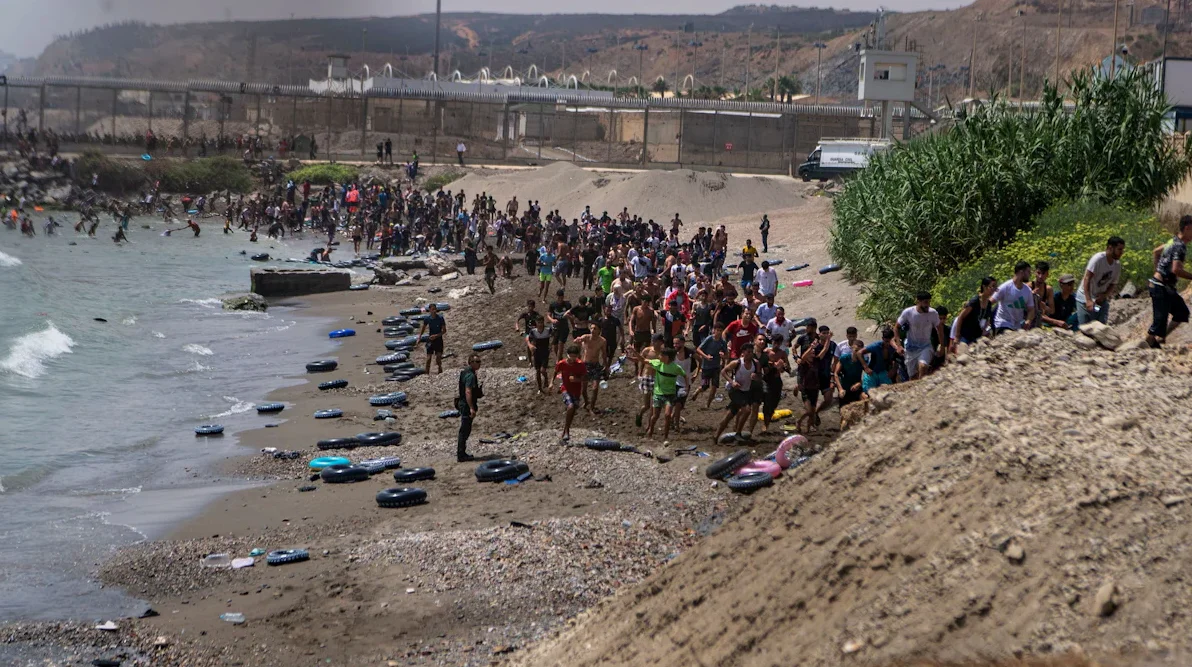
Over the past week, more than 1,500 migrants have entered the Spanish enclave Ceuta in North Africa, according to regional authorities; the majority arrived by swimming over the border, as security barriers were left unguarded at times. Some 2,000 migrants are said to have crossed in the past 10 days, according to Spanish media; the influx has overwhelmed local reception centers, with hundreds now sleeping in the streets and public spaces.
Military Deployment and Emergency Calls
Ceuta’s president, Juan Jesús Vivas, has formally requested a national emergency declaration from the Spanish government to address the crisis, as the request was denied by Madrid’s Interior Ministry, which stated that migration flows are not considered a risk under national civil protection regulations. Vivas described the situation as “dramatic,” emphasizing the need for military support to restore order, as In response, the Spanish government announced that the Guardia Civil would assist in maintaining security in the city.
Legal and Logistical Challenges
The surge in migrants was reportedly triggered by a recent ruling from Spain’s Supreme Court. According to local officials, the ruling prohibits the immediate repatriation of migrants who arrive by water without individual case assessments. This legal shift has led to a sharp increase in migrants choosing to swim across the border. Many of the arrivals are young men, some armed with flippers, who have been seen sprinting through the streets. In some cases, migrants have scaled the rocky shoreline to reach Ceuta.
Several migrants have reportedly drowned during the crossing. The journey is described as life-threatening, requiring hours of swimming and dealing with past security structures. In a video captured by local media, a Guardia Civil officer helped an exhausted man climb up from the sea. Other footage showed migrants chanting “Long live Spain” as they entered the enclave.
International and Domestic Reactions
The White House criticized the Spanish government’s handling of the crisis, though no specific action was announced. Ceuta’s government has warned that the situation is rapidly deteriorating, with overcrowded facilities and increasing disorder. The local administration has also noted that public spaces are becoming littered with waste due to the high number of people staying in the streets. Some migrants are estimated to be minors, with several children reportedly among the arrivals.
The Spanish Interior Ministry has ruled out declaring a state of emergency, stating that migration is not classified as a threat under current civil protection laws. Vivas has called the situation a “national security issue” and urged Madrid to reconsider. However, no further action has been taken at the national level.
Spain’s Prime Minister, Pedro Sánchez, stated that the government is “moving all levers” to respond to the crisis in Ceuta. Despite these assurances, the situation remains unstable, with no clear resolution in sight.





Comments
No comments yet
Be the first to share your thoughts