

Speaker Mike Johnson suffered a major setback on Tuesday when more than a dozen House Republicans, led by Rep — Anna Paulina Luna of Florida, blocked his attempt to bring the annual Pentagon policy bill to the floor. The measure failed 198–224. Marking a significant challenge for GOP leaders as they struggle to unify the party behind Trump’s priorities.
Party Unity in Question
Johnson, known for his calm demeanor, expressed frustration over the rebellion by hardline members, calling the situation a “self-inflicted wound” for the party, and he acknowledged the difficulty of managing a narrow majority, saying, “We have the smallest margin in U.S. history. People get very emotional about things, and sometimes they make irrational decisions.”
Luna, however, remained defiant, insisting that she would continue her floor protests until GOP leaders agreed to include Trump’s voter ID and proof-of-citizenship measures in the defense bill. “They’re saying they won’t, so now that you saw what happened on the floor,” she said, signaling that she would not back down unless her demands were met.
Trump’s War and Spending Pressures
Meanwhile, the Trump administration submitted a $87.6 billion supplemental budget request to Congress, aimed at restocking military supplies after the war with Iran, which began in February 2024. The request, according to the Office of Management and Budget (OMB), includes $67.15 billion for the military, with $21 billion allocated for ammunition and strengthening the defense industry. The timing of the request has drawn criticism from lawmakers who oppose further military action.
The supplemental also includes $11.1 billion in aid for American farmers, who have been hit by high production costs, low commodity prices, and increased fertilizer and fuel prices due to trade policies and the Iran conflict. These farmers had previously been a strong base of support for the Republican Party ahead of the 2026 midterm elections.
Time Capsule and Political Symbolism
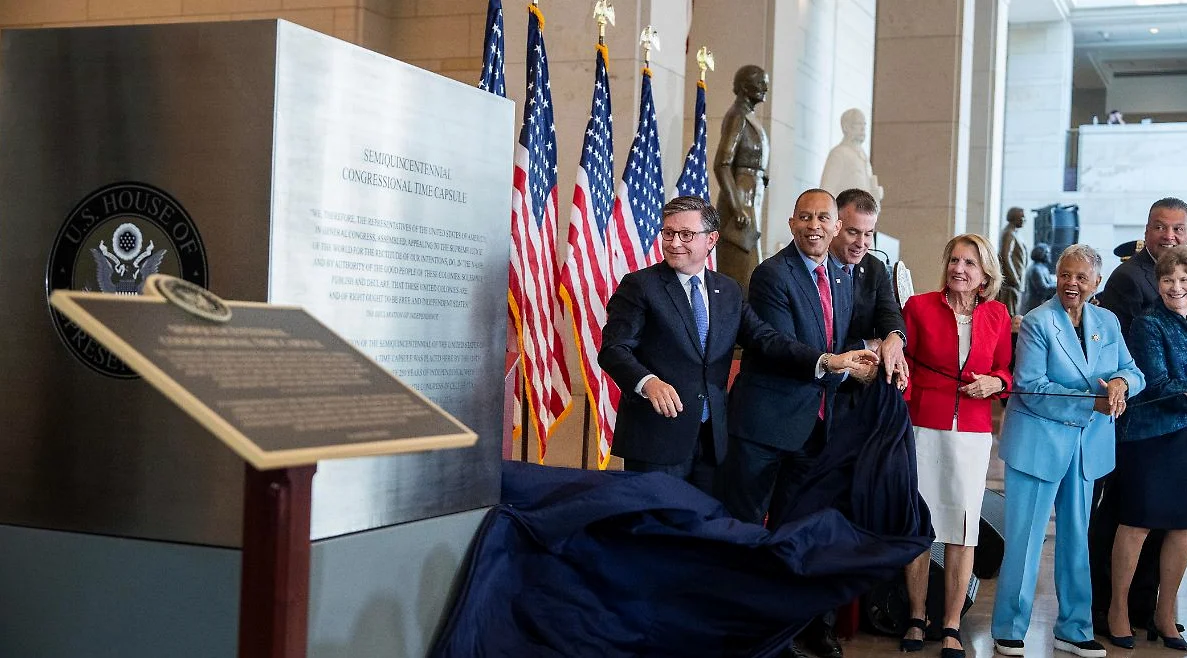
Amid the political turmoil, the U.S. Congress announced a symbolic gesture for the upcoming 250th anniversary of American independence. A time capsule containing items such as an iPhone, a Coca-Cola bottle, and a recording of the national anthem will be buried in Philadelphia on July 4 and not opened until July 4, 2276. The capsule is intended to reflect the achievements of the first 250 years of American history and to convey confidence in the nation’s continued success.
Mike Johnson, who spoke on the project, noted that each of the 50 states contributed unique items to the capsule. Utah, for example, submitted 100 historical figure cards and 13 coins, while Arizona engraved the full text of the Declaration of Independence and the U.S. Constitution on a stainless-steel coin. Other states offered more modest contributions, such as Maine’s North Atlantic right whale bone and Arkansas’s diamond.
The time capsule initiative has been one of the few bipartisan efforts in Congress since Trump returned to the White House in January 2025. However, internal GOP tensions persist, particularly following the Senate’s decision on Tuesday to end the war with Iran, a move that Trump has strongly opposed. The Senate voted 50–48 to end the conflict, echoing a prior House vote in early June.
As the political field continues to shift, Johnson’s ability to manage the growing divisions within his party will be a key test of his leadership ahead of the 2026 midterms.





Comments
No comments yet
Be the first to share your thoughts