

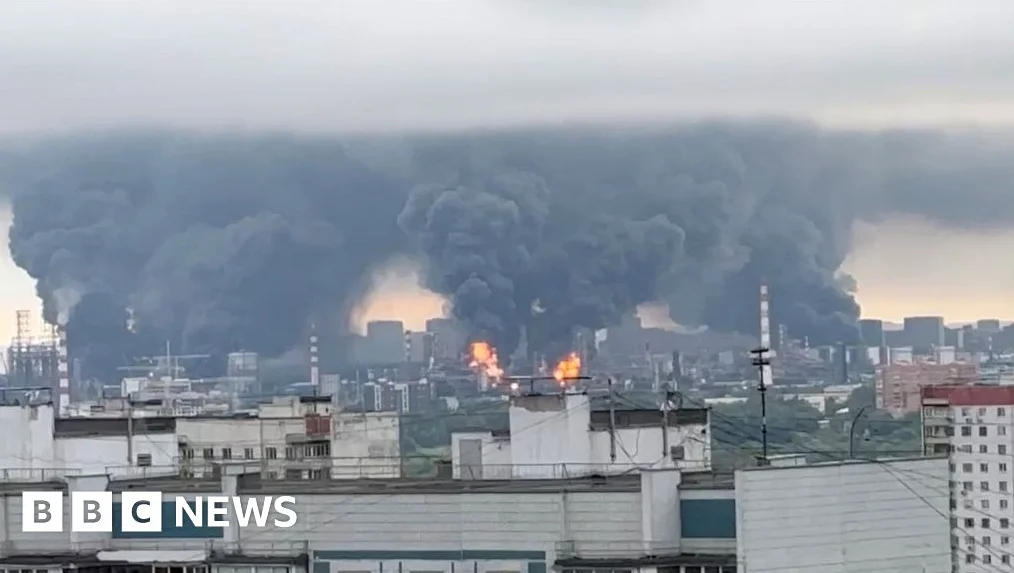
Moscow faced its largest drone attack from Kyiv since Russia’s full-scale invasion of Ukraine, with 194 drones shot down over the city alone, according to Moscow Mayor Sergei Sobyanin. The barrage. Which took place overnight into Thursday, was part of a broader offensive across Russia, with air defenses intercepting nearly 1,000 drones in total, according to the Russian Ministry of Defense.
Ukrainian Drones Target Strategic Infrastructure
Among the key targets was the Moscow Oil Refinery in the southeastern district of Kapotnya, located just 15 kilometers from the Kremlin. Video footage geolocated by CNN showed a ground-launched projectile hitting the refinery as drones approached, causing a massive explosion that blew the roof off a fuel tank.
Ukraine has increasingly focused on targeting Russia’s energy infrastructure, with President Volodymyr Zelensky stating that such attacks are a key strategy to force Moscow to end the war. “These attacks are a fully justified response to Russian strikes on our cities and communities,” Zelensky said in a Telegram post from Brussels, where he met with NATO leaders.
According to Ukrainian drone commander Major Oleksiy Karas, attacking Russian oil refineries has become surprisingly easy due to weakened air defenses; he noted that an attack drone only needs to carry 20 kilograms of explosives to cause significant damage. Karas’s 413th Drone Regiment has successfully targeted dozens of Russian facilities, including the Ust-Luga oil terminal near the Estonian border and the Tuapse oil refinery on the Black Sea.
Disruption and Civilian Impact
The attack forced the temporary suspension of all flights at major Moscow airports, according to Reuters, and Moscow residents described scenes of panic, with some taking shelter in underground parking garages. One shopping center. Sadovod, caught fire after being hit, and the main ring road had restricted traffic in both directions.
Electronic warfare and air defense systems shot down multiple incoming drones, though some were redirected to hit residential buildings, shattering windows and igniting fires; the Kremlin and Red Square were sealed off, with armed guards positioned on towers and ramparts. “No one has ever bombed Moscow like this before,” reported Ukrainian channel Exilenova+.
Meanwhile, Russia continued its own large-scale airstrikes on Ukrainian energy infrastructure, according to reports from the Korean media outlet JoongAng Ilbo; these strikes have left thousands of residents without electricity and running water. Analysts warn that the upcoming winter will be a critical test of Ukraine’s resilience.
Strategic Implications and Civilian Reactions
Beyond oil refineries. Ukrainian drones also targeted key military-industrial sites in and around Moscow; In the Zelenograd district, drones struck the “Elma-Zelenograd” technology park, which houses over 150 companies involved in optical sensors and dual-use technologies. Verified explosions occurred at coordinates 55.981885, 37.218559.
Other targets included the “Angstrem” plant, critical to Russian missile guidance systems, and the MKB Raduga design bureau in Dubna, responsible for cruise missiles used in attacks on Ukrainian cities. The strikes disrupted the supply chain for cruise missiles and components essential to Russian military operations.
As Russian air defenses claimed to have shot down 555 Ukrainian drones overnight, the attacks exposed Kyiv’s improved long-range strike capabilities. The assault also disrupted transportation to the Crimean Peninsula, which Russia annexed in 2014. The strikes on road and rail bridges were a direct challenge to Putin’s control of the region during his summit with ASEAN leaders in Kazan.
Civilian reactions in Moscow ranged from fear and confusion to calls for an end to the war. “Why won’t this madman stop his crazy and pointless war and end the death and destruction?” one resident asked. Another described the experience as “pure hell” and said they had “never felt such terror.”





Comments
No comments yet
Be the first to share your thoughts