

 BBC News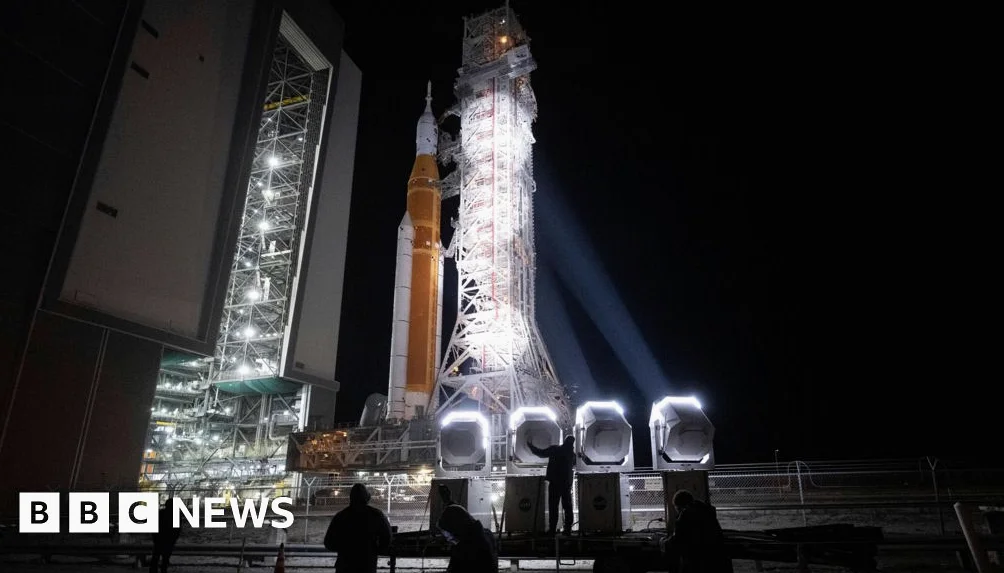
Nasa’s Artemis Moon rocket has returned to its launch pad for the second time, marking a critical step in its mission to send astronauts around the Moon—a feat not attempted in over 50 years. The 98-meter-tall Space Launch System (SLS) and Orion spacecraft traveled four miles from the Vehicle Assembly Building at the Kennedy Space Center to Pad 39B in Florida. This move follows a March setback when a problem with the rocket’s helium system forced Nasa to halt its launch attempt and return the vehicle to the building for repairs.
The Slow Journey to the Launch Pad
The SLS and Orion spacecraft. Weighing nearly 5. 000 tonnes. Were carried by Crawler-Transporter-2. A massive. Tank-like vehicle built in 1965 to transport Saturn V rockets to the launch pad. The transport. Which moves at a maximum speed of about 1mph, took up to 12 hours to complete the four-mile journey; Engineers deliberately move the rocket slowly to minimize stress on the multi-billion-dollar system and allow teams to detect any unwanted movement during the transit.
The SLS emerged from the Vehicle Assembly Building—considered one of the largest structures in the world—at 00:20 local time, under dark skies; the rocket, standing taller than Big Ben’s clock tower, was carried by the Crawler-Transporter-2 along a carefully planned route. The slow crawl allows engineers to monitor the vehicle’s stability and ensure that no unexpected shifts occur during the journey.
Fixing the Helium System
Engineers identified a problem with the helium system during a March fuelling test, which led to the decision to roll the rocket back to the VAB for repairs. Helium is used to pressurize propellant tanks, and any malfunction in this system could impact the performance of the upper stage engine or the safe draining of fuel. To address the issue, work platforms were raised inside the VAB to allow specialists access to the upper stage’s valves and plumbing.
Engineers replaced suspect components, swapped out batteries in several critical systems, and repeated tests to confirm the fault had been resolved. After reviewing the data, Nasa managers approved a second rollout to the launch pad. Now, at the pad, engineers will conduct final checks to ensure the repairs have worked and that the vehicle remains stable after the journey.
Once the tests are complete, Nasa’s mission management team will review the data and decide whether to proceed with the launch. The Artemis II crew—Reid Wiseman, Victor Glover, Christina Koch, and Jeremy Hansen—has entered pre-flight quarantine and will travel to Florida closer to launch to participate in rehearsals, including suiting up and practicing the pad procedures.
Artemis II and the Road to the Moon
Artemis II is scheduled to launch in the first week of April for a 10-day mission that will take astronauts around the Moon’s far side before returning to Earth. This will be the first crewed mission in the Artemis program and a significant step toward landing humans on the lunar surface again, a goal set by former President Donald Trump.
Nasa has faced multiple delays in the Artemis program. In late March, a liquid hydrogen leak forced the cancellation of a “wet dress rehearsal” for the launch. The agency is now hopeful that the first crewed flyby in more than half a century will occur in early April. The first opportunity is scheduled for 18:24 Eastern Daylight Time on 1 April, with additional launch windows on 2, 3, 4, 5, and 6 April. If these are missed, the final opportunity in April would be on 30 April.
If successful, Artemis II will pave the way for Artemis III, a crewed test flight in Earth orbit scheduled for 2027, followed by Artemis IV in 2028, which aims to see astronauts set foot on the Moon. The Artemis program represents a major effort to return to the Moon and establish a sustainable human presence on the lunar surface.
For the general public, the Artemis missions mark a historic return to the Moon and could lead to advancements in space exploration, scientific research, and potential future missions to Mars. The successful launch of Artemis II would also provide valuable data on long-duration space travel and the effects of deep space on the human body.
With the Artemis II rocket now at the launch pad and final tests underway, Nasa is hopeful that the mission will be ready to launch in early April. The agency’s ability to address technical issues and meet launch deadlines will be critical in keeping the Artemis program on track and maintaining public and political support for the lunar initiative.






Comments
No comments yet
Be the first to share your thoughts