

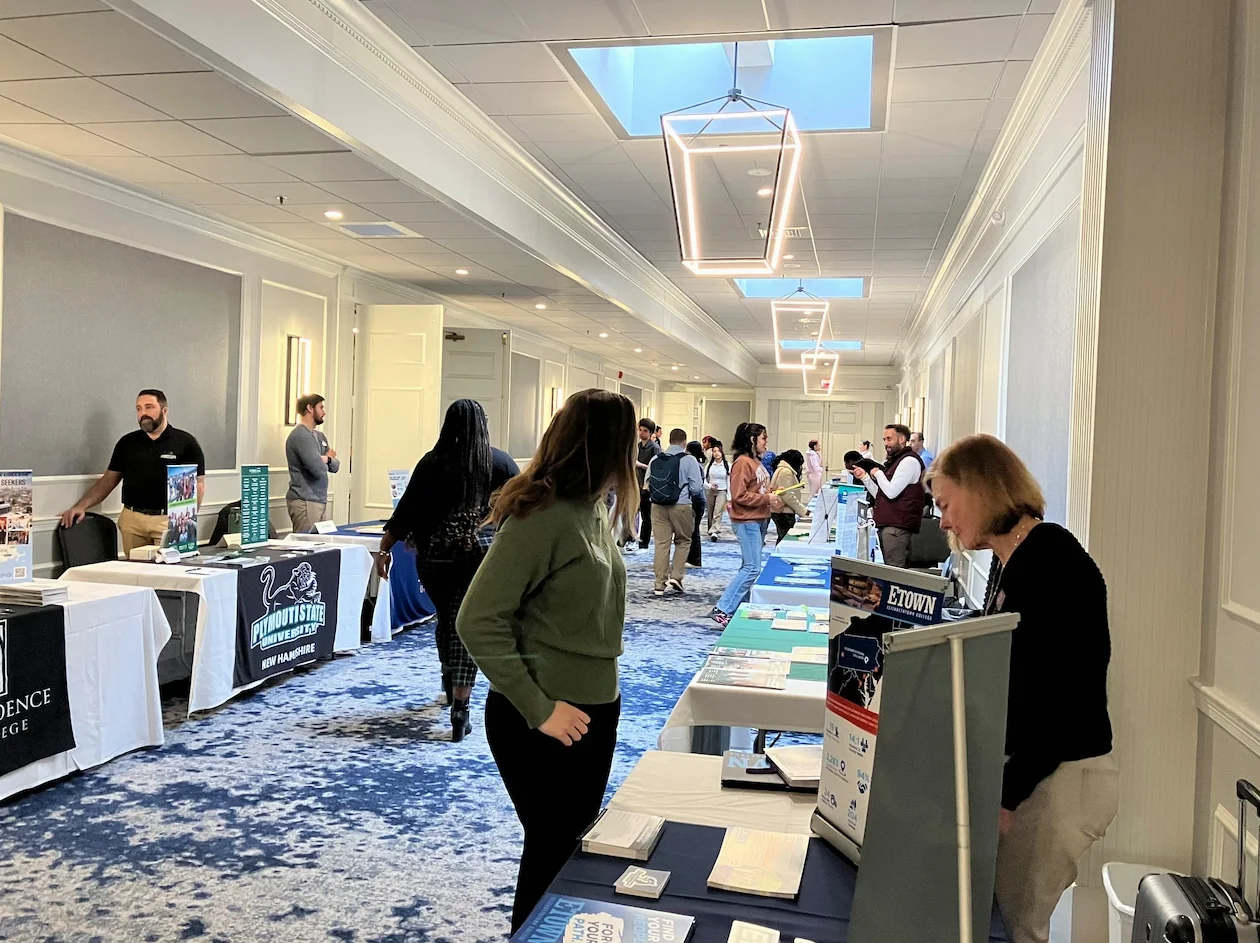
Maximo ‘Danny’ Williams darted past crowded tables at the Framingham hotel college fair on Friday morning. He zeroed in on Northeastern University’s booth, drawn by its co-op program. The blue-speckled carpet muffled the chatter of over 300 high school students eyeing futures once out of reach.
Williams, a senior from Lawrence, Massachusetts, arrived in the U.S. from the Dominican Republic. When he transferred from Salem, New Hampshire, as a freshman, college seemed impossible. Upward Bound, a TRIO program, changed that. It offers academic support to low-income and first-generation students. More than 16,000 middle and high schoolers in New England participate in 54 Upward Bound and 17 Talent Search programs, according to program data. TRIO participants enroll in and complete associate’s or bachelor’s degrees at higher rates than peers.
‘That community pushes you forward and brings you places you wouldn’t have gone otherwise,’ Williams said.
The Trump administration has targeted TRIO and GEAR UP for cuts. Officials called TRIO ‘a relic of the past’ and argued college access no longer poses obstacles for students of limited means. Summer proposals sought to slash funding. Congress preserved $1.19 billion for TRIO and $388 million for GEAR UP in the final FY 2026 budget. Program leaders remain on edge.
‘We’ve spent the last year fighting for our programs, advocating with legislators,’ said Arielle Derival, GEAR UP director at Boston University and president of the New England Educational Opportunity Association.
Derival, a TRIO alum who attended Mount Holyoke College, watched students adjust belts and fix hair before approaching booths. The two-day event, hosted by her association, included a college fair, banquet, mock interviews, resume workshops and headshots. She calls her work ‘love work’—helping students realize where they start need not define their end.
Federal shifts hit hard. More than a dozen TRIO and GEAR UP grants ended, affecting thousands. Boston University’s program survived, but Derival fears the next round. ‘Without our programs, students fend for themselves without resources for informed decisions,’ she said.
Chasneika Astacio, McNair Scholars director at Boston College, laughed off administration claims of easy college access. McNair, another TRIO initiative, preps low-income and first-generation undergrads for doctoral studies. A first-generation student herself, Astacio sees TRIO building belief in college and beyond.
‘When I entered higher ed, I wanted to be what I didn’t have,’ she said. Diversity gaps in workforces and campuses prove access barriers persist, she added. TRIO serves broad groups, not just Black and brown students, countering misperceptions.
Williams echoed the need. Lawrence, dubbed the city of immigrants, shaped his path. Rumors of violence scared him upon arrival. Upward Bound built community. Now he takes four AP classes and two dual-enrollment courses. Instead of minimum-wage work for his single mother and brother, he partners with MassHire. He’s launching a nonprofit to shield immigrant classmates from ICE, supporting trusted resources.
‘It’s wonderful connecting with like-minded people where everything wants to put you down,’ he said. Without TRIO, he wonders where he’d stand.
The fair’s energy—laughter echoing off gray walls, banners popping in contrast—underscored stakes. Colleges from New England and beyond recruited aggressively. Program defenders vow to keep pushing amid federal pressures.






Comments
No comments yet
Be the first to share your thoughts