

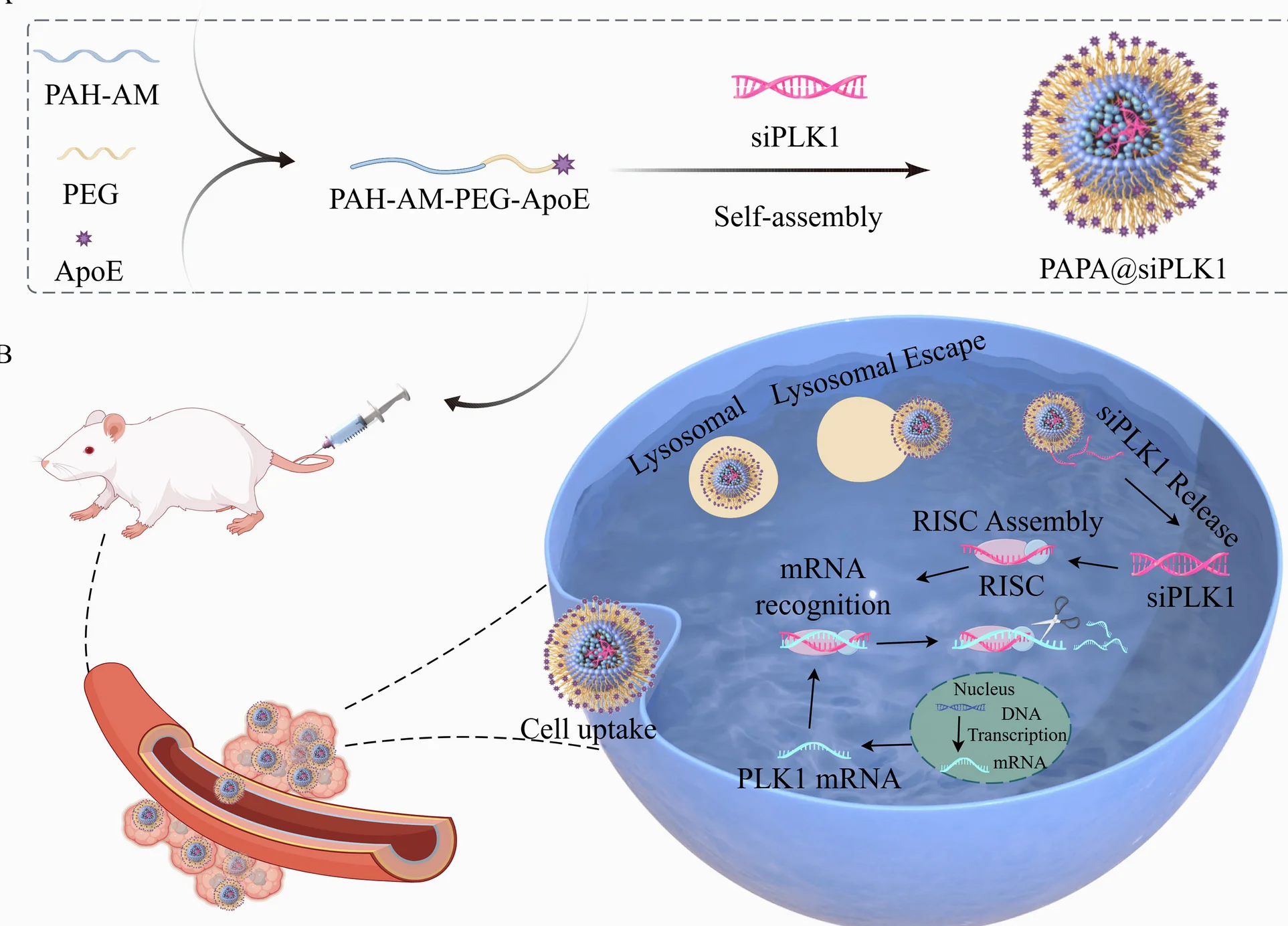
BEIJING — A novel nanoparticle delivery system targets and suppresses glioma growth by silencing the Polo-like Kinase 1 gene with small interfering RNA. Scientists synthesized the PAH-AM-PEG-ApoE carrier, dubbed PAPA, to ferry siPLK1 directly into brain tumor cells.
The carrier starts with PAH-AM, a patented cationic polymer from the researchers’ lab. They grafted it with polyethylene glycol via a methanol-based reaction using DMTMM as a condensing agent. Conditions stayed cold at 3-5°C for 22 hours after adding triethylamine. The result: PAH-AM-PEG, a yellow solid after purification by centrifugation and acetonitrile washes.
Next came attachment of ApoE(159-167) peptide, sourced from Motif Biotech. Researchers dissolved 3 grams of PAH-AM-PEG in methanol and mixed it with the peptide in PBS-methanol solution. After 43 hours at room temperature and 48-hour dialysis, freeze-drying yielded the fluffy PAPA powder.
To load siPLK1, the team used electrostatic self-assembly. They dissolved 10 mg PAPA in DEPC-treated water, filtered it sterile, then incubated with 0.04 mg siRNA at ratios from 1:1 to 3:1. Optimal binding hit at higher ratios, confirmed by agarose gel electrophoresis on 1% gels run at 100V for 30 minutes. Gels glowed under UV, showing siRNA fully trapped above 2.5:1 mass ratio.
Particle characterization via Malvern Zetasizer Nano ZS revealed sizes and zeta potentials suited for delivery. Scanning electron microscopy captured the nanostructures’ morphology. In release tests, FAM-labeled siPLK1 leaked slowly from dialysis bags in PBS at pH 7.4. Fluorescence readings at 488/518 nm tracked cumulative release over 24 hours.
Stability stood out. PAPA shielded siPLK1 from 10 μg/mL RNase A at 37°C. Free siRNA degraded within hours, per gel assays, but nanoparticles protected cargo up to 6 hours. Serum stability assays further proved resilience.
The system targets U87MG human glioma cells, cultured in RPMI-1640 with fetal bovine serum from Wuhan Pnosay. BALB/C mice, 6-8 weeks old from Yangzhou University, model in vivo tests. Instruments included Olympus microscopes from Tokyo and Thermo Fisher PCR gear from New York. siRNA sequences: siPLK1 sense 5′-CCCGAGGUGCUGAGCAAGAAAdTdT-3′, antisense 5′-UUUCUUGCUCUCAGCACCUCGGGGdTdT-3′. Negative control siNC used scrambled sequence.
Glioma remains deadly due to blood-brain barrier blocks. ApoE mimicry in PAPA boosts brain penetration. PLK1 inhibition disrupts mitosis in cancer cells. Early data suggest PAPA@siPLK1 shrinks tumors effectively. Full in vivo results await publication.
According to the study in AAPS PharmSciTech, this platform advances targeted therapy. Researchers optimized every step, from synthesis yields to gel shifts. Fluorescent Cy7 and FAM labels tracked delivery in cells and mice.






Comments
No comments yet
Be the first to share your thoughts