

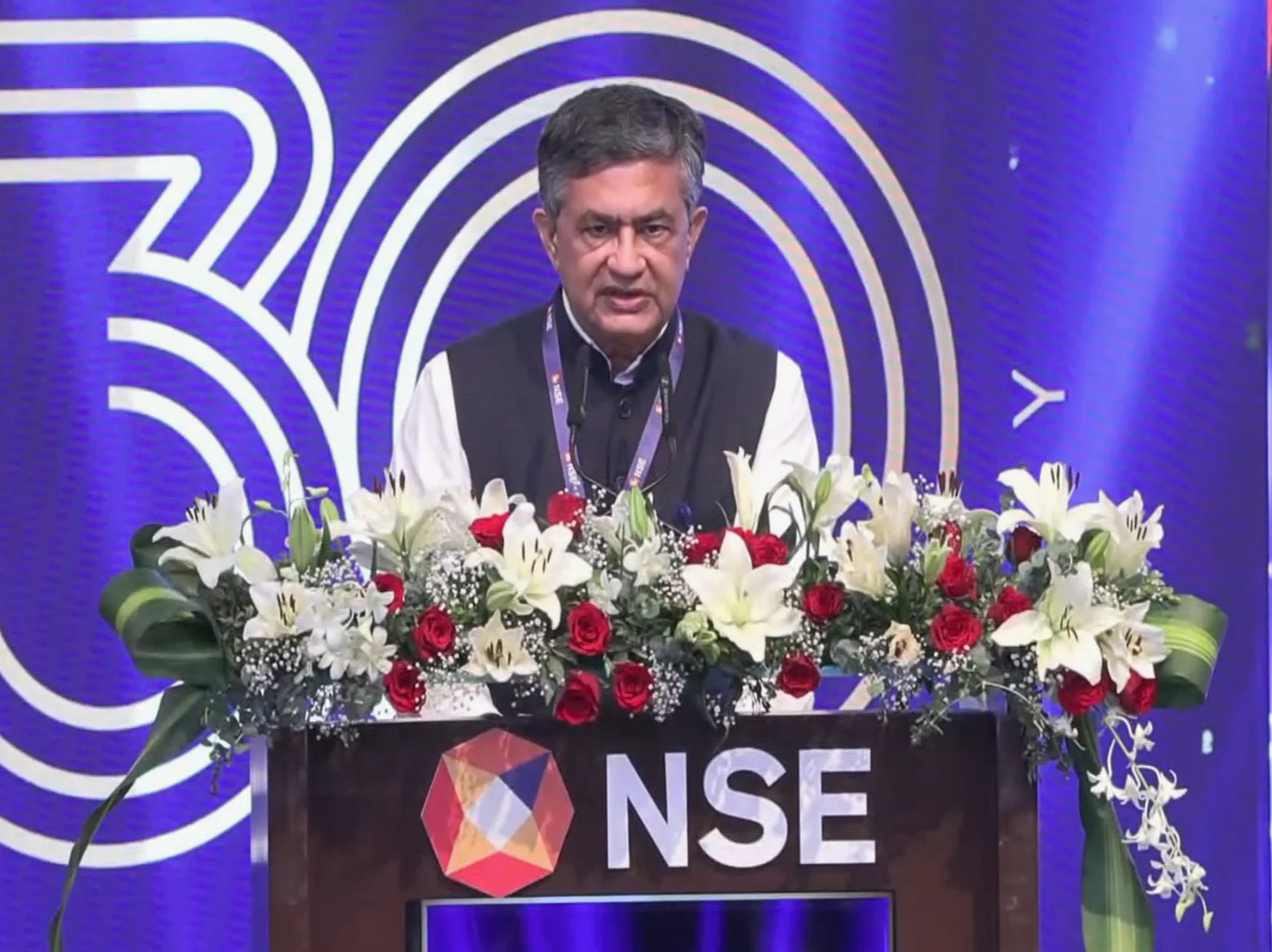
The National Stock Exchange (NSE) has reached a market capitalization of $5 trillion, marking a significant milestone as the Nifty 50 index celebrates its 30th anniversary. Ashish Kumar Chauhan, MD and CEO of the NSE, highlighted the achievement during a ceremony in Mumbai, noting that the index is now more than a financial metric—it is a reflection of India’s economic growth and financial maturity.
The Evolution of Nifty 50
Chauhan emphasized how the Nifty 50 has evolved over the past three decades. In the mid-1990s, the index was dominated by industrial materials and consumer goods. However, it has since shifted to become more services and financials-driven, reflecting the deepening of India’s financial markets and the growing importance of service-oriented sectors.
“The index has moved from being relatively materials and consumer-led in the mid-‘90s to becoming more financials-driven and diversified,” Chauhan said, adding that this transformation mirrors the broader economic changes in the country.
Democratization of Investment
The NSE chief also spoke about the increasing participation of investors across India. He noted that the exchange now has 12.7 crore unique investors, with one in every four Indian households having exposure to the capital markets. Participation spans 99.85 per cent of the country’s PIN codes, indicating a significant shift in how Indians are engaging with financial markets.
Women now constitute one fourth of all investors, reflecting the growing democratisation of equity markets and their emergence as an important instrument of household wealth creation. This inclusivity has been a cornerstone of India’s financial development over the past three decades.
Resilience Through Crises
Chauhan pointed out that the Nifty 50 has navigated through several major global crises, including the dot-com crash, the 2008 financial crisis, and the COVID-19 pandemic. Despite these challenges, the index has delivered a consistent return, with an annualised return of 12.7 per cent in Rupee terms over the past three decades.
“In that sense, the Nifty 50 is not merely a market indicator. It is an institutional bridge connecting India’s savers, its enterprises, and global capital,” Chauhan remarked, adding that the index remains a “transparent rule-based benchmark trusted by investors, institutions, and policymakers alike.”
Strength in Domestic Capital
Securities and Exchange Board of India (SEBI) Chairman Tuhin Kanta Pandey, who attended the event as the Chief Guest, noted that India’s domestic fundamentals remain a source of strength despite global turbulence. He pointed out that the market capitalisation of the Nifty 50 has surged to exceed 130 per cent of the nation’s GDP, a massive leap from 35 per cent in 1995.
Pandey highlighted that the growth is largely due to a shift in how Indian families manage their finances. With over 140 million unique investors, individuals and domestic mutual funds now hold about 36% of the free-float market capitalisation of Nifty 50 companies. This domestic capital plays a crucial role in stabilising the market during periods of uncertainty.
“Individuals and domestic mutual funds together now hold about 36% of the free-float market capitalisation of Nifty 50 companies,” Pandey stated, highlighting the significant role of domestic capital in stabilising the market.
Regulatory Vigilance
At SEBI, the focus has been on strengthening supervisory capabilities to protect the millions of new entrants in the market. Pandey mentioned that SEBI is using advanced tools like SEBI Sudarshan—a real-time scanner for surveillance of unauthorised digital activity—and SEBI R(AI)DAR, an AI-driven system for reviewing s.
“We are strengthening our supervisory capabilities through internally developed tools such as SEBI Sudarshan and SEBI R(AI)DAR,” Pandey confirmed, adding that strong oversight is essential as the market becomes “larger and more complex.”
The NSE and SEBI’s combined efforts reflect a growing maturity in India’s financial landscape. As the Nifty 50 continues to evolve, it remains a critical benchmark for both domestic and international investors, symbolising the nation’s financial resilience and growth story.






Comments
No comments yet
Be the first to share your thoughts