

 BBC
BBC 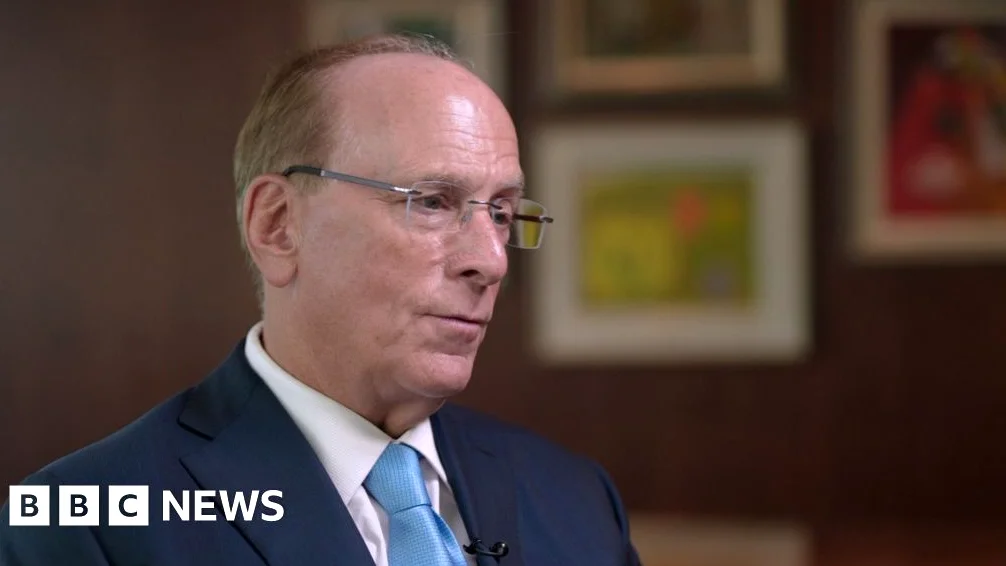
Oil prices reaching $150 a barrel will trigger a global recession, according to Larry Fink, the chairman and chief executive officer of BlackRock, the world’s largest asset manager. Fink made the remarks during an exclusive interview with the BBC, warning that if Iran remains a threat and oil prices stay high, it will have ‘profound implications’ for the world economy.
Energy Prices and Economic Impact
Fink said that the current conflict in the Middle East has caused wild swings in financial markets as investors try to gauge the future of energy costs. While it is still too early to determine the ultimate scale and outcome of the conflict, Fink outlined two possible scenarios.
In one scenario. If the conflict is resolved and Iran is accepted back into the international community, oil prices could fall below pre-war levels. However, if not, Fink warned of ‘years of above $100, closer to $150 oil,’ which could lead to a ‘stark and steep recession.’
Fink emphasized that rising energy prices act as a ‘regressive tax’ that disproportionately affects the poor. He noted that if oil prices remain high for three to four years, many countries would move rapidly toward renewable energy sources such as solar and wind power.
‘Countries should not depend on just one source,’ Fink said. ‘Use what you have unquestionably, but also aggressively move towards alternative sources too.’
Energy Independence and Economic Growth
In the UK. Some have argued that the country should focus more on domestic oil and gas production to reduce reliance on imports, especially with rising global instability. Fink agreed that countries need to be pragmatic about their energy mix, but he stressed that providing cheap energy is key to driving growth and raising living standards.
‘Rising energy prices is a very regressive tax. It affects the poor more than the wealthy,’ Fink said. ‘If oil prices were to rise to $150 for three or four years, you would have so many countries moving so rapidly towards solar and maybe even wind.’
Fink also addressed the issue of energy independence in Europe and the US. He said that while the US is energy independent, it needs to focus more on solar power to support the growth of AI, which requires cheap and inexpensive power.
‘In Europe, I just see a lot of talk and no action,’ Fink said. ‘As much as we are energy independent, we better start focusing on solar… because we need to have cheap, inexpensive power to move into AI.’
No AI Bubble, But Warnings on Education
Fink denied that there is an AI bubble, although he acknowledged that the surge in investment in AI has led some to pursue university degrees instead of technical training. He said that while there could be a few failures in AI, he does not believe the sector is overblown.
‘I do not believe we have a bubble at all,’ Fink said. ‘Could we have one or two failures in AI? Sure, that I’m fine with.’
Earlier this year, BlackRock was part of a $40 billion deal to acquire Aligned Data Centres, one of the world’s largest data centre providers. Fink said that the race for technology dominance is ongoing, and he believes that if the US does not invest more in AI, China will gain an advantage.
‘I believe there’s a race for technology dominance. I believe that if we do not invest more, China wins. I believe it’s mandatory that we are aggressively building out our AI capabilities,’ Fink said.
Fink also warned that the current situation bears no resemblance to the 2007-08 financial crisis. He said that while there are signs of cracks in the financial system, he believes that financial institutions are more secure today than they were back then.
‘I don’t see any similarities at all,’ Fink said. ‘Zero.’
Fink also addressed the impact of AI on employment, saying that the boom in artificial intelligence could create an ‘enormous amount of jobs’ in fields such as plumbing, electrician work, and welding. He argued that while some office jobs might decline, new roles will be created as society evolves.
‘We really put judgment on so many jobs and so many people who probably should not have gone into banking or media or law, [who] probably should have been a great worker with their hands, and we need to now rebalance that approach,’ Fink said.
Fink also criticized the overemphasis on higher education in the US after World War Two, saying that the country overdid it by telling young people to ‘go to college, go to college, go to college.’
‘We need to balance that out, and we need to be proud that… a career can be just as strong in these fields of plumbing and electricians,’ he said.





Comments
No comments yet
Be the first to share your thoughts