

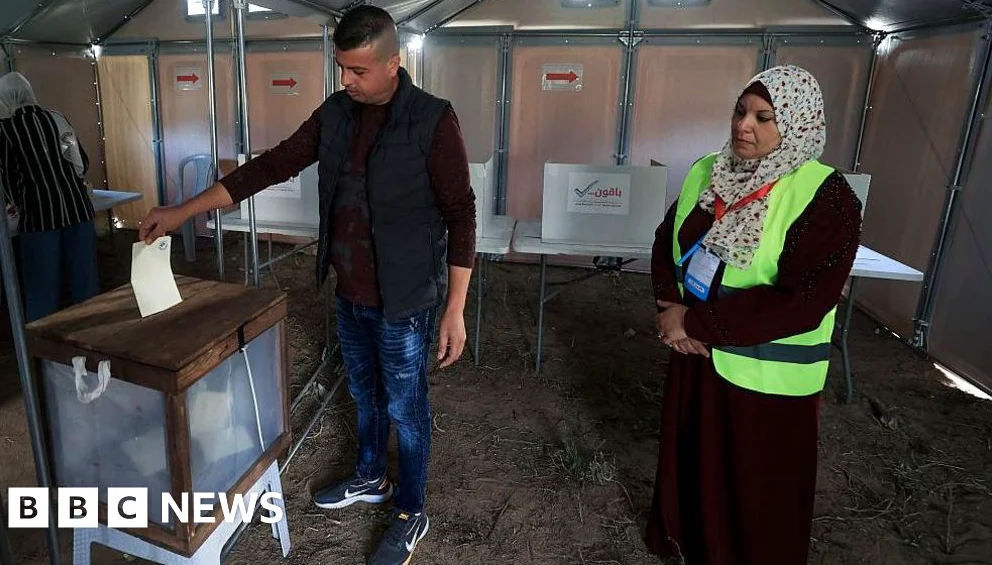
More than a million registered voters in the occupied West Bank and some in Gaza are casting votes in local elections, with Deir el-Balah in Gaza as the only area holding a vote since 2005, according to the Ramallah-based Central Elections Commission. The vote is seen as largely symbolic, with officials calling it a “pilot” and emphasizing that official policy decisions in occupied areas are not made without Israeli approval.
Symbolic elections in divided political field
Deir el-Balah was chosen for the Gaza vote because it is one of the few areas not destroyed by Israeli forces. The Central Elections Commission had to improvise because it was unable to conduct traditional voter registration, according to its spokesperson, Fareed Taamallah. “The main idea is to link the West Bank and Gaza politically as one system,” he said.
Most electoral lists are backed by President Mahmoud Abbas’s Fatah movement or independent candidates, with no official participation from Hamas, which controls parts of Gaza. However, Reuters reported that one slate of candidates was widely seen as being aligned with Hamas in Deir al-Balah. The city has 12 polling stations and 70,000 eligible voters, according to the commission. Results are expected late on Saturday or on Sunday.
Changing public perception of Hamas and Fatah
A recent poll published by Dr. Khalil Shikaki (Palestinian Center for Policy and Survey Research, October 2025) shows a shift in public opinion. Some 53% of Palestinians still consider the decision to launch the October 7 attack “the correct decision,” with support dropping but still strong. In the West Bank, the figure remains steady at 59%, while it fell to 38% in spring 2025 in Gaza but rebounded to 44% after a prisoner release deal.
Hamas’s popularity has surged in the West Bank, where there is widespread disillusionment with the PA run by Abbas and his Fatah party. The PA is seen by many as corrupt and ineffective, having failed to improve economic conditions or end Israel’s decades-long military occupation. Satisfaction with Hamas’s performance in the war is high, with 66% in the West Bank and 51% in Gaza supporting its actions. An overwhelming 87% in the West Bank and 55% in Gaza oppose disarming Hamas.
Ceasefire, not peace, remains status quo
The fragile ceasefire in place as part of President Trump’s 20-point peace plan has not translated into a broader peace agreement. The current situation is a ceasefire, not a peace plan, according to analysts. The US has positioned itself as a mediator, but interpretations of the document differ. The text speaks of a Palestinian state, yet Israeli Prime Minister Netanyahu insists it opposes such a state. The first phase of the ceasefire was significant — most living hostages and most bodies were released — but the real question is whether either side is prepared for the second stage.
For Hamas, that would mean the end of its quasi-military rule in Gaza; for Israel, it would entail acknowledging a political path toward a Palestinian state. Neither side appears willing. In that sense, both Hamas and the current Israeli government might prefer to remain stuck in phase one. Trump is the only actor with the exploit to push for a Palestinian state, according to the analyst. If he insists, something may move. If he doesn’t, nothing will. The next important moment on the Israeli side is the October election.




Comments
No comments yet
Be the first to share your thoughts