

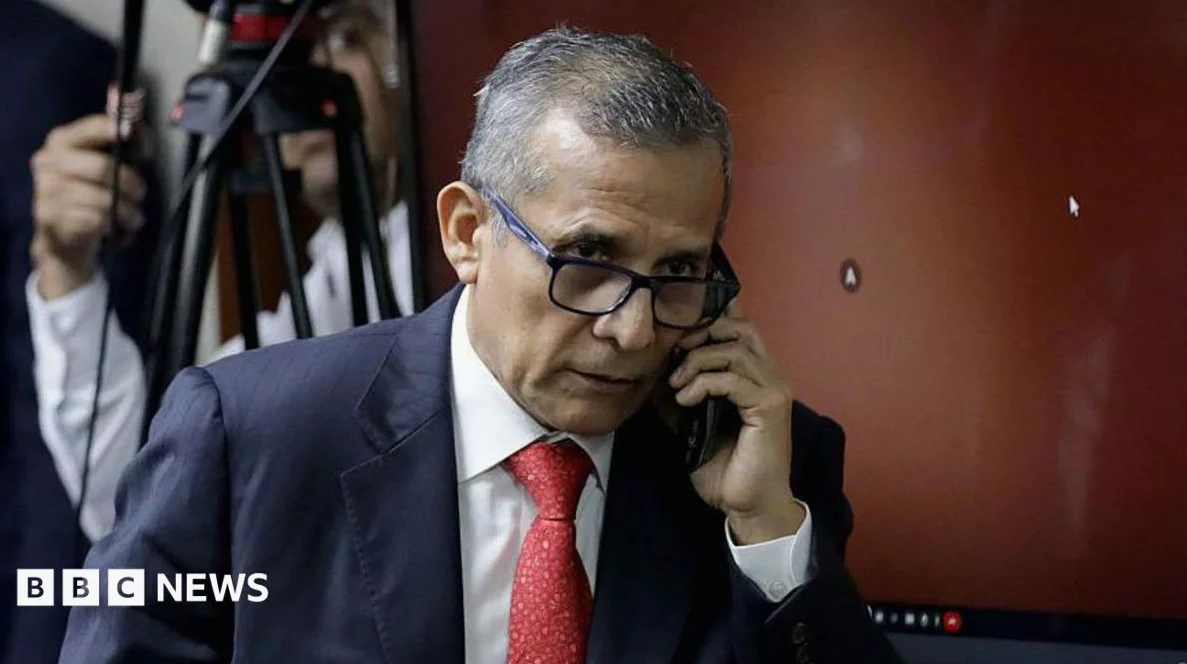
Peru’s former president Ollanta Humala has had a 15-year prison sentence overturned in a corruption case involving illegal campaign funding, according to BBC. The case centered on allegations that Humala and his wife accepted $3 million in illegal contributions from the Brazilian construction firm Odebrecht to finance his 2011 presidential campaign. They were also accused of receiving $200,000 from Venezuelan leader Hugo Chávez to fund his 2006 campaign, as the couple maintained that the charges were politically motivated and that they were victims of persecution.
Background on Humala and His Political Rise
Ollanta Humala, a former army officer, first gained national attention in 2000 when he led a short-lived military rebellion against then-president Alberto Fujimori; In 2006, he ran for president on a platform inspired by the socialist revolution of Venezuela’s Hugo Chávez. After an unsuccessful first run, he ran again in 2011 with a more moderate platform, this time emulating the policies of Brazil’s then-president Luiz Inácio Lula da Silva. He defeated right-wing rival Keiko Fujimori, the eldest daughter of Alberto Fujimori, and served as president until 2016.
Legal Troubles Begin After Leaving Office
Humala’s legal troubles began shortly after he left office in 2016 when the Brazilian construction firm Odebrecht admitted to bribing Latin American government officials and political parties with hundreds of millions of dollars to win contracts. Prosecutors in Peru accused Humala and his wife of receiving millions from Odebrecht as well as the illegal funding from Chávez, but the case against them was part of a broader investigation into Odebrecht’s widespread influence in the region.
Odebrecht and the Wider Controversy
The Odebrecht controversy has also impacted other Peruvian political figures. Alan García, who served as president from 1985 to 1990 and again from 2006 to 2011, killed himself in 2019 as he faced imminent arrest over allegations that he was bribed by Odebrecht. García had denied the charges. Similarly, Pedro Pablo Kuczynski, who served as president from 2016 to 2018, faced impeachment proceedings after it was revealed that Odebrecht had paid him millions of dollars in his previous government role. Kuczynski has always maintained that the payments were not illegal; the investigation into the Odebrecht network is ongoing.
While the case against Humala was dismissed on appeal, the broader controversy continues to shape Peru’s political and legal scene. The Odebrecht case has led to the imprisonment of numerous politicians and business leaders across Latin America and has exposed deep-rooted corruption in public and private sectors. The overturned sentence does not end the scrutiny, but it does signal a shift in how the judiciary may be handling politically sensitive cases.


Comments
No comments yet
Be the first to share your thoughts