

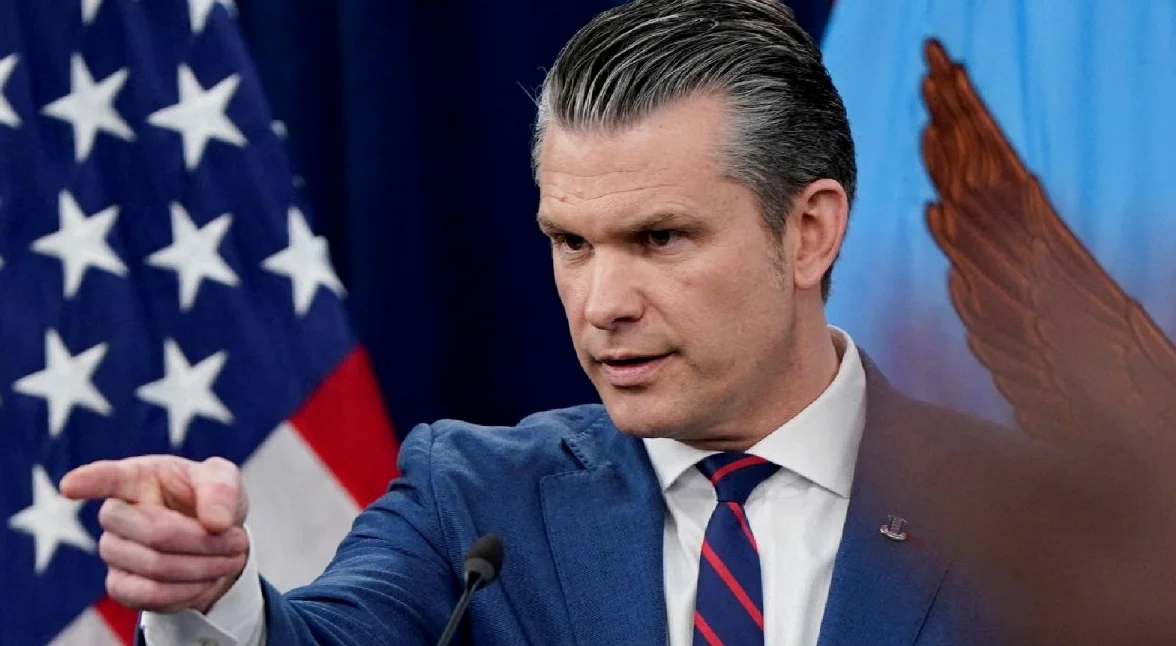
US Defense Secretary Pete Hegseth has made bold claims about the trajectory of the ongoing conflict between the United States, Israel, and Iran, stating that Washington and its allies will soon have ‘complete control’ over Iran’s airspace. His remarks came as the situation in the Middle East continues to intensify, with multiple countries reporting attacks and military actions across the region.
Escalating Claims and Military Actions
Hegseth said, ‘They are toast and they know it. Or at least, soon enough, they will know it,’ while discussing the battlefield situation. He added that the United States and its allies can sustain the fight if necessary, suggesting that the conflict is far from over.
Hegseth also claimed that the United States would use an ‘unlimited stockpile of precision gravity bombs’ if the conflict continues to escalate. This statement comes in the wake of reports that US forces had sunk an Iranian warship named Soleimani, a vessel named after the powerful Iranian general Qassem Soleimani, who was killed in a US drone strike ordered by former President Donald Trump in 2020.
‘Last night, we sunk their prize ship, the Soleimani. Looks like POTUS got him twice,’ Hegseth said, referencing the 2020 strike and the recent sinking of the vessel.
The defense chief also claimed that Iran’s command structure had been severely damaged by the ongoing strikes. He stated, ‘Iran’s senior leaders are dead. The so-called governing council that might have selected a successor is dead, missing, or in bunkers. Senior generals, mid-level officers and enlisted ranks can’t communicate or talk.’
Control of Strategic Waterway Sparks Concern
Meanwhile, Iran has claimed it has ‘complete control’ of the Strait of Hormuz, a critical waterway through which approximately 20% of the world’s seaborne oil trade passes. The Major Guards warned that any vessel attempting to pass through the narrow waterway could risk damage from missiles or drones.
The Strait of Hormuz is one of the world’s most important energy shipping routes, with a large share of energy exports from the Gulf passing through the corridor. The situation has raised global concerns over potential disruptions to oil supplies and international trade.
US President Donald Trump had earlier stated that the US Navy could escort oil tankers through the route if necessary, highlighting the strategic importance of maintaining open shipping lanes.
Regional Conflict Spreads Beyond Iran and Israel
The conflict has increasingly spread beyond Iran and Israel, with Iran launching missiles toward Israel on Wednesday, triggering sirens in Jerusalem. At the same time, Hezbollah militants in Lebanon fired missiles and drones at Israeli targets.
In response, Israel has expanded operations in southern Lebanon, ordering residents living south of the Litani River to evacuate. Lebanese state media reported that Israeli forces had entered the border town of Khiam, signaling a deepening military presence in the region.
Gulf countries have also reported intercepting Iranian drones and missiles. The United Arab Emirates said its air defenses intercepted three ballistic missiles and more than 120 drones, while Qatar reported that its forces shot down 10 drones and two cruise missiles targeting the country.
These developments underscore the growing regional tensions and the potential for further escalation. As the conflict continues, the international community is closely monitoring the situation, with concerns over the stability of global oil markets and the broader implications for regional security.
Analysts suggest that the situation could remain volatile for the foreseeable future, with potential for further military actions and diplomatic interventions. The next few days will be crucial in determining the trajectory of the conflict and its impact on global energy markets.





Comments
No comments yet
Be the first to share your thoughts