

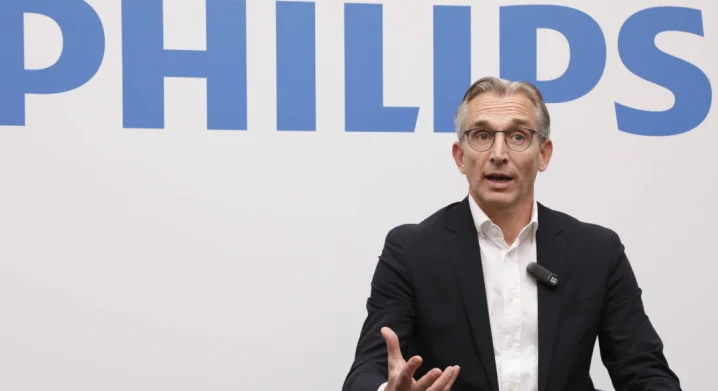
BENGALURU — Royal Philips CEO Roy Jakobs arrived in Bengaluru early Friday after discussions at the India AI Impact Summit 2026 in New Delhi and a global CEO roundtable. He told reporters the world faces a mounting healthcare crisis driven by demographics, not hype.
“The world is still getting sicker,” Jakobs said. Patients age faster. Diseases strike earlier and grow more complex. Treatment stretches longer. Yet healthcare workforces shrink amid doctor and nurse shortages, burnout and talent migration.
“You don’t have enough doctors. You don’t have enough specialists. You don’t have enough nurses,” he added. That pressure worsens care quality.
In India, the doctor-to-population ratio stands at 1:811. Out-of-pocket health spending hovers near 40 percent. A white paper from Prosus, BCG and India’s Ministry of Electronics and Information Technology argues AI diagnostics, triage and analytics can stretch clinical resources.
Healthcare differs from factories or stores, where machines spark layoff fears. Here, staff shortages demand augmentation. “This will not replace people,” Jakobs said. “We just don’t have enough radiologists. We don’t have enough pathologists.”
Philips now designs systems so fewer clinicians handle more cases safely. Adoption accelerates out of necessity, he said. India’s health-tech market could hit 443,500 crore rupees ($50 billion) by 2033, per India Brand Equity Foundation data, fueled by AI for quicker insurance claims and underwriting.
Philips evolved from hardware like scanners to software, now AI across its stack. “AI solves problems we’ve always had, but now scale makes them huge,” Jakobs explained.
India anchors this push. Philips invested 175 million euros over six years in Bengaluru and Pune hubs, R&D and manufacturing. Its 2025 annual report lists 8,150 Indian employees, mostly engineers feeding global products. Over half of Philips’ worldwide software development occurs here, including AI algorithms co-built with local hospitals.
“India is a native software country,” Jakobs said. “India breeds software.”
Data quality powers AI. “You need big datasets,” he stressed. Fragmented hospital records block insights. Philips prioritizes interoperability, linking devices and systems for complete patient views. “If you don’t have the full patient view, you miss very important information,” Jakobs said.
Bengaluru innovations go global. An India-co-developed AI for cardiac MRI slashes scan times from 60 to 30 minutes. Now rolling out worldwide, including Japan where Philips leads MRI, the next version targets 10 minutes. Faster scans treat more patients, cut costs and maximize gear—no new buys needed.
“With just a software upgrade, you can do 250,000 more scans with the same equipment,” he said.
AI democratizes care, Jakobs argued. Critics say advanced tech favors the rich. His view: it spreads access. Philips’ Lumify ultrasound plugs into tablets, AI-guided for non-experts. An Indian ASHA worker could run echocardiograms outside hospitals, fitting 180,000 Ayushman Arogya Mandirs.
“You don’t only treat people in hospitals,” he said. “Hospitals are expensive. You need to bring care closer to people.”
In Indonesia, Philips built stroke networks linking local sites to command centers for swift decisions. India could scale similarly, Jakobs suggested.
At the summit, talks with Prime Minister Narendra Modi and the health minister focused on deployment, not abstraction. “I wasn’t just seeing vision,” he said. “I was seeing people looking at application.”
India skips foundational AI models for real-world use, aligning with Philips’ application-layer focus across clouds, chips and records. Trust seals the deal as AI embeds deeper. Regulated devices and clinician oversight build confidence, he noted.
Jakobs tied growth to trust, talent and sustained bets like India’s.






Comments
No comments yet
Be the first to share your thoughts