

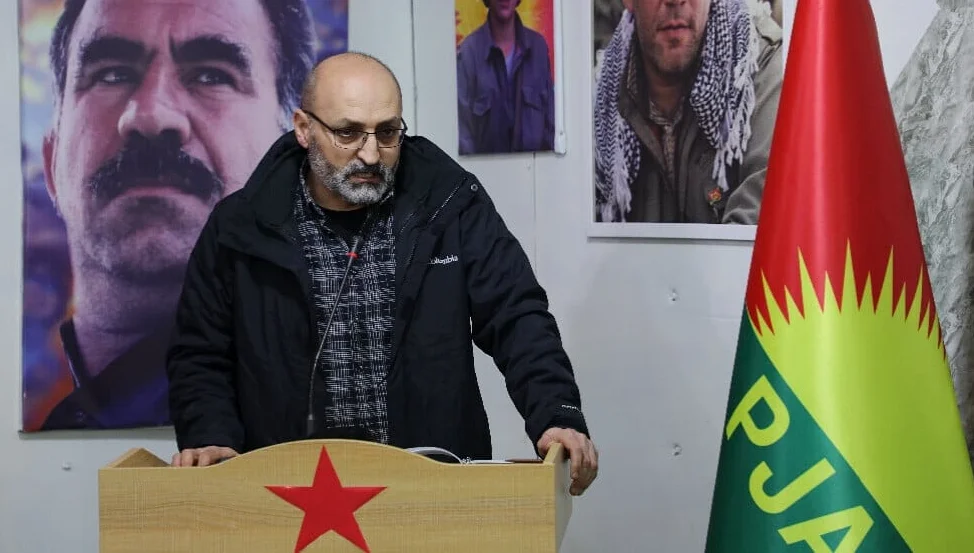
Amir Karimi, co-chair of the Party for a Free Life in Kurdistan (PJAK), has stated that his movement is prepared to defend the Kurdish population amid the ongoing US-Israeli attacks on Iran. In an interview with Stêrk TV, Karimi emphasized that PJAK has a strong social base in Rojhilat and is organizationally prepared for possible developments. The interview took place at a time of heightened geopolitical tensions, with the US and Israel conducting sustained military operations in Iran.
PJAK Sees Itself Prepared for Possible Developments
Karimi commemorated Kurdish politician Salih Muslim, a member of the Presidential Council of the PYD, who recently passed away after a long illness. Muslim, Karimi said, was a defining figure of the Kurdish freedom movement. He dedicated his life to the political struggle for the rights of the Kurdish people and became a symbol of this commitment for many, he added.
Referring to the attacks by the United States and Israel on Iranian territory that have continued for weeks, Karimi stated that PJAK is a strong movement and sees itself as part of society in Rojhilat. ‘Many young people are active within its ranks, fighting for freedom and the rights of the Kurdish population,’ he said. ‘In more than two decades of political activity, we have shown that we are ready to make great sacrifices for the freedom of the people. The movement is also prepared in the current situation. As PJAK, we are ready to do everything necessary to protect our people.’
However, he emphasized that the defense of the population must be based on social organization and collective self-defense. ‘We are not talking about military force in the traditional sense,’ Karimi explained. ‘It is about organizing the people, empowering them, and ensuring that our communities are prepared to respond to any threat.’
Denial of Reports About Border Movements
Karimi also rejected reports in international media claiming that Kurdish parties were transferring their forces from South Kurdistan across the border into Rojhilat (East Kurdistan). Such portrayals do not correspond to reality but are part of propaganda, the PJAK co-chair said. ‘These reports are not true. Moreover, such an approach would also be strategically wrong.’
He said it was unclear according to what logic reports were being spread claiming that all forces would first wait at the border and then collectively cross to the other side. ‘We cannot understand what is intended with such portrayals,’ Karimi said. According to him, no such movement has taken place. For PJAK, there is also no reason to stage such a scenario. ‘We are already in Rojhilat, that is, inside Iran. Therefore, we do not need to claim that our forces are waiting at the border or have crossed it.’
Karimi stated that the organization has prepared and operational structures inside Iran. ‘These forces are in close contact with the people, which is widely known. Reports by some media about alleged border crossings therefore have no basis and do not concern PJAK.’ He also said he had not observed any such movement among other Kurdish parties. ‘There are absolutely no signs that would confirm such claims,’ Karimi stated.
No Talks with the United States
The PJAK co-chair also commented on recent statements by US President Donald Trump about the Kurdish people. He clarified that there have been no talks between his party and the United States. At the same time, Karimi rejected reports claiming that Washington is holding talks with Kurdish political parties. ‘Such claims do not correspond to reality. Trump has not contacted any Kurdish political party,’ Karimi said.
He added that no clear political line of the United States toward the Kurdish people can be seen. ‘So far, we see no strategy from Washington regarding the rights of the Kurdish population, their political status, or their territories. We still do not see a US policy regarding us.’
Amir Karimi also addressed the alliance recently formed by six Kurdish political parties in Rojhilat. He emphasized: ‘It is not a military alliance but a political one. At the same time, it is a very important and historic alliance. PJAK attaches great importance to this formation. It is not merely a tactical gathering or an occasional exchange of views. Rather, the goal is to place this alliance on a democratic foundation.’
Regardless of different political positions, the Kurdish people must be able to act together on a democratic basis. ‘Each party has its own political ideology and will continue to represent it. What matters is that these differences can be discussed within a democratic framework. To understand one another, we must take this path,’ Karimi said. ‘The goal is to develop a democratic form of political struggle. This does not mean that criticism among the parties is excluded. Rather, the alliance aims to create a democratic political climate and to accept different positions.’
Karimi noted that the alliance was created in the interest of the Kurdish population and thanked all the parties that participated, describing their stance as positive. At the same time, he called on other parties that have not yet joined to become part of the alliance. The alliance, he said, should not be limited to political parties alone. ‘Civil society forces should also be included. The aim is to create a political force that represents society as a whole and contributes to developing a common political language among the Kurds.’
Karimi also pointed out that there are efforts to establish a similar form of cooperation in the military field alongside the political alliance of Kurdish parties. ‘There are initiatives in this direction, but no results have yet been achieved. However, we hope that a joint military force can also emerge. Such a structure, however, should not be tied to a single party. Military forces should fundamentally not be under the control of political parties.’
‘The parties should focus on politics and diplomacy,’ Karimi emphasized. He remarked that the alliance of Kurdish parties in Rojhilat must lay the foundation for a free country, a free people, and a society that governs itself. ‘Political parties should continue their work within such a system. Military structures and security forces, on the other hand, must be accountable to society itself. In principle, all parties agree on this issue,’ Karimi said, while acknowledging that implementation will take time.
Karimi also stressed the importance of Kurdish national unity. In addition to political unity among Kurdish forces in Rojhilat, unity among the Kurdish people in all four parts of Kurdistan must also be strengthened, he noted. ‘This unity is especially important for Rojhilat. Fragmentation harms us. We have repeatedly experienced its negative consequences in the past.’
The population in Rojhilat, he said, is a courageous people who have made great sacrifices and deserve freedom. ‘All Kurdish political parties must act with this sense of responsibility. The political steps taken today must honor those who have fallen.’ ‘Precisely for this reason, unity is of central importance,’ Karimi stressed. He noted that a rational common approach has now emerged that allows the parties to better understand and accept one another.
‘Through the alliance of Kurdish parties, it has become possible to reach all of Rojhilat. In the past, individual parties were often limited to certain regions. With the new alliance, all forces can now be present in all parts of the region. As PJAK, we are present everywhere — from Urmia to Kermanshah and Ilam, and into the Zagros Mountains,’ Karimi said. He also called on all Kurdish parties to become active in these areas, carry out political work, and represent their positions within society.
‘The time when Kurdish parties were played against each other because of small differences must belong to the past. Different political approaches are not a weakness but a richness,’ Karimi continued. He also emphasized that the Kurdish people could benefit from a more unified front. ‘Differences must belong to the past,’ he said. ‘The Kurdish people must now work together to build a future that is free, just, and inclusive for all.’



Comments
No comments yet
Be the first to share your thoughts