

 BBC
BBC 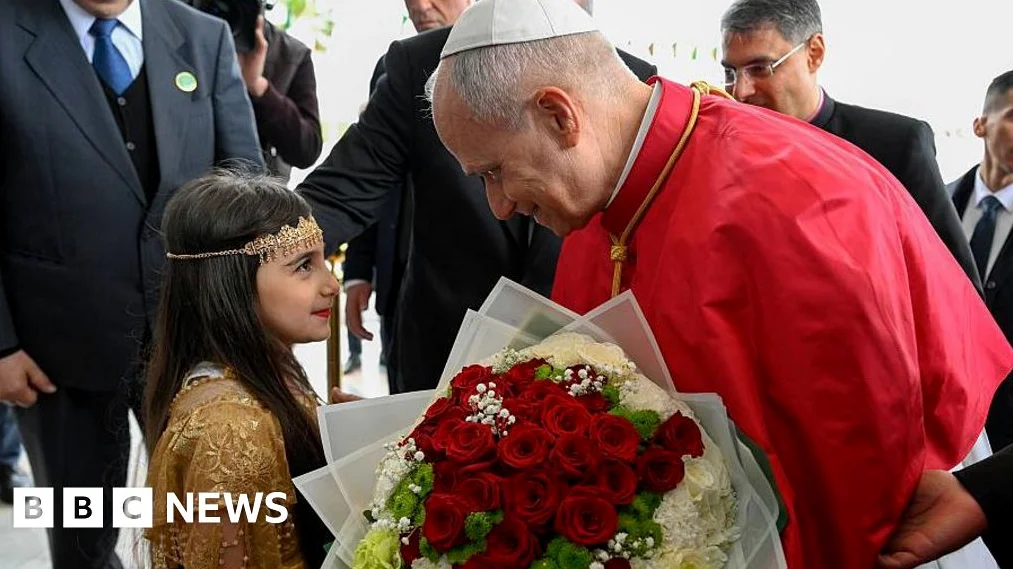
Pope Leo XIV has become the first pope to visit Algeria, marking the start of an 11-day tour of Africa that exposes the continent’s increasing importance to the Catholic Church, according to the BBC. The trip. Which begins on Monday. Will take the pontiff through four countries: Algeria, Cameroon, Angola, and Equatorial Guinea, covering nearly 18,000 km (11,185 miles) by air and land.
Africa’s Growing Role in the Catholic Church
The Vatican has stated that Africa is one of the fastest-growing regions for Catholicism, with over 288 million Catholics as of 2024, according to a Vatican survey. This figure represents more than a fifth of the world’s Catholic population — the Vatican described this as a ‘remarkable increase’ in the number of baptised Catholics on the continent.
Pope Leo XIV’s decision to begin his tour in Algeria is significant — the country is the birthplace of St, and Augustine, a 4th-century North African theologian whose ideas on community and humility have influenced the current leader of the Catholic Church. The pope will visit the city of Annaba, formerly known as Hippo, where St. Augustine once served as a bishop. This will be the first papal visit to Algeria in history.
During his time in Algiers. Pope Leo XIV told political leaders that he had travelled to Africa ‘as a witness to the peace and hope that the world so ardently desires,’ according to Reuters. He also condemned ‘continuous violations of international law and neocolonial tendencies’ in his speech, highlighting concerns about global power dynamics.
Focus on Peace, Migration, and Interfaith Dialogue
The tour will include stops at key religious and historical sites, including the Martyrs’ Memorial in Algiers, where the pope will pay tribute to victims of Algeria’s independence war against France. He will also visit the Great Mosque of Algiers and the Basilica of Our Lady of Africa, a place of pilgrimage for both Christians and Muslims. The statue of a black Virgin Mary at the basilica is venerated by both religions, with the words ‘pray for us and pray for the Muslims’ inscribed beneath it.
The Rector of the Basilica. Father Peter Claver Kogh, said he expects Pope Leo XIV to ‘encourage us in our faith and in our mission to build a new world. A world where there is peace and where people live together in harmony.’
However, concerns have been raised by rights groups about Algeria’s treatment of religious minorities. In the past, courts in Algeria have imprisoned Christians and Ahmadi Muslims for ‘unauthorised worship’ or for what has been described as ‘offence to Islam.’
The pope’s visit to Cameroon will focus on the ongoing conflict in the country’s two anglophone regions, where the UN estimates at least 6,000 people have been killed and over half a million forced from their homes. The conflict, which has spanned nearly a decade, has seen tensions between English-speaking separatists and the francophone-dominated government. In the capital of Cameroon’s North-West region, Bamenda, the pope will hold a Mass for peace and justice at the airport.
Ernestine Afanwi, a 45-year-old woman who fled Bamenda after her house and shop were destroyed, said she hopes the pope’s presence will bring about reconciliation. ‘I know that everything will be solved,’ she said, expressing her belief that the pope, as ‘God’s representative on earth,’ can help resolve the conflict.
Africa’s Role in the Future of the Church
In Angola, the pope will focus on peace and reconstruction, a theme that resonates with the country’s history of decades of civil war from the mid-1970s to 2002. The pontiff will celebrate Mass with some 200,000 faithful in a country where between 40% and 55% of the population identify as Catholic. The Catholic Church’s presence in Angola dates back to the late 15th century, when Portuguese explorers and missionaries arrived along the Angolan coast.
In Equatorial Guinea, the last stop on the tour, more than 70% of the population identifies as Catholic. However, the country’s president, Teodoro Obiang Nguema, has been in power for nearly 50 years, and critics accuse his government of human rights abuses, which the regime denies. The pope is expected to visit a psychiatric hospital and a prison, as well as meet with young people during his time in the country.
The tour comes amid broader recognition of Africa’s role in the future of the Catholic Church. According to Adriaan van Klinken, a professor of religion and African studies at the University of Leeds, Africa is ‘the site of vitality, of growth, of the future of the church.’
John Pontifex, from the Catholic charity Aid to the Church in Need UK, noted that the Catholic population in Africa has grown by 7 million in the last year alone, with 14 new dioceses created across the continent. This shows the Vatican’s decision to prioritise engagement with the continent, reinforcing its role as a place of faith, resilience, and future growth.






Comments
No comments yet
Be the first to share your thoughts