

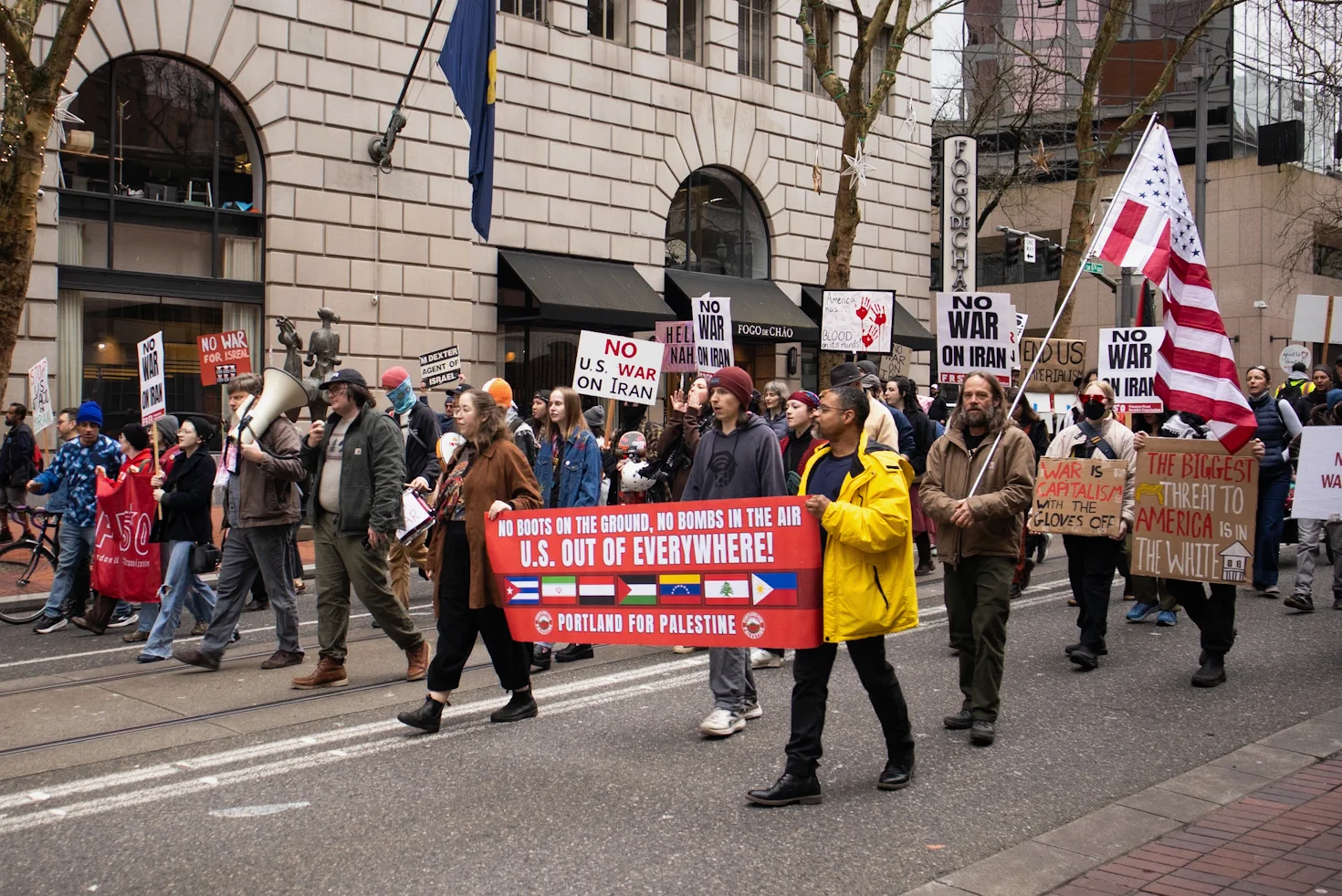
PORTLAND — On Feb. 28, a large group of demonstrators gathered outside Pioneer Courthouse in downtown Portland for an emergency protest titled ‘Hands Off Iran.’ The event was organized by Portland for Palestine, Freedom Road Socialist Organization Portland, and the Anti-War Action Network. The demonstration came in response to recent military strikes reported across the Middle East, primarily involving Iran and Israel.
Protesters Voice Concerns Over Civilian Casualties
Participants at the protest expressed deep concern over the potential civilian impact of the strikes. One of the demonstrators, Mary McClain, stated that she attended the event because she ‘disagree[s] with bombing innocent people.’ She also criticized President Donald Trump’s decision to involve the U.S. in the conflict without congressional approval.
‘Of course I don’t want the Iranian people to be oppressed, but I don’t believe the United States or Netanyahu has any right to be the deciders,’ McClain said during the demonstration. Her comments reflected a broader sentiment among the protesters who believe the U.S. should not unilaterally decide to engage in military action.
Criticism of U.S. Imperialism and War Policies
Another protester, Curtis Bell, emphasized that he attended the event to oppose what he described as ‘another example of U.S. imperialism waging war on countries that do not need war.’ Bell added that he believes ‘the American people do not want this war,’ and urged support for senators and members of Congress who oppose the conflict.
The protest took place amid growing tensions in the Middle East, following reports of strikes attributed to Israel and the U.S. President Trump and the Federal Investigations Bureau claimed involvement in Israel’s retaliation strikes in Iran, and also announced the assassination of the Supreme Leader of Iran, Ayatollah Ali Khamenei. However, these claims have not been independently verified by other sources.
The situation remains volatile, with the potential for further escalation. The U.S. and Israel have not officially confirmed the details of the strikes, and Iran has not made any public statements about the reported attacks. The lack of transparency has only deepened public concern and fueled calls for diplomatic resolution.
Significance for Ordinary Americans
The protests in Portland reflect a broader trend of anti-war sentiment across the U.S. Many Americans, particularly those in the Pacific Northwest, have voiced concerns about the potential for a wider regional conflict and the impact it could have on global stability. With the U.S. already involved in multiple conflicts around the world, critics argue that another war could strain military resources and increase the risk of civilian casualties.
Moreover, the lack of congressional approval for the conflict has raised questions about the separation of powers and the role of the executive branch in initiating military actions. This issue has been a point of contention for years, with some lawmakers calling for stricter oversight of U.S. military engagements.
According to a recent survey by the Pew Research Center, 63% of Americans believe that the U.S. should not be involved in the Middle East conflict. The findings highlight a growing public sentiment against continued U.S. military involvement in the region.
As the situation develops, the U.S. government is expected to provide more information about the nature of the strikes and the involvement of U.S. forces. However, the lack of immediate clarity has only intensified the calls for transparency and diplomacy.
Analysts warn that the situation could escalate further if diplomatic efforts fail. The potential for a regional conflict involving multiple countries could have far-reaching consequences, including economic instability and a rise in global tensions.
While the protest in Portland has concluded, the movement against the conflict is likely to continue. Activists are planning further demonstrations and are urging lawmakers to take a stronger stance against military actions without congressional approval.






Comments
No comments yet
Be the first to share your thoughts