

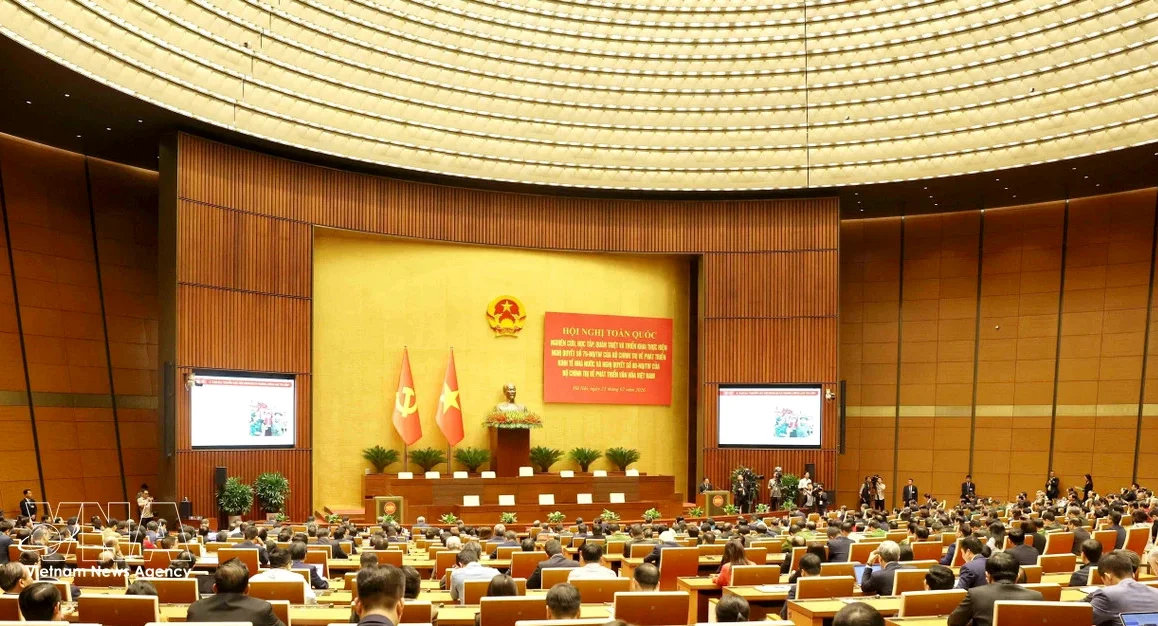
Vietnam’s Politburo has adopted Resolution No. 80-NQ/TW, positioning culture as a central pillar of national development with strategic goals extending to 2045, according to official statements. The resolution, revealed at a nationwide conference in Hanoi on February 25, outlines new and overarching requirements for cultural development in the new era, with specific targets set for 2030 and a vision extending to 2045.
Cultural Development as a National Priority
Trinh Van Quyet, a Politburo member and Chairman of the Party Central Committee’s Commission for Information, Education and Mass Mobilisation, emphasized the resolution’s significance during the conference. He noted that national development in the new era requires major, strategic, and synchronized policies to support cultural development. The resolution aims to affirm the stature of Vietnamese culture as befits a socialist-oriented developed nation, rooted in a long tradition of culture and civilization and contributing meaningfully to human civilization.
According to Quyet, the resolution sets out new and overarching requirements for cultural development in the new era, defining strategic viewpoints, goals, and solutions through 2030 with a vision to 2045. It builds on past achievements while addressing existing shortcomings, marking both theoretical continuity and advancement.
Culture and People as Foundational Pillars
The resolution affirms that culture and people are not only the spiritual foundation but also a solid pillar and regulatory force for rapid and sustainable national development. It places culture on par with politics, economy, and society, calling for culture to permeate all areas—from governance and economy to defense, security, and foreign affairs—and to become a source of national soft power.
For the first time, culture is identified as both a pillar and a regulating system of rapid and sustainable development. The resolution highlights science, technology, innovation, and digital transformation as key drivers, with the application of digital technologies in culture defined as one of three major areas. It calls for the introduction of major mechanisms and policies, the issuance of codes of conduct for digital spaces to help support a healthy and civilized online cultural environment, and the development of a thorough digital cultural ecosystem.
Quyet said the resolution sets out major tasks to modernize cultural development, focusing on institutional reform, strategic breakthroughs, resource mobilization, and building laws governing cultural activities, while removing bottlenecks, adopting tailored policies, and shifting from administrative control to modern and service-oriented cultural governance.
Cultural Security and Digital Sovereignty
In implementing these new approaches, the resolution highlights the shared responsibility of all stakeholders, with the Party providing leadership, the State managing, and the people—alongside intellectuals, artists, cultural workers, and entrepreneurs—serving as the central creative force.
Quyet said Resolution No. 80-NQ/TW marks a new perception by placing culture on an equal footing with politics, economy, and society, while linking it to cultural security, human security, and digital cultural sovereignty. This reflects a fundamental shift in mindset that elevates the role of culture in shaping national identity in the new era.
The resolution calls for building a ‘cultural security posture’ by maximizing national cultural values, harmonizing preservation and development, tradition and modernity, and national identity and international integration, while promoting cultural diversity and core values such as patriotism and national independence. It also ties cultural security to national defense and security, urging firm action against harmful and false information and stronger resilience to inappropriate foreign cultural influences, particularly on cross-border digital platforms.
A new vision for goals and core tasks is outlined in Resolution No. 80-NQ/TW, which not only defines overarching goals for each cultural field but also sets out specific, measurable targets, linking high-quality development requirements with concrete indicators and avoiding vague objectives, according to Quyet. Human development remains the central and ultimate goal of the Party’s resolution on culture, with the resolution emphasizing the dialectical relationship between developing culture to perfect the socialist-oriented human personality in the new era and building people as the driving force of cultural development.
The resolution calls for coordinated implementation of cultural, national, and family value systems to guide personal development, with cultural norms and laws shaping behavior. It also stresses building a humane, healthy, and modern cultural environment, including a clean digital cultural space amid rapid digital transformation. At the same time, it promotes proactive international cultural integration, embedding culture across external relations while selectively absorbing global cultural values. It also stresses the need to harmonize internal cultural relationships, particularly between tradition and modernity, national identity and international integration, preservation and development—affirming cultural uniqueness while aspiring to contribute meaningfully to global civilization.
The frequent emphasis on ‘modernity’ throughout the resolution reflects the imperative for Vietnamese culture to evolve in the new era. The resolution also integrates three core tasks into a unified agenda: developing cultural infrastructure, mobilizing and effectively using resources, and improving the quality of cultural human resources.
For implementation, the resolution calls for flexible and effective dissemination to ensure thorough understanding, build consensus and determination, and translate its innovations into coherent medium- and long-term action programs, with the people at the center and the active participation of cadres, intellectuals, artists, entrepreneurs, and the armed forces.
Resolution No. 80-NQ/TW offers a thorough and forward-looking framework for cultural development, whose effective implementation will elevate the stature of a modern Vietnamese culture rich in national identity and contribute directly to rapid, sustainable national development and global civilization, Quyet concluded.



Comments
No comments yet
Be the first to share your thoughts