

 BBC
BBC 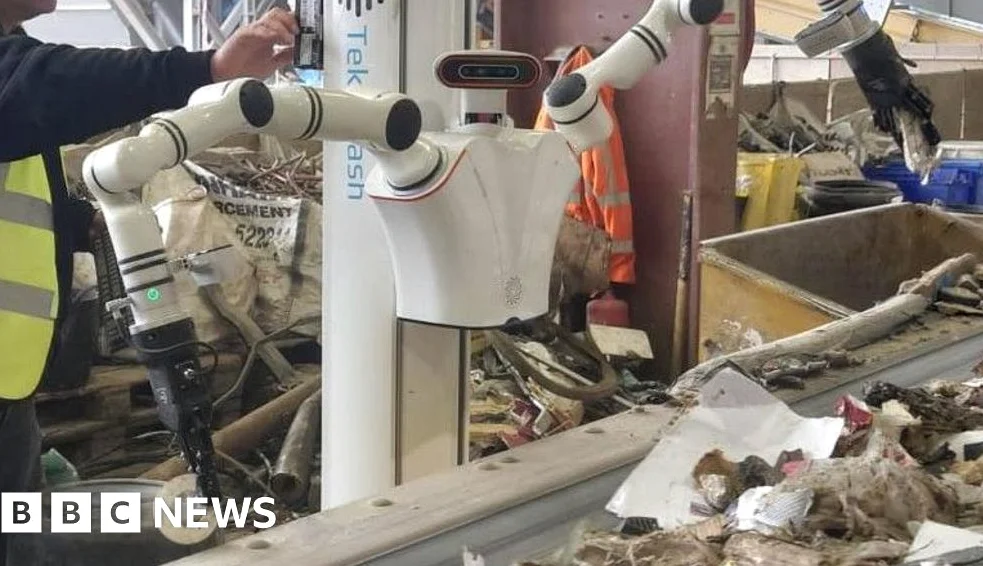
At a busy recycling plant in Rainham, east London, the dust is thick and the noise of hoppers and conveyor belts creates a challenging work environment. The facility is operated by Sharp Group, a family-run skip and waste management company.
High Injury Rates and Staff Turnover
This facility processes up to 280,000 tonnes of mixed recycling annually using 24 agency workers. The waste industry is known for its hazards. According to the BBC, work-related injury and ill-health in the sector are 45% higher than in other industries. The fatality rate is also significantly higher than the national average.
Annual staff turnover at the plant is 40%. Line supervisor Ken Dordoy explains that the constant movement on the conveyor belts makes it difficult to keep workers. ‘The belt is moving all the time, you’re constantly picking. I go through a lot of pickers because they just aren’t up to the job,’ he said.
Robots as a Solution
To address these challenges, a robot named Alpha (Automated Litter Processing Humanoid Assistant) is being trained to sort through the waste. Built by RealMan Robotics in China, the robot is being adapted for use by TeknTrash Robotics, a British firm.
Alpha is being trained through a two-part process: identifying items on the conveyor and physically lifting them. TeknTrash founder and CEO Al Costa explains that the robots need extensive data to function effectively. ‘The market thinks these robots are prêt-à-porter, that all you need to do is to plug them to the mains and they will work flawlessly. But they need extensive data in order to be effectively useful,’ he said.
Chelsea Sharp, the plant finance director and granddaughter of company founder Tom Sharp, notes the potential benefits of using humanoid robots. ‘The attraction of a humanoid is that you can put it here and it stays here. It will pick all day, 24 hours a day, seven days a week. It’s not going to apply for a holiday, it’s not going to have a sick day,’ she said.
Industry-Wide Shift to Automation
Other companies are also adopting automation. Colorado-based AMP runs three of its own plants and has supplied equipment to dozens of other facilities worldwide. CEO Tim Stuart explains that their system uses air jets and AI to improve sorting efficiency. ‘Our robots are much more efficient than humans, probably eight or 10 times the pace. The AI technology and jets have really increased the capacity and efficiency and accuracy of what we can do,’ he said.
California-based company Glacier, co-founded by Rebecca Hu-Thrams, uses robotic arms and AI to sort through waste. Hu-Thrams notes that the variability of trash is a significant challenge. ‘As our models learn from more than a billion items, the AI gets better and better,’ she said.
Across the industry, experts agree that the shift to automation is necessary. Prof Marian Chertow of Yale University states that ‘robotics coupled with AI-driven vision systems offers the greatest potential for improving material recovery, worker experience, and economic competitiveness in the recycling sector.’
Sharp Group aims to upskill its workers as the technology scales up. ‘The plan is to upskill those staff. They’ll be maintaining and overseeing the robots. And it brings those same people away from any dangers, including the unpleasant environment, heavy lifting and noise,’ said Chelsea Sharp.






Comments
No comments yet
Be the first to share your thoughts