

 BBC
BBC 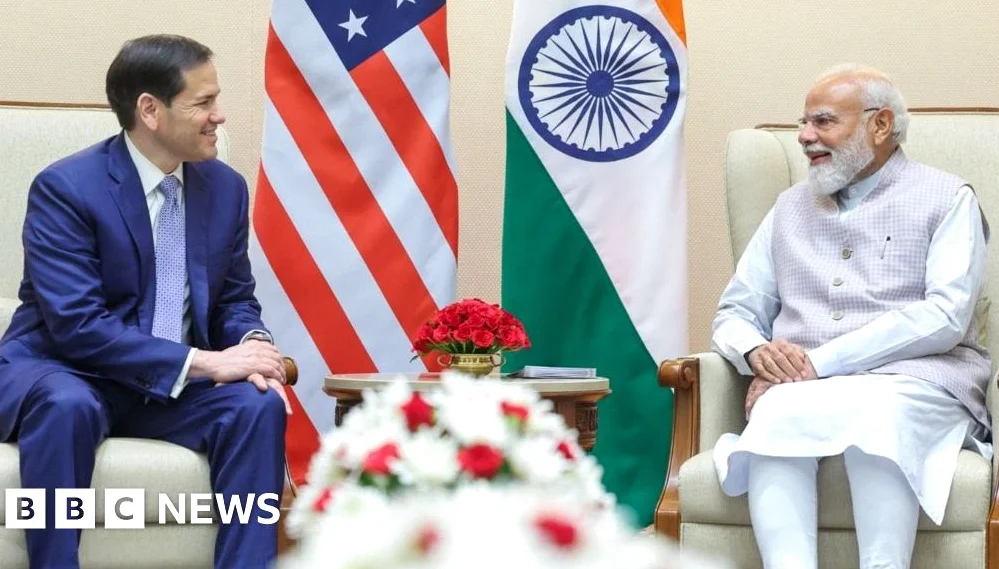
US Secretary of State Marco Rubio has held talks with Indian Prime Minister Narendra Modi in Delhi as part of a four-day visit to the country. Rubio arrived in the eastern city of Kolkata (formerly Calcutta) on Saturday morning before travelling to the capital. He is also due to visit Jaipur and Agra.
Energy Security a Key Discussion Point
During their meeting, Rubio extended an invitation to visit the White House to Modi, US officials said. The Indian premier, meanwhile, said the pair had discussed ‘issues related to regional and global peace and security.’ The visit comes as the two nations seek to redefine their economic relationship amid a global energy crisis triggered by the Iran war that has acutely affected India.
Energy shipments through the Strait of Hormuz—where around 20% of the world’s oil and natural gas flows,have virtually ground to a halt since Israel and the US attacked Iran. Iran has used the effective closure of the strait as a pressure tactic in the fragile peace negotiations with the US.
India, which imports more than 80% of its energy needs, has suffered as a result. Nearly half of India’s crude oil imports usually pass through the strait. Rubio discussed the situation in the Middle East with Modi, his spokesman said following their meeting.
Trade and Energy Ties
‘[He] emphasised that the United States will not let Iran hold the global energy market hostage and affirmed that US energy products have the potential to diversify India’s energy supply,’ the US official added. Rubio had indicated ahead of the meeting that the US was keen to sell India ‘as much energy as they’ll buy.’
There will be appetite in Delhi to boost its energy imports from the US as it will also help bridge the trade deficit that has been in India’s favour—something that has constantly irked US President Donald Trump. The US goods trade deficit with India was $58.2bn (£43.3bn) in 2025, a 27.1% increase on 2024.
However, it is not a straightforward solution. It’s a much longer and expensive route for India to get energy shipments from the US. Analysts say it is not logical for India to fill the current shortfall in its imports from the US.
Trade Negotiations and Geopolitical Tensions
‘Energy security is going to be the key theme of this visit because the Iran situation is not going to be resolved anytime soon,’ Vineet Prakash, associate professor of US studies at Delhi’s Jawaharlal Nehru University, said. ‘The US has already given a waiver to India on buying Russian oil, but Delhi is likely to push for more concessions.’
Rubio’s visit also comes under the shadow of prolonged tensions between Delhi and Washington over trade negotiations and conflicting claims on who settled the brief India-Pakistan conflict last year. While Trump has repeatedly claimed that he brokered peace between the neighbours, Delhi has consistently denied this with its stated policy of not welcoming a third party to mediate between the nuclear-armed nations in South Asia.
What also appears to have displeased Delhi is Trump’s open affection for Pakistani army chief Asim Munir, whom the US president has called his ‘favourite field marshal.’ Prakash added that this wasn’t surprising, as Pakistan shares a long border with Iran and is strategically important for the US to keep the country close.
Meanwhile, the last few months have also seen Washington and Delhi offering an olive branch to each other. Trump’s decision to lower reciprocal tariffs on India earlier this year from 50% to 18% after a 10-month impasse was met with a huge sense of relief in Delhi.
Following a US Supreme Court verdict against his sweeping duties, the levies were reduced to 10%, further easing pressure on Indian exporters. The reduction in tariffs came after India committed to buy more American goods, including energy, aircrafts, technology and agricultural products worth $500bn, in an interim trade agreement in February.
The two sides are currently negotiating the final text of a broader bilateral deal, but further details of the negotiations remain sketchy. Trade experts are circumspect about the big numbers being thrown around because India’s current trade with the US is at a fraction of the $500bn figure and Trump’s announcements haven’t been met with tangible investment commitments from India yet.




Comments
No comments yet
Be the first to share your thoughts