

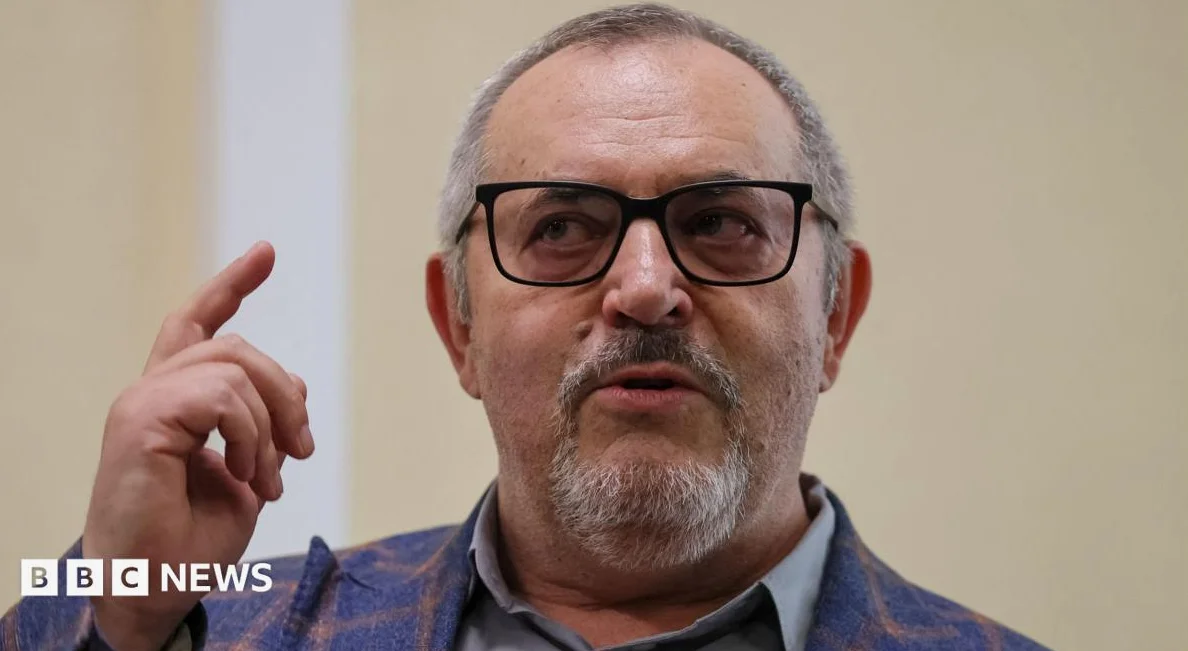
Russian anti-war politician Alexei Nadezhdin says he has fled the country amid a pre-election enforcement action on dissent, according to The Guardian — In a video filmed in front of the Eiffel Tower, Nadezhdin, 63, stated, ‘Good news: I’m alive and free. Unfortunately, I’m not in Russia for the time being.’ He added that he needed ‘to look around and figure out life going forward.’
Pressure on Dissenters Intensifies
Since registering to run in September’s parliamentary elections, Nadezhdin was briefly detained and accused of a minor administrative violation, which was widely seen as an attempt to intimidate him and undermine his candidacy. The same month, the Russian justice ministry designated Nadezhdin a ‘foreign agent’,a label that carries onerous reporting requirements, increased government scrutiny, and a powerful stigma in Russia. Combined with a conviction on an extremism-related administrative charge, this barred him from running in the parliamentary elections, which are widely expected to be tightly controlled by the Kremlin.
In an interview with Russian independent outlet Meduza last month, Nadezhdin said he and his family were considering leaving Russia as pressure from the authorities intensified. While he wanted to remain in the country and run in the parliamentary elections, he acknowledged that the growing risk of imprisonment was becoming increasingly difficult to ignore.
Broader Context of Russian Migration and Repression
The full-scale invasion of Ukraine in February 2022 triggered the largest wave of migration from Russia in decades, according to a report by the Zentrum für Osteuropa- und internationale Studien (ZOiS) in Berlin. This exodus, however, is not a homogeneous opposition to the war; many left for pragmatic reasons; the post-2022 diaspora includes people who oppose the war as well as those who left for economic or safety-related concerns. Unlike the Belarusian diaspora, exiled Russian politicians have not acted as a unifying force, and transnational repression—intimidation of families, surveillance, and legal harassment,has become a defining feature of this migration wave.
Some migrants have adopted ‘strategic non-engagement’ as a mode of participation in response to these risks. The ZOiS report highlights that the new diaspora encounters ambivalent responses from host publics and faces complex interactions with other diasporas, especially Ukrainians, which are characterised by both solidarity and tension.
Independent Media and Censorship
Since the invasion of Ukraine, it has become increasingly difficult to get information about what is really going on inside Russia, according to a report in the Asahi Shimbun. One of the reasons is the administration’s program of censorship. Russian journalist Eugene Magdalits, based in Georgia, faced criminal prosecution for his work with anti-government politicians. ‘If you say something that is against the official government line, you might be imprisoned,’ he said. ‘Suppression has been going on since the 2000s and has only gotten worse with the invasion.’
Alina Didkovskaya, a reporter for Dozhd, an independent online television station based in Latvia, noted that state-owned television does not report what is happening in the country. This lack of independent media coverage further exacerbates the difficulty of accessing accurate information from within Russia.
Following the invasion, Russian authorities launched an historic enforcement action on dissent, targeting independent media, human rights groups, civil society organizations, and critics of the war. Hundreds have been imprisoned and thousands more have fled the country.

Comments
No comments yet
Be the first to share your thoughts