

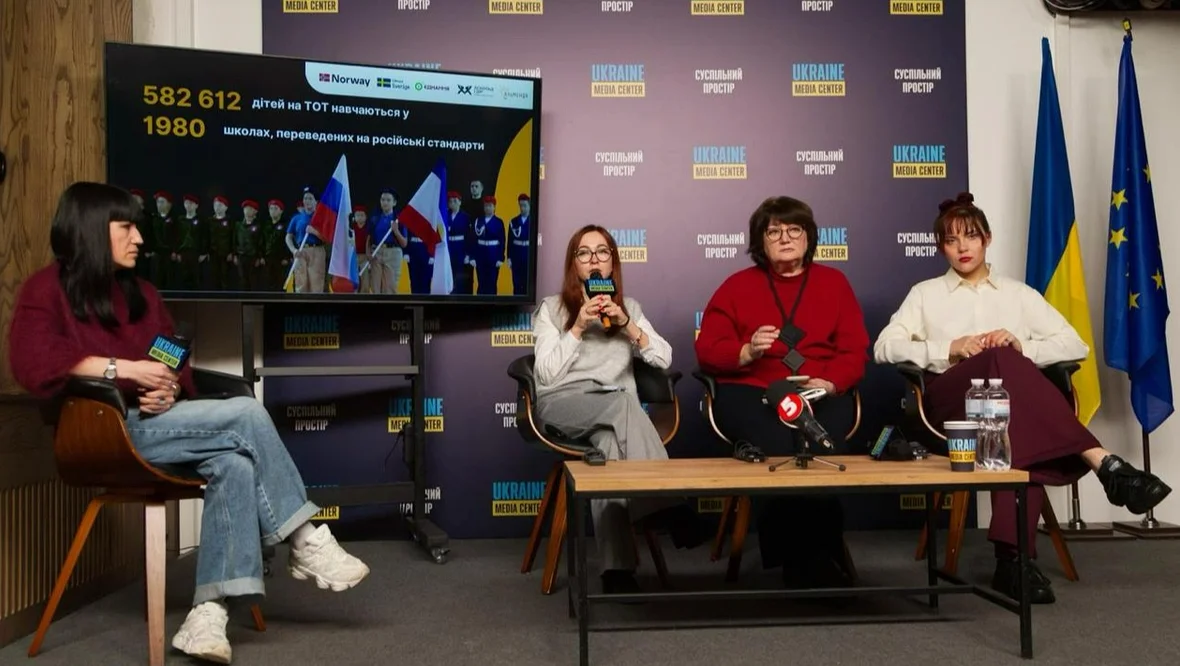
Russian curricula are now in place in nearly 2,000 schools across Ukraine’s temporarily occupied territories, impacting the education of over 582,000 children. According to a report by the Centre of Civil Education Almenda, this shift is part of a broader effort to erase Ukrainian identity and instill loyalty to Russian state ideology.
Erasing Ukrainian Identity Through Education
The report, titled “Russia’s Policy on the Erasure of Children’s Identity in the Temporarily Occupied Territories of Ukraine in 2025,” highlights the rapid militarization of education in occupied regions. Russian authorities have introduced new subjects focusing on “patriotic” indoctrination, including a compulsory module called “Conversations about Important Things.” This subject aims to reinforce state narratives and promote Russification.
“All Ukrainian children are denied the right to choose,” said Tetiana Lychko, a data coordinator at the Centre of Civil Education Almenda. “They cannot select the language of instruction or the curriculum they follow. Meanwhile, they live in constant fear of being penalised if they do not attend Russian schools and of punishment under anti-extremism laws.”
Historical Revisions and Language Suppression
Since 2025, Russian authorities have introduced distorted historical narratives into school textbooks. History courses now emphasize the “distinctiveness of Russian civilisation” and a “rejection of Eurocentrism.” These textbooks are in use across all temporarily occupied territories for students in Years 5-11, roughly ages 9 to 16.
The curriculum now devotes more hours to history, including a new module called “History of the Region.” Students are taught that the occupied territories were an “integral part of the Russian Empire,” while their historical ties to Ukraine are deliberately erased.
Additionally, the Ukrainian language has been entirely removed from the curriculum under federal educational standards since December 15, 2025. This move has further marginalized the Ukrainian language in schools, replacing it with Russian as the primary medium of instruction.
Militarization and Youth Mobilization
The Centre of Civil Education Almenda has documented an intensification of the militarization of education in occupied areas. All schools have received equipment for practical lessons in subjects such as “Fundamentals of Security and Defence of the Motherland” and “Technology.” The equipment includes models of Kalashnikov rifles, first-person view (FPV) drones, and other unmanned aerial vehicles.
Russia allocated around RUB 139 million (US$1.8 million) from federal and state budgets for this purpose. Military personnel and veterans of the so-called “special military operation” — Russia’s propaganda term for the war against Ukraine — are being integrated into the educational process. According to Lychko, this supports in children the perception of these figures as mentors and role models.
In occupied Crimea and Sevastopol, a new subject called “Spiritual and Moral Culture of Russia” has been introduced. This subject is taught with the involvement of church representatives and is set to become mandatory in all schools in the temporarily occupied territories from September 1, 2025.
“It has been introduced to instill in children traditional Russian values, where service to the state is placed above human rights,” Lychko emphasized.
Over the past decade of occupation in Crimea, the number of cadet classes has grown 102-fold, from just three in 2015 to 306 in 2025. As of 2025, at least 479 cadet classes have been established under the patronage of the Investigative Committee of the Russian Federation, prosecution authorities, and other security services.
The Russian leadership continues to actively involve children and young people in Yunarmiya, a youth program promoting loyalty to the state through military-style activities. To date, over two million children are members, including 44,000 from the occupied territories of Ukraine.

Comments
No comments yet
Be the first to share your thoughts