

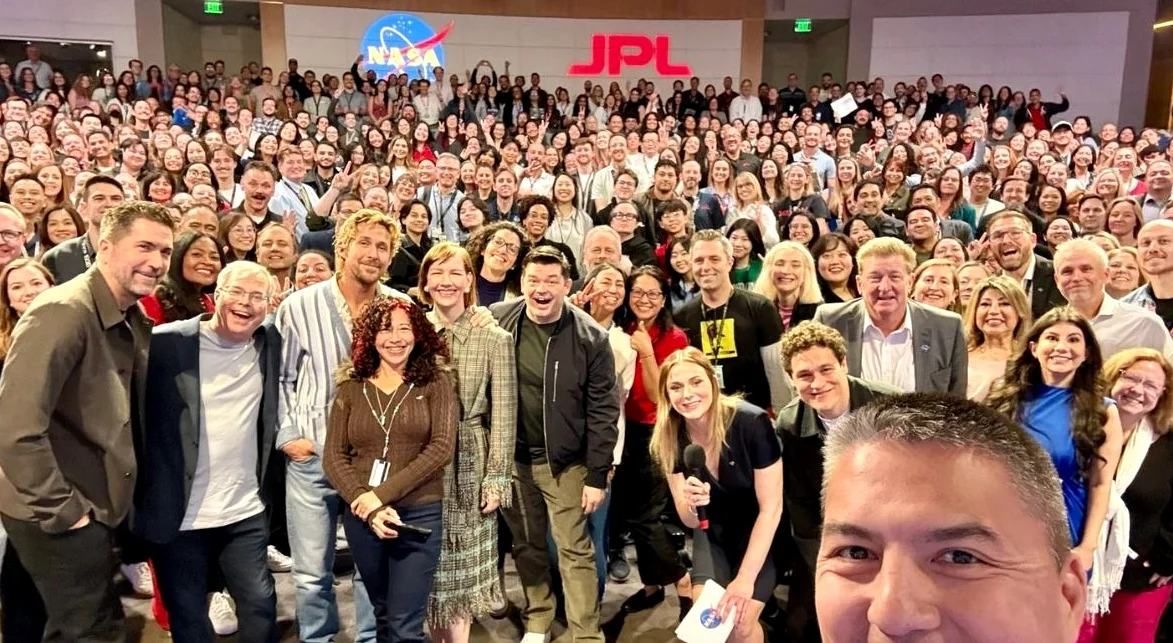
Ryan Gosling, star of the upcoming science-fiction film Project Hail Mary, joined the film’s creative team for a town hall meeting at NASA’s Jet Propulsion Laboratory (JPL) on February 25, 2026. The event marked a rare collaboration between Hollywood and space scientists aimed at aligning the film’s science with real-world research.
Collaboration Between Science and Storytelling
The meeting included Gosling, screenwriter Drew Goddard, directors Phil Lord and Christopher Miller, author Andy Weir, and actress Sandra Hüller. The group engaged in a detailed discussion with NASA scientists and engineers about the technical aspects of deep space travel, spacecraft design, and the psychological challenges of long-duration space missions.
According to NASA officials, the collaboration is not merely for entertainment value but represents a genuine effort to bridge the gap between science fiction and science fact. ‘This is more than a marketing stunt,’ said a NASA spokesperson. ‘It’s a chance to educate the public through storytelling.’
The film, based on Andy Weir’s bestselling novel, follows an astronaut on a high-stakes mission to save Earth from a solar catastrophe. Weir, who was present at the meeting, emphasized the importance of scientific accuracy. ‘I want audiences to feel like they’re learning something new while being entertained,’ he said.
Real-World Insights for Cinematic Accuracy
During the meeting, NASA astronaut Kjell Lindgren provided Gosling with firsthand insights into the physical and psychological realities of spaceflight. Lindgren, who has spent time aboard the International Space Station, shared experiences that helped shape the film’s portrayal of space travel.
The production team also visited JPL’s facilities to observe the advanced technology used in robotic space exploration. This included tours of mission control centers and research labs that manage some of NASA’s most ambitious projects, such as the Mars rover missions and the upcoming Europa Clipper mission to Jupiter’s moon.
The town hall was broadcast internally to NASA centers across the United States, allowing scientists and engineers to engage with the filmmakers. According to NASA officials, the event was a two-way exchange. ‘Scientists often find inspiration in the bold, imaginative concepts presented by science fiction,’ said a JPL engineer.
The film’s commitment to accuracy extends to the depiction of the spacecraft and the challenges of interstellar travel. The story involves a journey to Tau Ceti, a Sun-like star in the constellation Cetus, which is approximately 12 light-years from Earth. The production team worked closely with astrophysicists to ensure that the science behind the journey is plausible.
Impact on Science Communication
The collaboration between NASA and the filmmakers has been praised as a potential milestone in science communication. With a 100% commitment to accuracy, the film aims to educate audiences while entertaining them. ‘This is a unique opportunity to bring real science into the mainstream through popular culture,’ said a NASA spokesperson.
The film’s release is anticipated in 2027, with a marketing campaign that will highlight the scientific collaboration. The partnership between NASA and the production team has already sparked interest among educators and science communicators, who see the film as a potential tool for engaging the public with space science.
As the film moves into production, the collaboration with NASA will continue. The filmmakers have access to a wealth of scientific knowledge that will inform every aspect of the production, from spacecraft design to the portrayal of space travel’s challenges.
The event at JPL has also inspired a new generation of science enthusiasts. Students and educators across the country have been following the collaboration closely, seeing it as a rare example of science and entertainment working together to promote scientific literacy.






Comments
No comments yet
Be the first to share your thoughts