

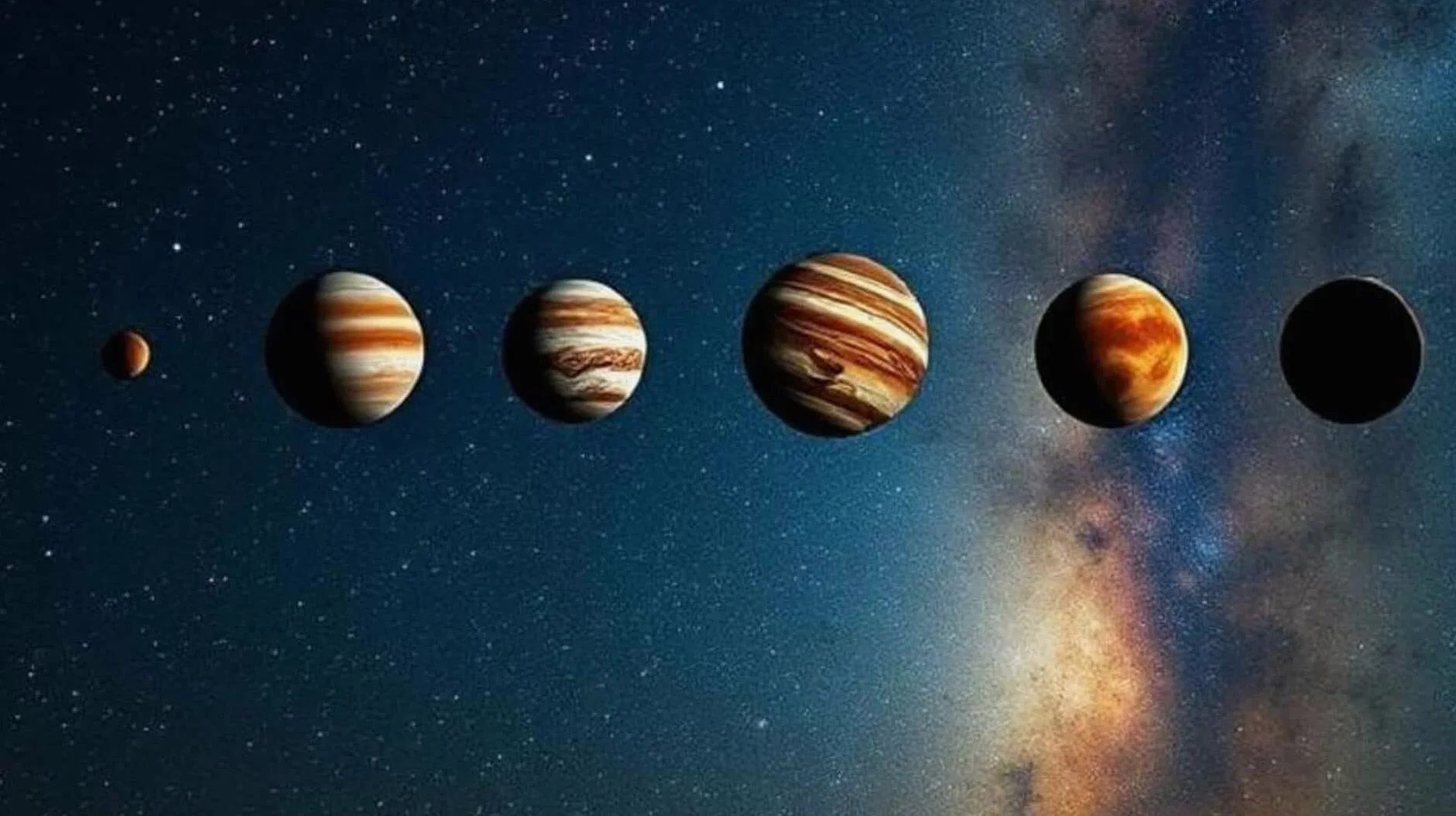
On February 28, a rare planetary alignment will bring six planets into view across much of the world, offering a unique opportunity for amateur and professional astronomers alike. The event, known as a planet parade, will be visible from regions with low light pollution, including South Asia, the UK, France, Germany, Spain, Egypt, Kenya, Morocco, and parts of the Americas.
What to Expect in the Sky
The alignment will feature Mercury, Venus, Saturn, Uranus, Neptune, and Jupiter. Each planet will appear at a different brightness and position in the sky. Mercury, the closest planet to the Sun, will be faint and near the horizon, while Venus will shine brightly, making it easier to spot near Mercury. Saturn will appear as a dim yellowish light, also near the horizon, while Uranus and Neptune will be fainter but higher in the sky than Saturn. Jupiter, the largest planet in the solar system, will be the brightest and easiest to identify as it is higher in the sky than the others.
According to astronomy experts, the best time to view the alignment will be 30 to 90 minutes after sunset. During this window, the planets will be visible in the western sky, though some may begin to sink below the horizon as the night progresses. For the best viewing experience, observers are advised to wait until the Sun has fully set and to use stargazing apps to track the planets’ positions based on their specific locations.
Why This Alignment is Special
Planet parades occur when planets, which orbit the Sun in nearly the same flat plane, appear together from Earth’s perspective. This does not mean the planets are in a straight line, but rather that they appear in the same region of the sky, creating an eye-catching grouping after sunset. While such alignments are relatively common, seeing six planets in one sky is a rare occurrence.
This year’s event will not include Mars, which is currently on the opposite side of the Sun from Earth. However, the sight of six planets together is still considered a rare treat for stargazers. According to Dr. Emily Carter, an astronomer at the University of Oxford, ‘This alignment is a reminder of the dynamic nature of our solar system and how the movement of planets can create stunning visual displays from our vantage point.’
Historically, similar events have occurred, but the exact visibility and configuration of the planets depend on their orbital positions. The last time six planets aligned in the night sky was in 2021, but the visibility was limited to specific regions. This year’s alignment, however, will be more widely visible across multiple continents.
How to Watch the Spectacle
For those hoping to catch the event, the western states of the US and Canada, as well as countries like Chile, Argentina, Australia, and New Zealand, will also have visibility of the alignment. Observers are encouraged to find a location with minimal light pollution to get the clearest view of the planets.
Stargazing apps such as SkySafari and Star Walk can help users track the planets’ positions and determine the best viewing times based on their location. Telescopes or binoculars may be useful for spotting fainter planets like Uranus and Neptune, though they can also be seen with the naked eye under clear conditions.
The event will be visible in the evening sky, with the best viewing time shortly after sunset. Observers should allow time for their eyes to adjust to the darkness and look toward the western horizon where the planets will be clustered.
As the planets continue their orbits, the alignment will gradually become less visible in the coming weeks. However, the February 28 event offers a rare chance to witness the beauty of our solar system in action, reminding viewers of the vastness and complexity of the universe.






Comments
No comments yet
Be the first to share your thoughts