

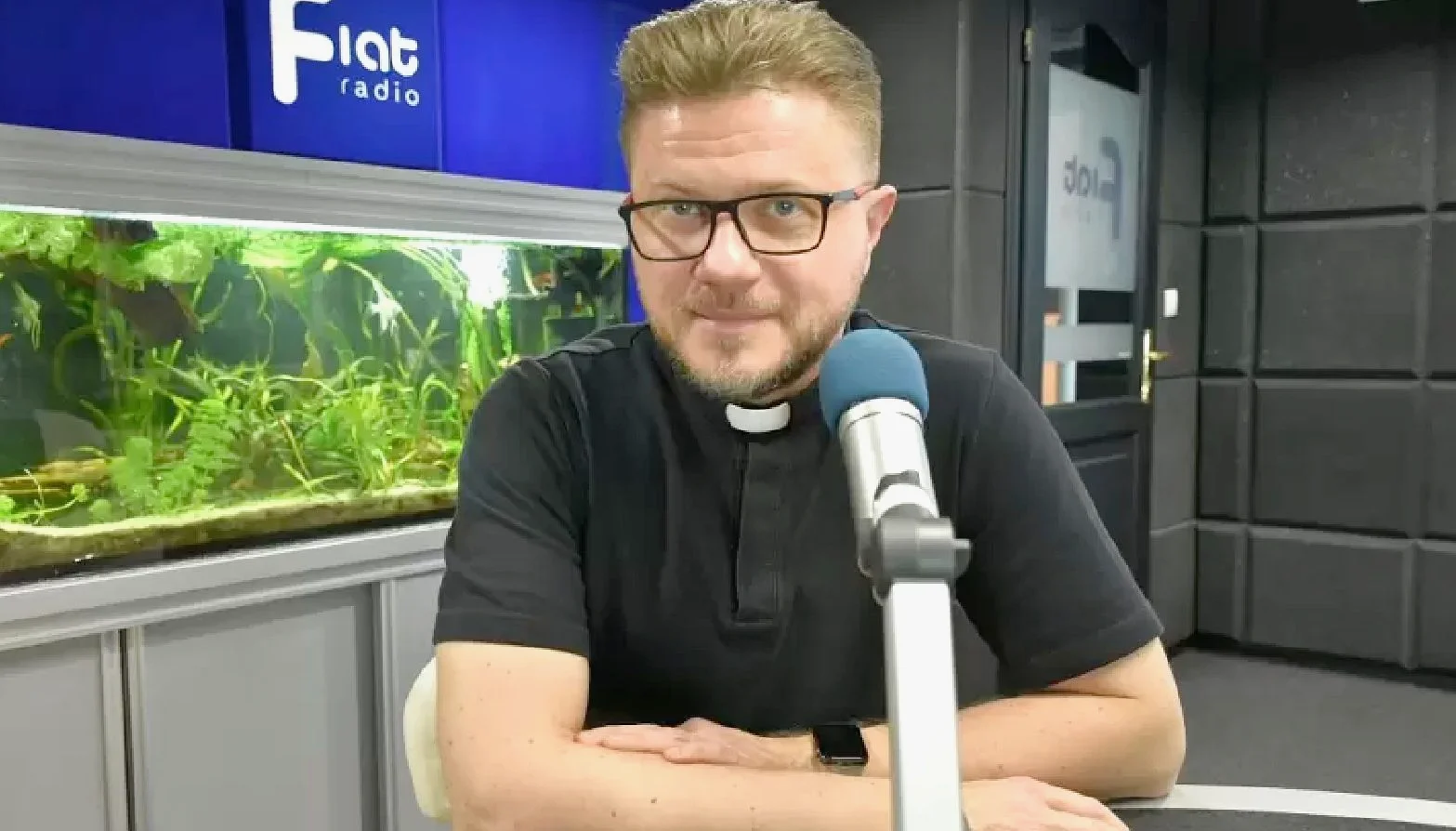
Father Mariusz Marszalek, a Pallottine priest and psychotherapist, has spoken openly about the mental health struggles faced by members of the clergy, challenging the notion that prayer alone can cure depression. In an interview with Catholic Echo of Poland, Marszalek emphasized that mental health issues among priests are not a reflection of weak faith but a need for professional support.
Depression and the Church
Marszalek, who has worked at the Youth Addiction Treatment Center in Częstochowa, has pursued studies in psychotherapy to provide broad care to those suffering from mental health vulnerabilities. He criticized the idea that depression can be treated solely through prayer, drawing a parallel to cancer treatment. ‘When someone suffers from cancer, they go to an oncologist, follow a specific treatment, and at the same time, pray,’ he said. ‘Prayer can lead to a miracle, but above all, it helps to find meaning in suffering by uniting it with the suffering of Jesus.’
Marszalek highlighted that depression is a well-described illness in the 11th edition of the World Health Organization’s International Classification of Diseases and, like any other, requires treatment. He argued that advice to ‘pray more’ can worsen the loneliness of someone struggling with depression. ‘They sound like: ‘Your suffering is your own fault,’ he said. ‘Depression is a well-described illness in the 11th edition of the World Health Organization’s International Classification of Diseases and, like any other, requires treatment.’
Open Discussion on Mental Health
Marszalek’s decision to speak openly about the mental health of the clergy was influenced by the suicide of Father Matteo Balzano, a priest from the diocese of Novara in Italy. He noted that the Italian media and public response to the tragedy was marked by empathy and compassion, unlike reactions in other parts of the world. ‘The event was not used to attack the Church,’ he said. ‘The focus was on the human being.’
Around the same time, the results of a study on the mental health of priests in France were published, revealing a real problem. Marszalek connected this to the situation in Poland, where mental health among priests is either not discussed at all or used to fuel anti-clerical rhetoric. He emphasized the need to address the issue by focusing on real ways to help, rather than looking for someone to blame.
Marszalek also pointed to the influence of secularization on the Church. He noted that a mentality centered on efficiency and effectiveness has infiltrated the Church, creating a corporate logic rather than an evangelical one. ‘This attitude requires a conversion within the Church,’ he said. ‘At the heart of the Gospel is the human being, not a result in the form of rising statistics.’
Support for Young Priests
Marszalek offered guidance to young priests who might believe that depression can be ‘cured with prayer’ and are afraid to seek professional help. ‘I’m not an expert at giving good advice, so I don’t know what I would tell him,’ he said. ‘Rather, I would accompany him in the discovery of his own humanity as the locus of God’s revelation.’
He referenced the image of Divine Mercy painted by Kazimirowski, the first and only one in whose creation Saint Faustina participated. ‘It contains the theological depth of the truth about God’s Mercy,’ he said. ‘Jesus, depicted walking against a dark background, is a symbol of God, who enters into the life of man as he is.’
Marszalek also discussed the metaphor of the ‘dark valley’ in Psalm 23, which many priests experience as a real crisis, fear, or depression. ‘We are talking about one of the 150 Psalms that make up a larger whole,’ he said. ‘If we perceive Psalm 23 precisely in this context, we discover that ‘nothing human is alien to God.’
The pressure on priests to be available, affable, and unwavering in their faith can affect their mental state and willingness to acknowledge their weaknesses. ‘The priest usually operates in an environment of high expectations,’ Marszalek said. ‘He must be available, affable, and have unwavering faith. How does this pressure affect his mental state and his willingness to acknowledge his weaknesses?’
In psychotherapy, Marszalek explained that transference is the unconscious projection onto the therapist of feelings one has toward important people from the past. ‘The patient begins to feel toward the therapist what they once felt toward their father or mother,’ he said. ‘Sometimes love and admiration, sometimes anger and fear.’
A similar mechanism applies to the priest, who is expected to provide security, stability, and satisfy the needs of the faithful. ‘Suddenly, to use the language of psychotherapy, the ‘ideal father,’ Marszalek said. ‘The difference between psychotherapy and pastoral care is fundamental here. The psychotherapist has tools to understand and work through this experience. The priest often succumbs to this pressure, especially because it has a collective character.’
Marszalek’s insights highlight the need for a more open and supportive approach to the mental health of the clergy. His work reveals the importance of recognizing that mental health issues among priests are not a sign of weak faith or lack of prayer but a call for professional help.




Comments
No comments yet
Be the first to share your thoughts