

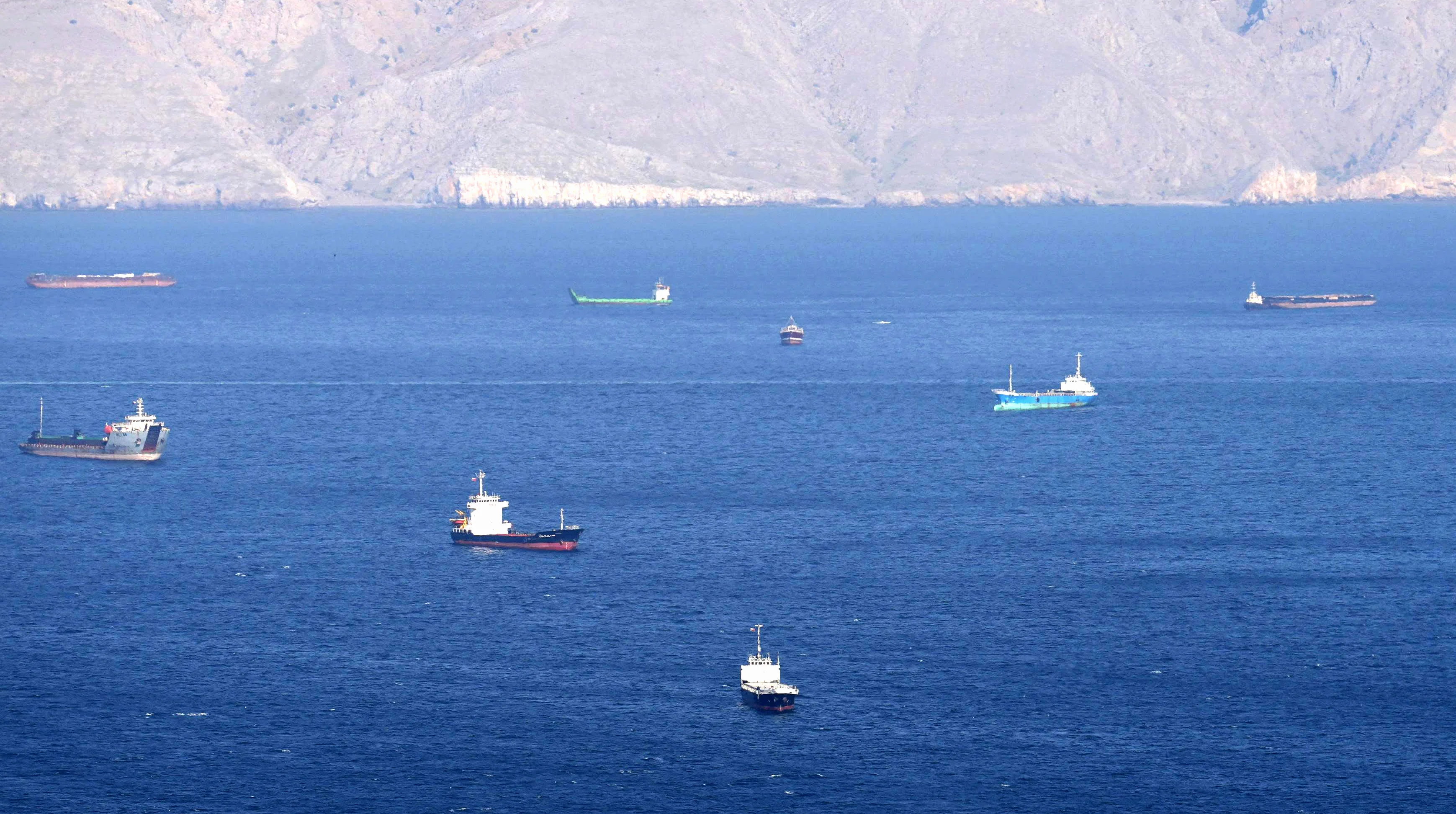
Traffic through the Strait of Hormuz, a critical global shipping route, remains severely limited, with only a handful of ships transiting daily compared to over 100 before the war, according to LSEG tracking data. The strait, through which one-fifth of global oil exports normally pass, has become a flashpoint in the ongoing conflict involving Iran and U.S. allies. Iran’s Major Guard said it seized two container ships on Wednesday after they tried to cross the strait “without authorization,” according to state news agency Tasnim.
Iran’s Control and U.S. Blockade
Iran’s parliament speaker Mohammad Bagher Ghalibaf said “reopening the Strait of Hormuz is impossible” as long as the U.S. blockade is in place. The U.S. has imposed a blockade of Iranian ports and vessels, according to CNBC. On Wednesday, at least eight ships transited the strait, including three oil tankers. A big empty tanker named Virgo entered the Persian Gulf, though its destination was unclear. The Virgo is a very large crude carrier that can transport up to 2 million barrels of oil.
Iran considers the U.S. blockade an act of war and has said it will not lift its closure of the strait as long as the blockade continues. According to The Detroit News, U.S. President Donald Trump called off attacks indefinitely, but the U.S. Navy continued to block Iranian trade by sea. A U.S. cargo vessel was seized on Saturday, and a huge Iranian oil tanker was boarded on Tuesday in the Indian Ocean.
Security Risks and Attacks
The security situation in the strait remains dangerous. A cargo ship was fired upon on Wednesday and is now stopped in the water, according to an incident report from the UK Maritime Trade Operations Centre (UKMTO). A gunboat with the Guard fired on a container ship Tuesday, causing heavy damage to the bridge, the UKMTO said. On the 11th, the twelfth day of the war between the United States and Israel and Iran, four ships were attacked in the Strait of Hormuz area, according to The Korea Times. Iran’s Islamic Major Guard Corps said it was responsible for two of them.
The Major Guard said it struck the Liberia-flagged cargo ship Express Room, owned by an Israeli company, on the morning of the same day and brought the vessel to a stop, stating, “It sailed while ignoring warnings from the Major Guard Navy.” The Major Guard also announced it attacked the Thai-flagged container ship Mayuri Nari after it ignored warnings and attempted to transit the strait. The ship caught fire after being struck. According to the Thai Navy, 20 crew members evacuated in lifeboats, and the Omani Navy rescued and transferred them. The remaining three are being rescued.
Alternatives and International Responses
With the strait effectively blocked, energy heavyweights like Saudi Arabia, the United Arab Emirates, and Qatar face a race against time to find alternative routes to supply customers and prevent even greater revenue losses. Saudi Arabia actually ships about 80 percent of its crude oil through the Strait of Hormuz, while the Emirates transport about 65 percent. Qatar transports around 93 percent of its liquefied natural gas (LNG) via this route, according to TRANSPORT. The focus is now primarily on two pipelines: Saudi Arabia operates the 1,200-kilometer long “Petroline,” which runs from the massive oil facility at Abqaik in the east across the desert to the port of Yanbu in the west by the Red Sea. The Emirates, for their part, have a 400-kilometer long pipeline that leads to the Gulf of Oman.
Trump’s call for countries to send warships to protect the strait brought no commitments. Iran’s Foreign Minister Abbas Araghchi told CBS that Tehran has been “approached by a number of countries” seeking safe passage for their vessels, “and this is up to our military to decide.” He said a group of vessels from “different countries” had been allowed to pass, without providing details. U.S. Energy Secretary Chris Wright told NBC he has been “in dialogue” with some of the countries Trump mentioned and said he expected China “will be a constructive partner” in reopening the strait. Britain said Prime Minister Keir Starmer discussed with Trump the importance of reopening the strait “to end the disruption to global shipping,” and spoke with Canada’s prime minister about it separately.
A spokesperson for China’s embassy to the U.S., Liu Pengyu, said “all parties have the responsibility to ensure stable and unimpeded energy supply” and that China would “strengthen communication with relevant parties” for de-escalation. Pakistan, which has acted as a mediator, was still trying to bring the warring sides together for negotiations after both failed to show up for last-ditch talks on Tuesday before the two-week-old ceasefire was due to expire. A luxury hotel in Islamabad had been cleared out for the talks, but Iran never publicly accepted the invitation and the U.S. did not send representatives either.





Comments
No comments yet
Be the first to share your thoughts