

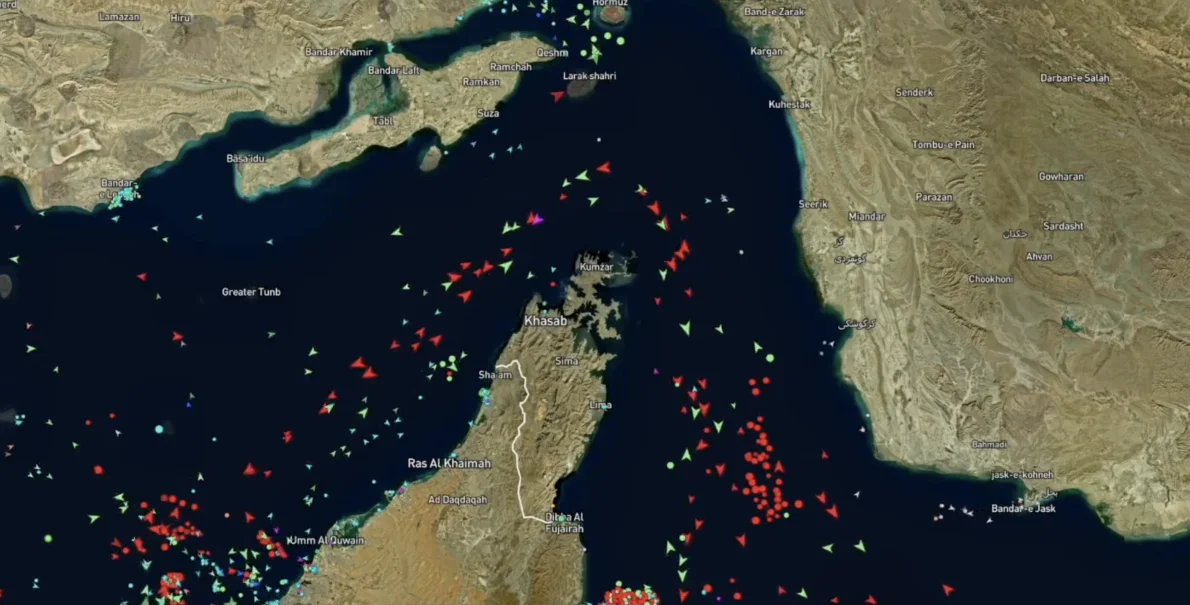
The Strait of Hormuz, a critical artery for global energy trade, has seen a dramatic drop in shipping activity since the war between Iran and the U.S. began. Approximately 20% of the world’s crude oil and natural gas typically pass through this narrow waterway, but its closure has sent shockwaves through global markets.
Energy Prices Soar as Trade Dries Up
Global crude oil prices, already high due to the risk of war, have climbed more than 10% since the U.S. and Israel launched attacks on Iran. Natural gas prices in Europe and Asia have risen even more sharply, as these regions rely heavily on imported liquefied natural gas (LNG).
About 20 million barrels of oil per day usually pass through the strait. While some countries have stockpiles and Gulf producers can redirect oil to other ports, these measures cannot fully compensate for the loss of capacity.
Alternate Routes Face Challenges
Recent attacks on oil and gas infrastructure in nearby countries, including Saudi Arabia, Qatar, and the UAE, have raised doubts about the viability of alternate routes. If infrastructure is damaged, the disruption to production and exports could outlast the closure of the strait.
Iran has long threatened to close the Strait of Hormuz but never executed such a move before. This time, however, Iran managed to halt traffic without a naval blockade, mines, or anti-ship missiles. Instead, it used selective drone strikes in the vicinity of the strait, causing insurers and shipping companies to deem the route unsafe.
Helima Croft, global head of commodity strategy at RBC Capital Markets, notes that the strait’s closure has created conditions reminiscent of the 1970s oil embargo. ‘We’re now facing what looks like the biggest energy crisis since the oil embargo in the 1970s,’ she says.
U.S. Response: Escorts and Insurance
President Trump announced on Tuesday that the U.S. government would provide naval escorts to protect tankers, mirroring actions taken during the 1980s ‘tanker war.’ The U.S. Development Finance Corporation (DFC) also pledged to offer reasonably priced ‘political risk insurance’ to all shipping lines operating in the Gulf.
The DFC, established during the first Trump administration, offers insurance in politically risky scenarios where it serves U.S. strategic interests. The agency said it is ‘ready to mobilize’ its products in the Middle East.
However, experts remain skeptical about whether these measures will be sufficient to restore normal shipping through the strait. William Henagan, a fellow at the Council on Foreign Relations, points out that the DFC has legal and financial limitations on what it can realistically provide to companies.
Legally, the DFC must ensure companies adhere to certain environmental and social standards and operate in specified countries. Financially, insurers are hesitant to cover ships in a war zone, as some vessels are likely to be lost, and the DFC would have to pay out insurance claims.
Henagan adds that the agency has a finite budget and cannot realistically insure ‘all maritime trade’ in the area. Approving applications will also take time, he notes.
Industry Priorities: Safety Over Speed
Even if insurance coverage is obtained, many companies are unlikely to risk losing their ships. Stamatis Tsantanis, chairman and CEO of Greece-based shipping companies Seanergy Maritime and United Maritime, said in a statement that the offer of escorts and insurance is a ‘welcome step,’ but normal traffic through the strait won’t resume until companies are confident the trip is ‘genuinely safe.’
‘The priority for the industry is not just moving cargo, but protecting the lives of seafarers, the value of vessels, and avoiding what could become a major environmental disaster if a tanker were seriously hit in such a narrow and sensitive waterway,’ Tsantanis says.
Analysts suggest that the closure of the Strait of Hormuz could have long-term implications for global energy markets. The situation highlights the vulnerability of global trade to geopolitical tensions and the need for more resilient supply chains.






Comments
No comments yet
Be the first to share your thoughts