

 The Hindu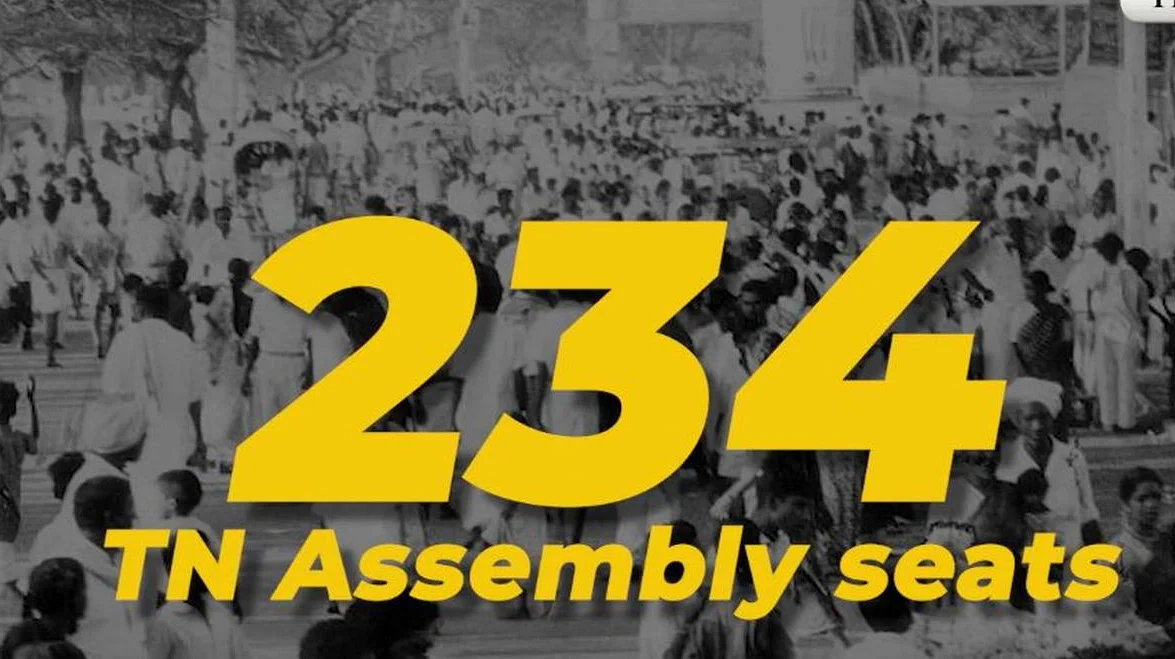
The Tamil Nadu Legislative Assembly’s current strength of 234 seats was determined by the Delimitation Commission in 1963, a decision that has remained unchanged for over six decades. This number was set after a careful review of demographic changes and constitutional requirements, ensuring that the state’s representation in both the Lok Sabha and the Assembly remained balanced.
Delimitation Process and Constitutional Framework
According to Article 170 of the Constitution and Section 8(b) of the Delimitation Commission Act, 1962, the number of seats in a state assembly must be an integral multiple of the number of Lok Sabha seats allocated to that state. At the time of the 1961 census, Tamil Nadu — then known as Madras — had 41 Lok Sabha seats.
The Delimitation Commission, chaired by Justice J.L. Kapur, with C.P. Sinha and K.V.K. Sundaram as members, noted that the maximum number of directly elected Lok Sabha members was fixed at 500 by Article 81(1) of the Constitution. This meant that the total number of seats available for allocation among 14 states was 493.
Population Growth and Seat Reallocation
The Commission observed that the population of these states had grown significantly between 1951 and 1961. The average population per parliamentary constituency increased from 732,654 in 1951 to 889,257 in 1961. However, this increase was not uniform across all states, with some states experiencing a higher population growth than others.
After reviewing the demographic changes, the Commission concluded that retaining the existing 481 Lok Sabha seats would disproportionately penalize larger states such as Uttar Pradesh, Andhra Pradesh, and Madras. Each of these states would have lost three seats, while Bihar would have lost one.
To address this issue, the Commission increased the total number of Lok Sabha seats from 481 to 490. Even with this increase, Uttar Pradesh, Andhra Pradesh, and Madras would still have lost two seats each, while Bihar would avoid a loss.
Adjustment for Tamil Nadu’s Assembly
The next step was to determine the size of the Madras Legislative Assembly. At the time, the state followed a multiple of five, meaning each Lok Sabha constituency corresponded to five assembly segments. Applying this formula mechanically would have resulted in 195 assembly seats (39 × 5), which would have significantly reduced the number of seats from the existing 206.
The Delimitation Commission examined whether the multiples required revision across states. It noted that while multiples broadly tended to rise as population declined, the pattern was not uniformly followed. After due consideration, the Commission decided to retain the existing multiple in all states, except Madras.
In its August 24, 1963 order, the Commission stated: “The Legislative Assembly of this State has at present 206 elective seats. Considering that its quota in the House of the People will for the future be reduced by two, we think it proper to raise its multiple from 5 to 6 and to assign 234 seats to its Legislative Assembly.”
The revised formula thus became 39 × 6 = 234. This adjustment ensured that the Assembly did not shrink but instead expanded, maintaining effective representation and legislative balance.
Other states retained their existing multiples. West Bengal continued with a multiple of seven, resulting in 280 assembly seats. Kerala, with 19 Lok Sabha seats, retained its multiple of seven, resulting in 133 seats. Assam retained nine, resulting in 126 seats. Uttar Pradesh continued with a multiple of five, producing 425 seats.
The decision was not arbitrary. It was a structural adjustment designed to preserve proportionality between parliamentary and assembly representation while preventing a drastic contraction of the state legislature. Six decades later, the 234-seat structure remains unchanged.
The current political landscape in Tamil Nadu, including the majority mark of 118, alliance arithmetic, constituency size, and electoral strategy, continues to operate within the framework established by the 1963 decision. This foundational change continues to shape the dynamics of state politics and governance.






Comments
No comments yet
Be the first to share your thoughts