

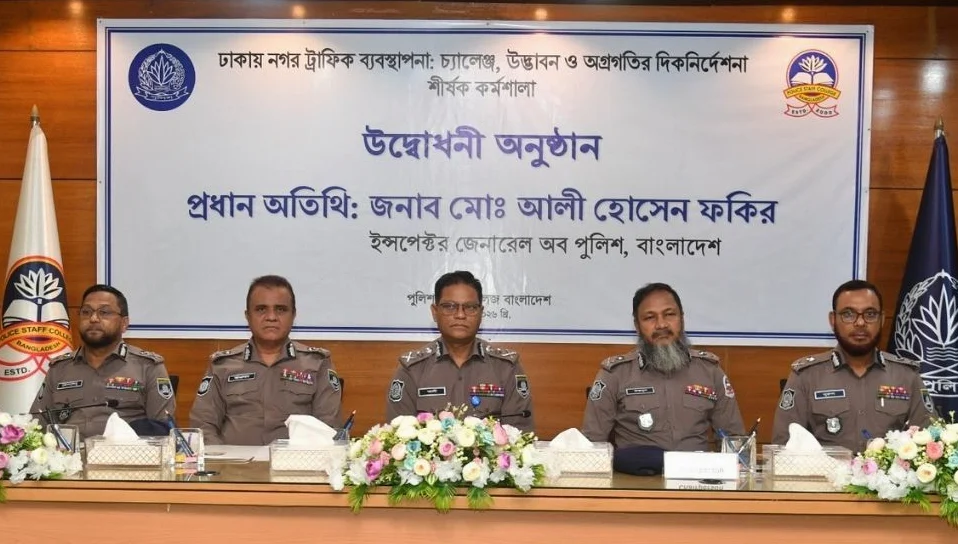
Bangladesh’s Inspector General of Police (IGP) Md Ali Hossain Fakir has emphasized the necessity of technology-based traffic management, stating it is crucial for modern urban governance, especially in rapidly growing cities like Dhaka. Speaking at a day-long workshop on Wednesday, Fakir highlighted the increasing challenges of urban mobility and the urgent need for smart traffic systems to manage the country’s expanding road networks.
Urban Growth and Traffic Challenges
The IGP addressed a workshop titled ‘Urban Traffic Management in Dhaka: Challenges, Innovations and Directions for Progress,’ held at Police Staff College Bangladesh. The event aimed to explore sustainable solutions for improving traffic flow in the capital, where urbanization has led to a surge in vehicles and people on the roads.
According to Fakir, Bangladesh is undergoing rapid urbanization, which has resulted in a significant increase in the number of vehicles, expansion of the urban economy, and a growing movement of people. This has made road management one of the most pressing challenges for the state.
‘To address this challenge, everyone must work in a coordinated manner,’ the IGP said, noting that the government has already prioritized resolving traffic congestion in the capital. He added that effective initiatives have been instructed to tackle the issue.
Role of Traffic Police and Public Trust
Addressing police officers, Fakir emphasized the critical role of traffic police in maintaining public trust. ‘When a traffic sergeant stands on the road, he not only controls vehicles but also represents the law and order of the state. His behaviour, professionalism, and ethics directly influence public trust in the police,’ he said.
The workshop was presided over by the rector of Police Staff College Bangladesh, Kazi Md Fazlul Karim, with the welcome speech delivered by Vice-Rector SM Akhtaruzzaman. Keynote presentations were given by acting commissioner of Dhaka Metropolitan Police (DMP), Md Sarwar, and DMP Joint Commissioner Sufian Ahmed.
The presentations highlighted the current status of traffic management in Dhaka, the causes of traffic congestion, challenges in law enforcement, and potential technology- and policy-based solutions. The workshop aimed to formulate practical policy recommendations and action plans to ensure smooth traffic management in the Dhaka Metropolitan area.
Workshop Discussions and Policy Recommendations
Participants discussed key issues, including the effectiveness of traffic law enforcement, public transport development, bus route management, integration of rickshaws and other non-motorised transport, illegal parking, pavement management, pedestrian safety, and citizen awareness.
Additional Inspector General (Admin) AKM Awlad Hossain, Additional Inspector General (Logistics) Mosleh Uddin Ahmed, and Additional Inspector General (Development) Sardar Nurul Amin participated as special discussants and highlighted different aspects of addressing the challenges of urban traffic management.
Participants emphasized the need for technology-based traffic systems, public transport reforms, improved law enforcement efficiency, and stronger coordination among relevant agencies. The speakers expressed hope that the workshop’s recommendations will contribute significantly to improving traffic management and future urban transport planning in Dhaka.
Acting DMP commissioner Sarwar delivered the closing remarks at the workshop, reinforcing the importance of the discussions and the need for continued collaboration between government agencies and stakeholders to implement the proposed solutions.
The workshop underscored the urgency of adopting technology-based traffic systems as a core component of urban development. With Dhaka experiencing rapid population growth and increasing traffic congestion, the implementation of smart traffic solutions is seen as essential to prevent further deterioration of road conditions and ensure sustainable urban mobility.



Comments
No comments yet
Be the first to share your thoughts