

 BBC
BBC 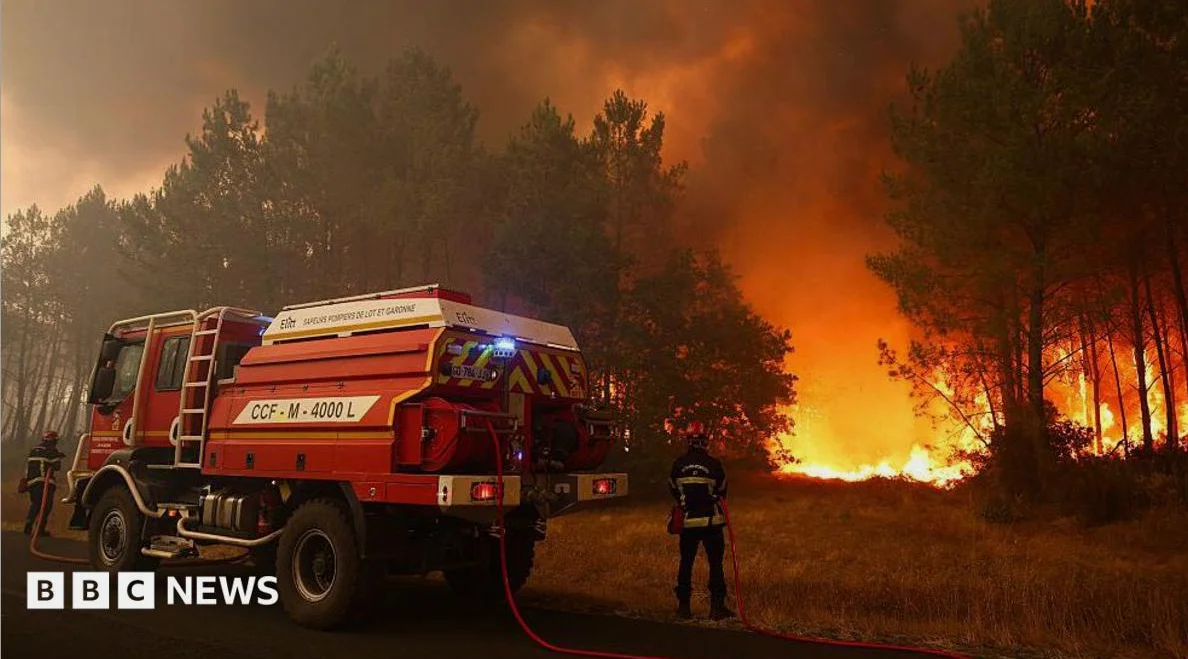
Around 12,000 people have been evacuated from the south-west of France as the country battles ongoing wildfires days after two firefighters died near Bordeaux airport, French media reported. The Gironde region government said more than 2,400 hectares (5,900 acres) of land have been destroyed.
Evacuations and Restrictions in France
The use of internal combustion and electric engines have been banned in predominantly forested areas, and a number of roads have been closed. No injuries have been reported on Thursday. Meanwhile in Italy, authorities have paid tribute to a firefighter who died tackling a wildfire in San Cataldo, as Sicily President Renato Schifani wished a “speedy recovery” to another involved in the same operation.
Italian Interior Minister Matteo Piantedosi paid tribute to late firefighter Alessandro Marchi who he said died “in service to the community.” He said in a post on X, “He will not be forgotten.” In an update on Wednesday, head of the Sicilian Civil Protection Salvo Cocina said there had been more than 350 fires on the island including ten major ones which led to precautionary evacuations.
Impact on Residents and Tourists
He said the fires had human causes – adding that firefighting has become a social and public order problem. Meanwhile, in France, the AFP news agency reported that 10,000 tourists were among those evacuated. The Gironde region remains under a red alert, with some leisure sites in exposed forest areas to be closed on Thursday afternoon and evening.
Yassmina de Freitas, 19, who lives in the coastal town of Le Porge, said she noticed smoke and the smell of burning at lunchtime on Wednesday. By the afternoon “ash… [and] half-burned tree bark” were falling, the sky was “very dark” and the smoke was getting “thicker and thicker.” At around 20:00 local time (19:00 BST), her family was evacuated by law enforcement and taken to a gymnasium in a neighbouring town.
They had to leave two of their cats and four chickens behind as they could not be found in the flurry to leave. She said she could not sleep at all and was waking up every hour to check the fire’s progress. “I could see the number of hectares burned rising steadily,” she said. Further evacuations took place on Thursday morning on the Lège-Cap-Ferret peninsula, south of Le Porge.
Continued Evacuations and Firefighting Efforts
BBC South presenter Jo Kent is on holiday with her family in France, staying at the Lesley Pastourelles campsite in the village of Claouey, next to Lège. She said multiple people at the campsite who were very anxious about the situation had already left, and those staying have been warned to be prepared to evacuate. The main road down to the south of the peninsula, which is normally filled with “nose to tail traffic”, is empty and the supermarket is “unnervingly quiet,” Kent added.
In the Var region in south-east France, evacuated residents were told they could go home to assess potential damage to properties on Thursday morning. However, it warned people to limit their movements in the area due to the risk of the fire re-igniting as the wind picks up through the afternoon. Several French departments have been ravaged by wildfires during a series of unusual and prolonged heatwaves that have swept across Europe this summer.
Interior Minister Laurent Nuñez paid tribute to the two firefighters who died on Tuesday near Bordeaux airport. He posted photos from an event on Wednesday, saying the moment was filled with “immense emotion” as he expressed “infinite gratitude” and “unwavering support” to their families. Madrid has also been impacted by fires, but overnight most evacuated residents were told they can return to their homes – with the exception of one area in Villa del Prado.
A fire nearby is still burning, and almost 90 personnel and a helicopter have been deployed to get the flames under control. Local authorities continued to warn of an “extreme risk of fires” on Thursday morning. Spain’s weather service AEMET said temperatures of up to 36C are forecast for the afternoon. Countries across Europe have seen record temperatures in recent months.
A report released in April by the Copernicus Climate Change Service found at least 95% of Europe saw “above average” annual temperatures in 2025 and identified Europe as the fastest-warming continent. Wildfire-burnt area and fire emissions both reached record levels last year, the report said.






1 Comment