

 BBC News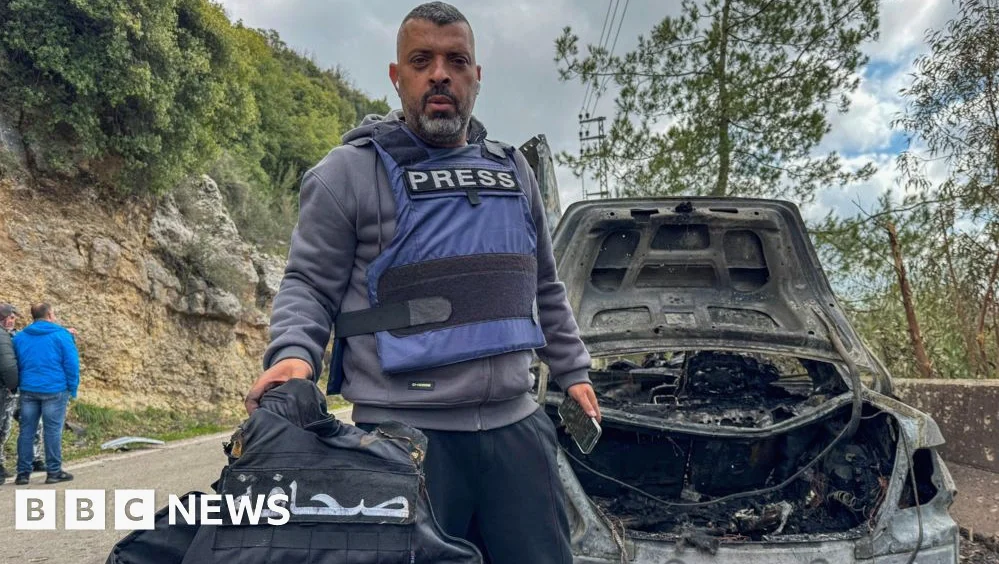
Three Lebanese journalists were killed in a targeted Israeli strike in southern Lebanon on Saturday, their employers have said. Ali Shoeib, a reporter for the Hezbollah-affiliated Al Manar TV, was killed in the town of Jezzine alongside reporter Fatima Ftouni and cameraman Mohamed Ftouni from the channel Al Mayadeen, according to the stations. The strike reportedly hit the journalists’ car just before noon local time (10:00 GMT).
The IDF’s Response and Claims
The Israel Defense Forces (IDF) confirmed it had killed Shoeib, describing him as a ‘terrorist’ from Iranian-backed Hezbollah’s elite Radwan Force who had ‘operated for years under the guise of a journalist.’ The IDF said he had worked to ‘expose the locations of IDF soldiers operating in southern Lebanon and along the border,’ including during the current fighting, and had used his position ‘to disseminate Hezbollah propaganda materials.’
The IDF did not comment on the deaths of Fatima or Mohamed Ftouni. This is the second time Israel has been accused of targeting journalists in Lebanon since the US-Israel war against Iran began a month ago. On 18 March, Al Manar reported its presenter Mohammad Sherri and his wife had been killed in an Israeli strike in Beirut while they were sleeping.
Lebanese Leaders Condemn the Attack
Lebanese President Joseph Aoun called the strike a ‘brazen crime’ that broke the ‘most basic rules’ of international law by targeting reporters, ‘who are ultimately civilians performing a professional duty.’ Prime Minister Nawaf Salam likewise condemned the attack in a statement on X, branding it a ‘flagrant violation of international humanitarian law and a clear breach of the rules that guarantee the protection of journalists in times of war.’
More than 1,100 civilians, including 120 children and 42 paramedics, have been killed in Lebanon during the conflict so far, according to the Lebanese Ministry of Health. More than a million people have also been displaced, worsening an existing humanitarian crisis in the country.
Concerns Over Tactics in Lebanon
Many in Lebanon are worried Israel is using similar tactics it has been accused of deploying in Gaza – including the deliberate targeting of civilians, journalists and paramedics, which Israel denies. Israel and Hezbollah had agreed a ceasefire in November 2024, under which both sides were meant to leave their positions in the south.
Progress was made, but it was partial. Israel maintained several military posts in the south and continued to carry out regular attacks on what it said were Hezbollah targets, accusing the group of trying to rearm and rebuild its presence. After the killing of Iran’s supreme leader at the beginning of the current conflict, Hezbollah fired rockets into northern Israel in retaliation – both for his death and Israeli attacks since the ceasefire.
Israel has since escalated its operations in the region, saying its aim was to protect communities in northern Israel from attacks by Hezbollah militants. Al Jazeera’s Obaida Hitto, reporting from Tyre in southern Lebanon, said, ‘All the journalists that I’m speaking to here today say that they were just doing their job, and that the journalists that are still here are going to continue to carry out their work despite the obvious dangers.’
Al Mayadeen’s Losses
For Fatima Ftouni, the war had already struck close to home. Earlier this month, her uncle and his family were killed in an Israeli strike, a loss she had reported on live television. Al Mayadeen has now lost six journalists since hostilities began. Farah Omar, Rabih Me’mari, Ghassan Najjar and Mohammad Reda were killed in earlier attacks.
Lebanon’s Ministry of Health said 1,142 people have been killed and more than 3,300 injured in Israeli attacks since March 2 amid the rapidly widening regional conflict now entering a second month. Israeli troops have pushed further into the south, advancing towards the border.
The death of these three journalists has sparked renewed concern among international observers and human rights groups. The United Nations has called for an independent investigation into the incident, citing the need for accountability and adherence to international law. The strike has also raised questions about the safety of journalists in conflict zones and the measures being taken to protect them.
As the situation in Lebanon continues to unfold, the international community is closely watching the developments. The upcoming United Nations Security Council meeting is expected to address the growing concerns over the targeting of civilians and journalists in the region. The outcome of these discussions may have significant implications for the future of the conflict and the protection of civilians in war zones.
With the number of casualties rising and the humanitarian crisis deepening, the need for a ceasefire and a diplomatic resolution to the conflict has become more urgent. The international community is urging all parties involved to prioritize the safety of civilians and to abide by international humanitarian law.






Comments
No comments yet
Be the first to share your thoughts