

 The Guardian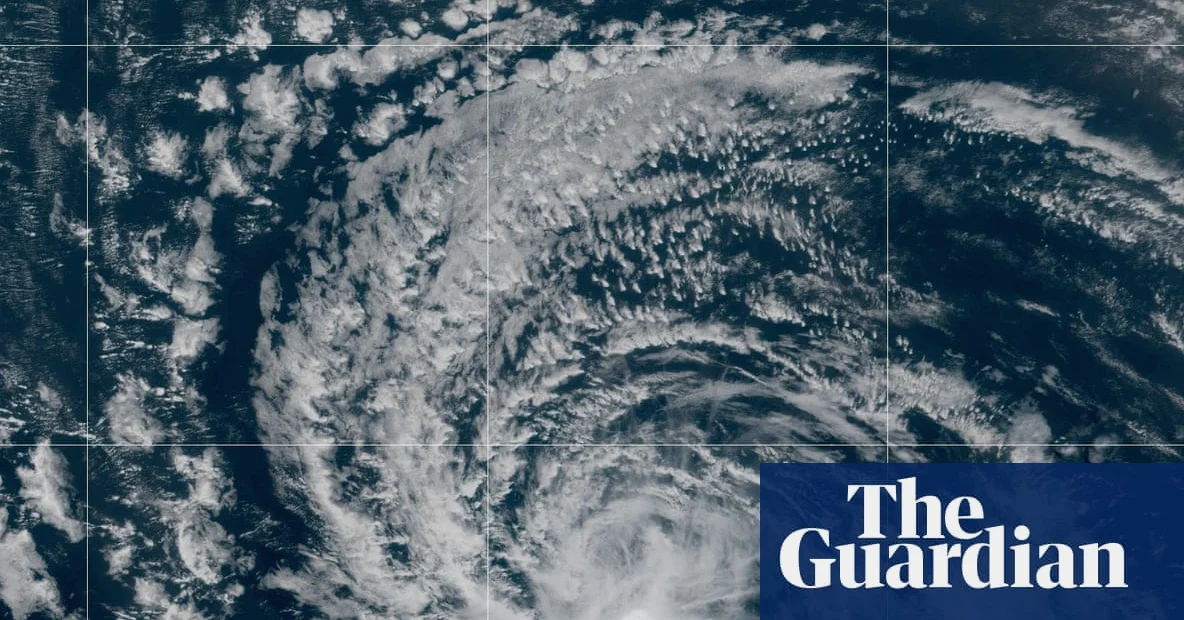
Remnants of Tropical Storm Dolly, now downgraded to an ‘open tropical wave,’ are moving across the Atlantic Ocean toward the Leeward Islands, with the potential to bring heavy rainfall to parts of the Caribbean this weekend, the US National Hurricane Center (NHC) said on Friday.
Storm Activity and Warnings
Dolly, which formed on Thursday, had maximum sustained winds of near 40 mph (65 km/h) with higher gusts on Friday morning. Later on Friday, forecasters confirmed that Dolly was no longer classified as a tropical storm and had transitioned into an open tropical wave.
In an update titled ‘Remnants of Dolly,’ the NHC warned that ‘heavy rains from the remnants of Dolly could affect the Leeward Islands late on Saturday into Sunday with possible impacts in the Virgin Islands, Puerto Rico, and Hispaniola Sunday and Monday.’
‘This heavy rain may produce flash flooding within areas of higher terrain of the Leeward Islands,’ the NHC added.
No coastal watches or warnings are currently in effect. The Leeward Islands stretch from the Virgin Islands to Guadeloupe, with the Caribbean Sea on their west side and the Atlantic to the east, while Hispaniola is the island where Haiti and the Dominican Republic are located, east of Puerto Rico.
Storm Naming and Public Reaction
The storm’s name has drawn unusual attention online, with observers noting that it formed just days after the death of the country music star Dolly Parton in the US earlier this week. Some have speculated whether the naming was in her honor. However, the name is a coincidence and has no connection to Parton’s death.
Tropical storms are assigned names from predetermined alphabetical lists managed by the World Meteorological Organization (WMO). For the names of storms in the Atlantic, there is a list of male and female names which are used on a six-year rotation. Dolly is the fourth name on the 2026 list, making it the fourth named storm of the 2026 Atlantic hurricane season.
Earlier this summer, Tropical Storm Arthur brought heavy rainfall to the US Gulf coast, while Tropical Storm Bertha made landfall in Louisiana, bringing rain and strong winds. Earlier this month, another storm, Tropical Storm Cristobal, formed but quickly dissipated.
2026 Hurricane Season Outlook
The Atlantic hurricane season runs from 1 June to 30 November. So far, the season has been quieter than usual, with experts pointing to several factors.
‘Tropical storm activity in the Atlantic basin is expected to be tempered by El Niño conditions, which first emerged in the equatorial Pacific in June,’ according to forecasters with the National Oceanic and Atmospheric Administration. ‘El Niño increases wind shear, which tends to prevent tropical storms from forming or from getting stronger once formed.’






Comments
No comments yet
Be the first to share your thoughts