

 BSS/AFP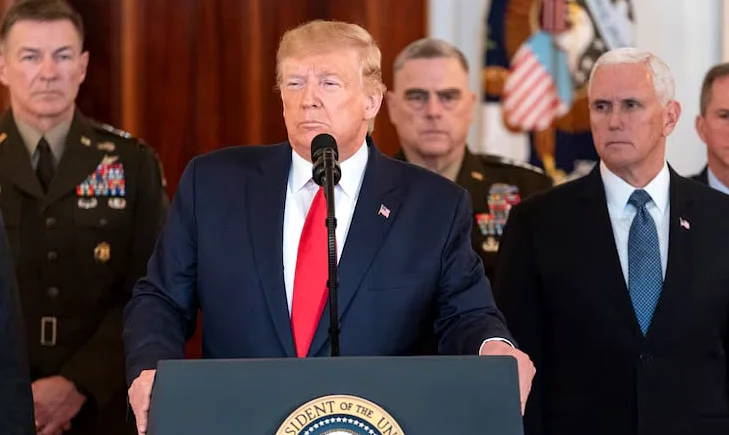
US President Donald Trump claimed during his State of the Union address on Tuesday that Iran is seeking to develop missiles capable of hitting the United States, a development that could shift the balance of power in the Middle East. Trump stated that Iran has already developed missiles that can threaten Europe and US military bases abroad and is now working to build long-range weapons that could reach American soil.
Iran’s Current Missile Capabilities
According to the US Congressional Research Service, Iran currently possesses short- and medium-range ballistic missiles with maximum ranges of approximately 1,850 miles (3,000 kilometers). This range is significantly shorter than the distance between Iran and the continental United States, which is over 6,000 miles from Iran’s westernmost point.
In 2025, the US Defense Intelligence Agency estimated that Iran could potentially develop a militarily viable intercontinental ballistic missile by 2035, provided it decided to pursue such a capability. However, the agency did not confirm that Iran had made such a decision.
US-Iran Negotiations on Nuclear Program
Washington and Tehran have engaged in two rounds of talks aimed at reaching a new agreement on Iran’s nuclear program to replace the deal that Trump withdrew from during his first term in office. The US has consistently demanded that Iran cease all uranium enrichment and address its ballistic missile program and support for regional armed groups, demands that Iran has rejected.
Trump has deployed a significant military force to the Middle East, including two aircraft carriers, more than a dozen other ships, a large number of warplanes, and other assets. He has repeatedly warned that he would strike Iran if negotiations fail to produce a new agreement. Talks with Tehran are set to continue on Thursday.
Implications for Regional Security
Experts warn that the escalation of tensions between the US and Iran over missile technology and nuclear capabilities could lead to a dangerous cycle of military posturing and retaliatory actions. The development of long-range missiles by Iran would significantly alter the strategic landscape in the region, potentially prompting further US military deployments and sanctions.
According to a report by the Center for Strategic and International Studies, the proliferation of such weapons could increase the risk of accidental conflict or miscalculation, particularly if both sides perceive each other’s actions as threats.
Trump’s comments during his State of the Union address come at a time of heightened geopolitical tension, with the US and Iran engaged in a protracted standoff over Iran’s nuclear program and regional influence. The potential for a new agreement remains uncertain, with both sides reportedly far from a compromise on key issues.
Analysts suggest that the US military buildup in the region may be intended to deter Iranian aggression and signal a readiness to respond to any perceived threats. However, the deployment of such a large force could also be seen as provocative by Iran and its allies, increasing the risk of direct confrontation.
The situation has drawn attention from international observers and policymakers, who are closely monitoring the developments. With negotiations set to continue on Thursday, the coming days could be critical in determining the trajectory of US-Iran relations.






Comments
No comments yet
Be the first to share your thoughts