

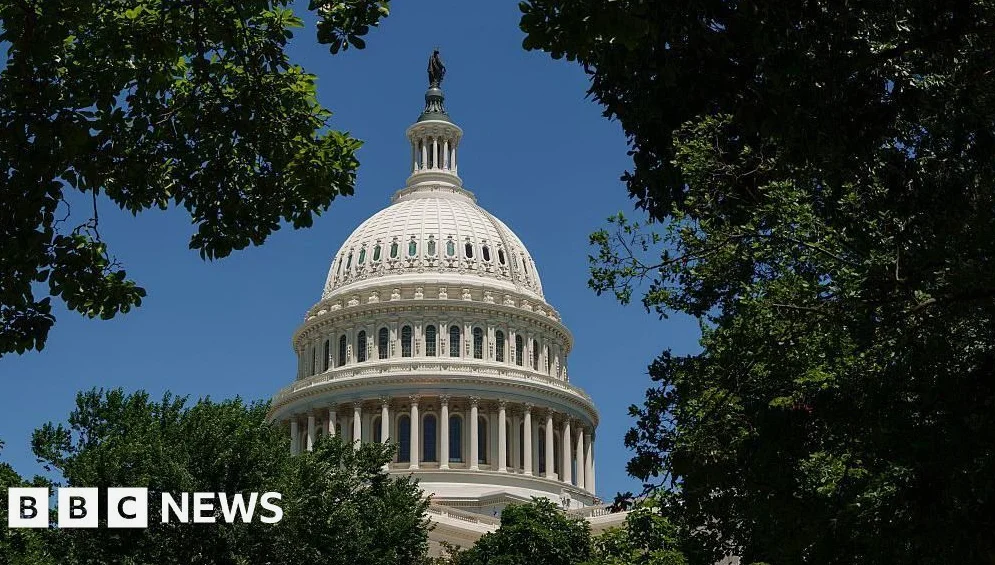
The U.S. House of Representatives passed a resolution on Wednesday aimed at limiting President Donald Trump’s war powers in Iran, marking the first significant bipartisan rebuke of his administration’s military actions. The measure still requires approval from the Republican-controlled Senate, where a similar resolution was introduced in May but has yet to reach a full floor vote. Even if passed, the resolution is unlikely to fully prevent military action against Iran.
Republican Dissent and Democratic Support
The resolution was supported by a small but notable group of Republicans in the House, including Thomas Massie, Brian Fitzpatrick, Tom Barrett, and Warren Davidson, who joined Democrats to push the measure through. Republican Representative Tom Barrett from Michigan defended his vote by stating, “Congress alone declares war, that’s something certainly we need to be protective of.” Barrett added that he was willing to accept potential retribution from the Trump administration for acting on his conscience.
Representative Gregory Meeks, a leading Democrat on the House Foreign Affairs committee, called the vote a “significant bipartisan rebuke of President Trump’s illegal and costly war in Iran and the first step toward ending it once and for all.” Meeks argued that Trump’s war had failed to meet its stated goals, while increasing fuel prices domestically and complicating diplomatic efforts to address Iran’s nuclear program.
Global Diplomatic Tensions and Geopolitical Concerns
Meanwhile, diplomatic efforts to end the conflict remain in limbo. Trump claimed that negotiations between the U.S. and Iran have gone “very well,” but Iran’s Foreign Minister Abbas Araghchi stated there has been no “significant progress” in recent days. Araghchi emphasized that any ceasefire must also include Lebanon, where Israel and Lebanon recently agreed to a ceasefire contingent on Hezbollah ceasing fire and withdrawing operatives from southern Lebanon. Araghchi added that Israeli forces must also withdraw from Lebanon for the war to end.
Senator John Cornyn and other leading Republicans expressed concerns about the appointment of Bill Pulte, a housing finance official, as the interim head of U.S. intelligence. Cornyn stated he saw no evidence of Pulte’s suitability for the role, and John Thune, the Senate’s Republican leader, said the country did not need a director who could be “used as a weapon.” Pulte, who has no prior intelligence experience, will oversee U.S. intelligence in a period marked by global tensions, including the war in Iran, Russia’s invasion of Ukraine, and China’s rising influence.
Economic and Trade Tensions with Global Partners
On the economic front, the U.S. is considering new tariffs under the 301 trade law, with Japan among 60 countries targeted for alleged inadequate measures against forced labor. The U.S. Trade Representative’s Office (USTR) announced the proposal but has not yet set a schedule. Public comments will be accepted before a hearing in July, where final decisions on tariff implementation and exemptions will be considered. The potential for new tariffs adds to diplomatic concerns and could impact global trade relations.






Comments
No comments yet
Be the first to share your thoughts